Over the last four articles, we’ve deep-dived into the technical plumbing of the Google Universal Commerce Protocol (UCP). We’ve looked at how it turns AI interactions into instant sales, the tussle between Merchant of Record and AI proxies, the architectural shift from blue links to buy buttons, and the interoperability wars between UCP, AP2, and MCP.
But if you’re sitting in a university marketing department or running a B2B SaaS enterprise, you might be thinking: “This is great for selling sneakers on Gemini, Marcus, but I’m selling a $60,000 Master’s degree and a three-year enterprise contract. How does an ‘agent’ buy that?”
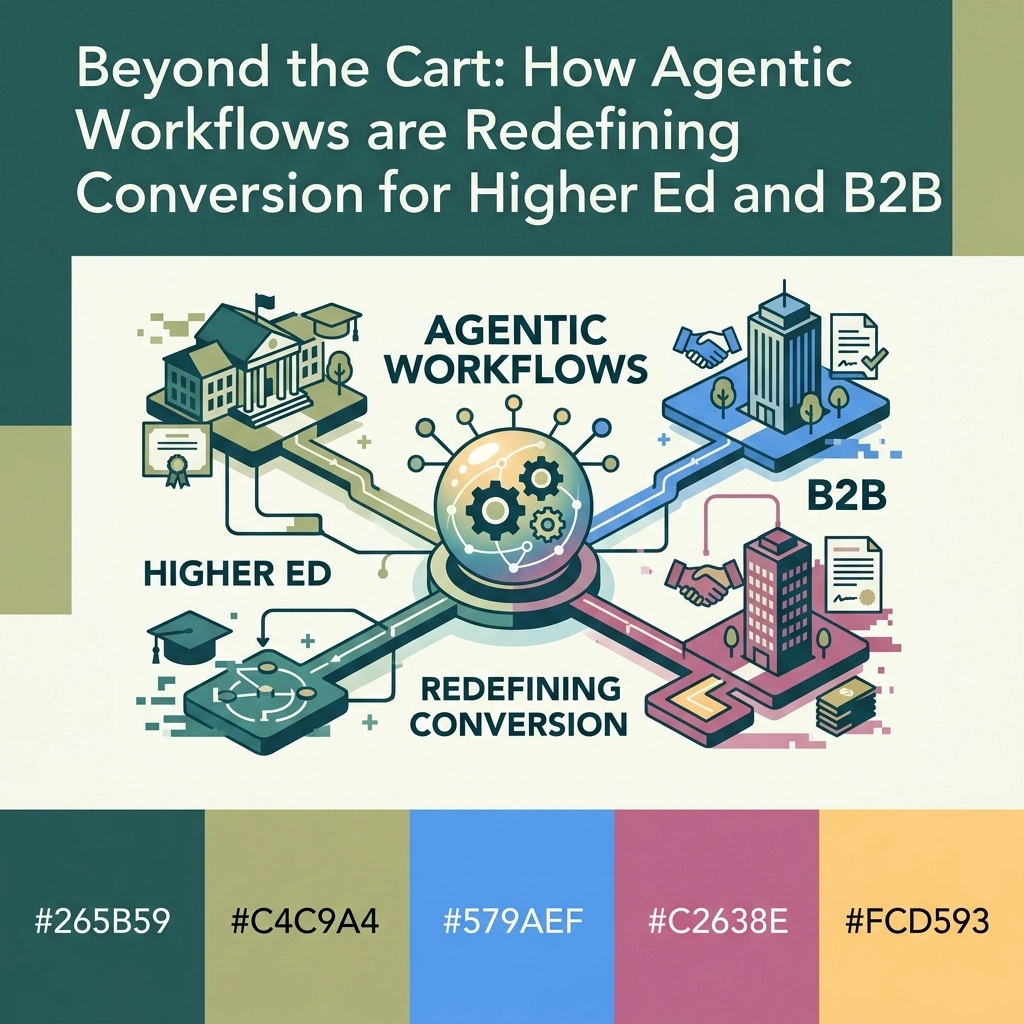
The answer lies in moving beyond the cart. Agentic commerce isn’t just about a one-click transaction; it’s about the agentic workflow: a series of autonomous, multi-step actions that move a prospect through a complex funnel without a human being having to babysit every form fill.
In this final installment of our series, we’re pivoting away from retail to explore how Higher Ed and B2B organizations can leverage Google UCP and agentic AI to solve their biggest conversion headaches.
The Shift: From “Transaction” to “Commitment”
In retail, the “conversion” is the checkout. In Higher Ed and B2B, the conversion is a commitment to the next step.
When we talk about agentic workflows in these sectors, we aren’t talking about an AI agent buying a degree. We are talking about an agent that has the authority: granted by the user: to execute the micro-conversions that lead to the big “Yes.”
This requires a fundamental rethink of conversion rate optimization (CRO). We are no longer optimizing for a human clicking a button; we are optimizing for an agent’s ability to pull data from a protocol (like Google UCP) and push it into your CRM.

Higher Ed: Solving the “Application Completion” Crisis
Higher Ed marketing is currently in a state of chaos. Between FAFSA delays and the general friction of the modern application process, “stealth applicants” are harder to track, and completion rates are plummeting.
Here is where agentic workflows change the game. Instead of a student staring at a confusing 20-field form, an agent (using the student’s verified data profile) can interact with a university’s UCP-enabled interface to:
- Validate Prerequisites: The agent checks the student’s digital transcript against the program requirements in real-time.
- Schedule the Tour: The agent looks at the student’s calendar and the university’s tour availability and books the slot.
- Complete the FAFSA Bridge: The agent helps navigate the complex financial aid questions by pulling relevant data from the student’s authorized financial vault.
Real-World Impact: The Numbers
Recent benchmarks in the sector suggest that agentic support can lift application completion rates by 14 to 22 points. Why? Because you’ve removed the “Paradox of Choice” and the cognitive load of the form.
At MM Sanford, we advocate for data sovereignty. By using Google UCP, the university doesn’t “own” the student’s data prematurely: the student’s agent holds it, providing only what is necessary to move to the next stage. This builds trust, which is the ultimate currency in enrollment.
B2B SEO and the Agentic Lead Gen Funnel
In B2B, the “Contact Us” form is where leads go to die. We’ve all seen the stats: if you don’t respond to a B2B lead within five minutes, your chances of conversion drop by 80%.
Agentic workflows eliminate the wait time.
Imagine a scenario where a procurement officer tells their AI agent: “Find me a SOC2-compliant cloud storage provider with a 99.9% uptime and request a custom quote for 500 seats.”
If your website is optimized for agentic SEO, your agent (powered by the technical frameworks we discussed in Part 3 of this series) talks directly to the buyer’s agent.
The B2B Multi-Step “Buying” Journey:
- The Qualification Agent: Your site deploys an agent that checks the buyer’s agent credentials. Is this a real company? Do they fit our ICP (Ideal Customer Profile)?
- The Negotiation Protocol: Using a secure handshake, the agents exchange pricing Tiers and SLA requirements.
- The Calendar Handshake: Once qualified, the agent doesn’t just “capture a lead”: it books a discovery call directly into your VP of Sales’ calendar.
This moves the needle from B2B SEO being about “ranking for keywords” to ranking for capabilities. Your data needs to be structured so that an agent can “understand” your service offerings as clearly as it understands a product SKU.

Series Summary: What We’ve Learned
Over this five-part series, we have covered a massive amount of ground:
- The Context: We are moving into an era where AI agents are the new consumers.
- The Safety: Google UCP offers a “Safe Play” for enterprise brands by maintaining brand control and data ownership.
- The Tech: Integration requires a shift from human-centric design to machine-readable infrastructure.
- The Ecosystem: Open standards like AP2 and MCP will compete and collaborate to build the future of the web.
- The Strategy: Higher Ed and B2B organizations must redefine conversion as autonomous commitment steps.

What’s Next for Marketing Leaders?
The “Blue Link” era is ending. The “Buy Button” era is evolving. We are entering the Workflow Era.
As a business owner or marketing lead, your job is no longer just to “get traffic.” Your job is to engineer the systems that allow agents to interact with your brand seamlessly.
Stop thinking about your website as a brochure. Start thinking about it as an API for agents.
Are your analytics ready to track a conversion that happened entirely inside a LLM? Is your technical SEO robust enough to survive a world without clicks? These are the questions we are answering every day for our clients.
If you’re ready to stop guessing and start building the agentic future of your organization, contact us at MM Sanford. We don’t just talk about the tech; we build the systems that drive measurable business outcomes.
This concludes our series on Agentic E-Commerce and Google UCP. For more deep dives into technical SEO, analytics, and the future of digital marketing, check out our latest news or browse our technical SEO audit guides.