I recently audited a high-stakes enterprise site that had $200k worth of measurement software humming in the background. They had the premium licenses, the fancy heatmapping tools, and a “state-of-the-art” web analytics implementation.
They also had exactly zero people on staff who knew how to use any of it.
When I asked the VP of Marketing for a basic breakdown of their conversion attribution, they had to call an outside vendor. That vendor took three days to “pull a report” that was essentially a CSV dump of raw data. No insights. No recommendations. Just a spreadsheet of numbers that nobody understood.
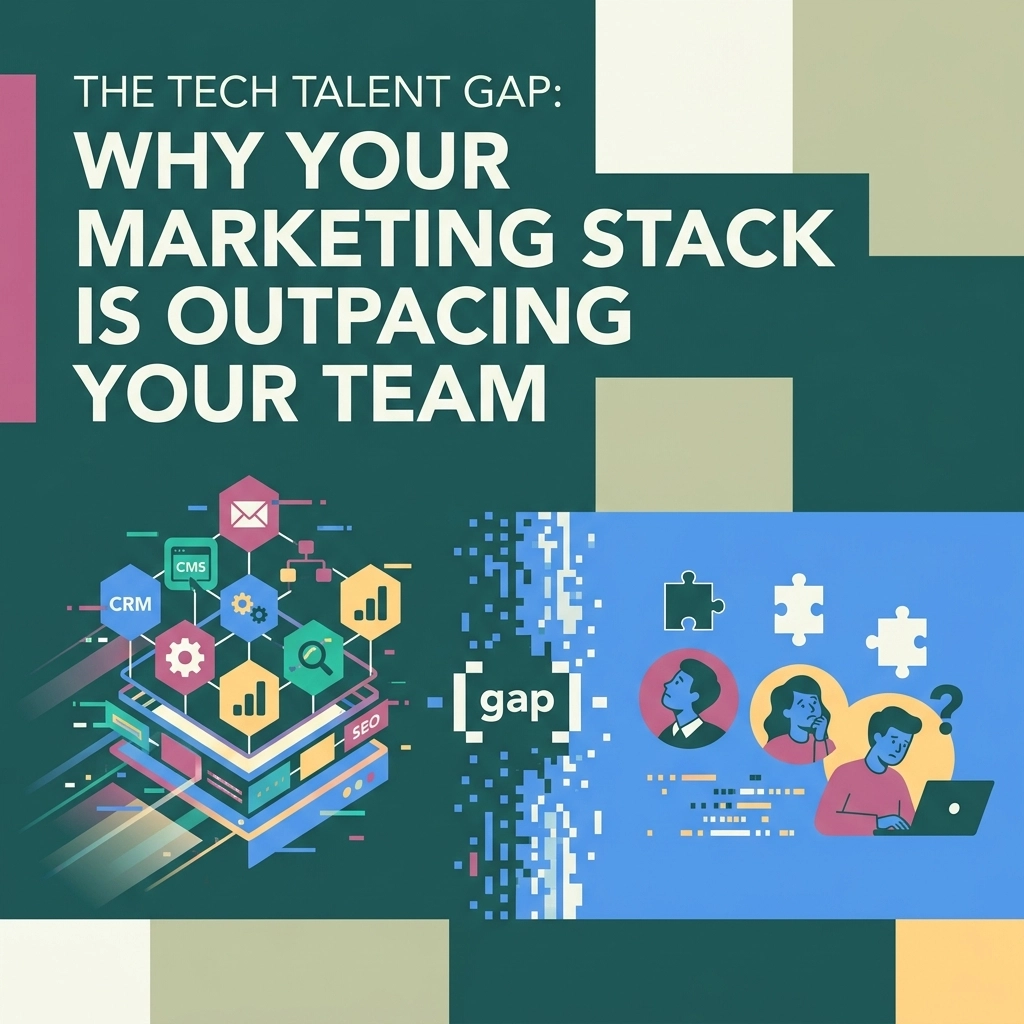
In 2026, the competitive advantage isn’t the shiny tool you buy. It’s the internal Analytical Maturity of your team. We’ve reached a tipping point where marketing technology is advancing so fast that it has officially outpaced the human capital required to run it. If you are sitting on a mountain of data but still making decisions based on “gut feelings,” you don’t have a tech problem, you have a talent gap.
The Tool vs. Talent Fallacy
We’ve been sold a lie for the last decade: the idea that “software will solve it.”
We were told that AI would automate our insights, that GA4 would simplify our tracking, and that CRM automation would handle our lead nurturing. But tools are just force multipliers. If you multiply your marketing efforts by zero, the “zero” being a lack of strategic oversight, you still get zero.
The Tech Talent Gap is the distance between what your software can do and what your team actually does with it. According to the World Economic Forum, technological literacy is one of the fastest-growing skill demands globally. Yet, in the trenches of Higher Ed, Government, and B2B marketing, we see a different reality. We see teams buried under “technical debt”, old scripts, broken tags, and platforms that haven’t been updated since 2023.

The “Agency Dependency” Trap
Many enterprise leaders try to bridge this gap by throwing money at “Black Box” agencies. This is what I call the Agency Dependency Trap, and it is a massive strategic risk.
When you rely entirely on an outside vendor for basic analytical questions, you create a bottleneck in your decision-making loop. If you have to wait 72 hours for an agency to tell you which campaign drove the most MQLs last week, you’ve already lost the opportunity to optimize that spend in real-time.
Worse, you are externalizing your institutional knowledge.
If that agency disappears tomorrow, or if your account manager quits, does your data go with them? I’ve seen organizations lose years of historical context because they didn’t own their own “technical backbone.” True Data Sovereignty means your team understands the “why” and the “how” of your data, even if a partner helps you build the “what.”
At MM Sanford, I advocate for a shift in this relationship. You don’t need a vendor to hand you a monthly PDF report that you’ll never read. You need a partner who helps you build the internal muscles to verify your own ROI.
Upskilling for the AI Era: Beyond “What Happened”
In 2026, simply reporting on “what happened” is the bare minimum. Your stakeholders don’t care that you had 50,000 visitors last month. They want to know what those visitors are going to do next month.
The shift from Descriptive Analytics (what happened) to Predictive Analytics (what will happen) requires a specific type of talent. Your SEO managers now need technical fluency to manage AI-assisted workflows. Your paid media specialists need to understand how to manage automation algorithms rather than just toggling keyword bids.
The goal is to move your team from “data-drowning” to “insight-driven.”
This doesn’t mean every marketer needs to be a data scientist. It means they need to be Data Literate. They need to be able to look at a dashboard and spot a “Ghost Script”, a tracking snippet that’s firing incorrectly and inflating your lead count by 20%. They need to understand the intersection of strategy and technology well enough to know when the AI is hallucinating and when it’s giving them a goldmine of a customer insight.

Sector-Specific Realities: Government and Higher Ed
For my clients in the public sector and higher education, the talent gap is often exacerbated by Organizational Inertia.
A state tax department or a large university system can’t just pivot their entire tech stack in a weekend. They have privacy concerns (PII), strict compliance rules, and procurement cycles that take years.
In these environments, the lack of internal talent leads to “Analysis Paralysis.” Because no one internally feels confident in the data, no one is willing to sign off on the big strategic shifts. You end up with a website that feels like a digital fossil, even though you’re paying for modern tools.
The Fix: You have to stop looking for a “Unicorn” hire who knows everything. Instead, you need to build a system that empowers your current staff through targeted, practical training rather than a generic “analytics 101” course.
What Actually Belongs in That Training
Generic analytics training teaches people to click through a GA4 interface. That’s not the skill gap that matters. The training that actually closes this gap covers three things specifically: how to read a Search Console coverage report well enough to spot an indexing problem before it costs three weeks of traffic, how to recognize the signs of a broken tag (a metric that suddenly doubles or vanishes overnight, rather than shifting gradually), and how to ask a vendor a pointed technical question instead of accepting a vague answer. None of that requires a data science degree. It requires roughly a day of hands-on walkthroughs using your own site’s actual dashboards, not generic training-vendor slides, followed by a habit of reviewing the same three reports weekly until pattern recognition kicks in.
The MM Sanford Blueprint: Consultative Partnership
The traditional agency model is broken because it thrives on client ignorance. The more confused you are, the more hours they can bill.
I operate on a Consultative Partnership model. My goal isn’t to be a permanent crutch for your marketing department; it’s to be an architect who designs the system and trains your crew to run it.
I’ve helped organizations move their MQL rates from a stagnant 1% to a healthy 5%, not by buying them a new piece of software, but by fixing the broken tracking they already had and teaching their team how to spot the “leaks” in their funnel.
We focus on the system, not the initial click.
When we work together, we look at the entire lifecycle of a user, from the first touchpoint on a LinkedIn ad to the final conversion in your CRM. We identify where the friction is, and we give your team the tools (and the knowledge) to smooth it out.
Is Your Team Ready for 2026?
The competition for talent is only going to get fiercer. With 61% of tech leaders planning to increase headcount this year, the “ideal” candidate is getting harder to find and more expensive to keep.
Your best bet isn’t just to hire better; it’s to architect better systems.
Ask yourself: If your lead analytics consultant disappeared tomorrow, would your team know how to verify your ROI for this quarter? If the answer is “no,” you don’t have a marketing strategy: you have a dependency.
It’s time to stop chasing the next shiny object and start investing in the people who are supposed to be driving the bus. Let’s build a data-first culture that doesn’t just collect information, but actually uses it to grow.
Ready to bridge the gap? Let’s talk about building your internal technical backbone.
Related reading: Your “factory” agency is lying to you · Beyond the Blue Link: Fire an Agency That Won't Teach You · The Conflict of Interest in Enrollment Marketing Agencies · The $100k Enrollment Leak · Why Your Brand Is Now a Knowledge Graph