
Stop listening to the vendor pitch for a second.
If you’ve spent any time in the digital marketing echo chamber lately, you’ve heard the roar about Server-Side Tagging (SST). It’s being sold as the “Holy Grail” of GA4 privacy compliance: the magical shield that protects you from the death of third-party cookies and the tightening grip of GDPR and CCPA.
But here’s the reality from the trenches: Most organizations are treating SST like a technical plug-in. They think they can just “turn it on” and solve their data problems.
In the world of Government and B2B Enterprise, that’s a dangerous assumption.
As a systems architect who has spent two decades untangling complex web ecosystems, I can tell you that Server-Side Tagging is not a tool; it is a fundamental shift in your data architecture. It’s about moving the “brain” of your tracking from a user’s messy, unpredictable browser to a controlled environment that you own.
Before you sign off on that cloud hosting budget, let’s look at whether you actually need this: or if you’re just buying a Ferrari to sit in a school zone.
The Illusion of “Standard” Compliance
Most Government agencies and B2B firms rely on client-side tagging. It’s the standard: you put a piece of JavaScript (GTM) on your site, and it fires data directly to Google Analytics 4.
The problem? You have zero control over what the browser actually sends.
When a citizen visits a state tax department portal to check their refund status, or a B2B lead interacts with a high-value whitepaper, the browser is essentially a “black box” leaking data. It sends IP addresses, device fingerprints, and potentially sensitive URL parameters directly to third-party servers.
Under GDPR and CCPA, this is a liability nightmare. If you aren’t careful, you’re violating “Data Sovereignty”: the principle that you should have absolute control over the data your constituents or clients provide.
The “Glitch” in the Current System
Browser-side tracking is crumbling. Apple’s Intelligent Tracking Prevention (ITP) and various ad blockers are actively “glitching” your data. You’re seeing 7-day expiration dates on cookies that should last for months. This doesn’t just hurt your marketing attribution; it breaks the user experience.
If your GA4 data looks like a series of disconnected sessions rather than a cohesive journey, your system is already broken. In fact, you might want to check out these 7 signs your GA4 data is broken before proceeding.

What is Server-Side Tagging, Really?
Imagine your current tracking setup as a postcard sent through the mail. Anyone who handles it: the post office, the sorter, the neighbor: can see the message.
Server-Side Tagging is like putting that postcard in a locked, armored briefcase before it ever leaves your building.
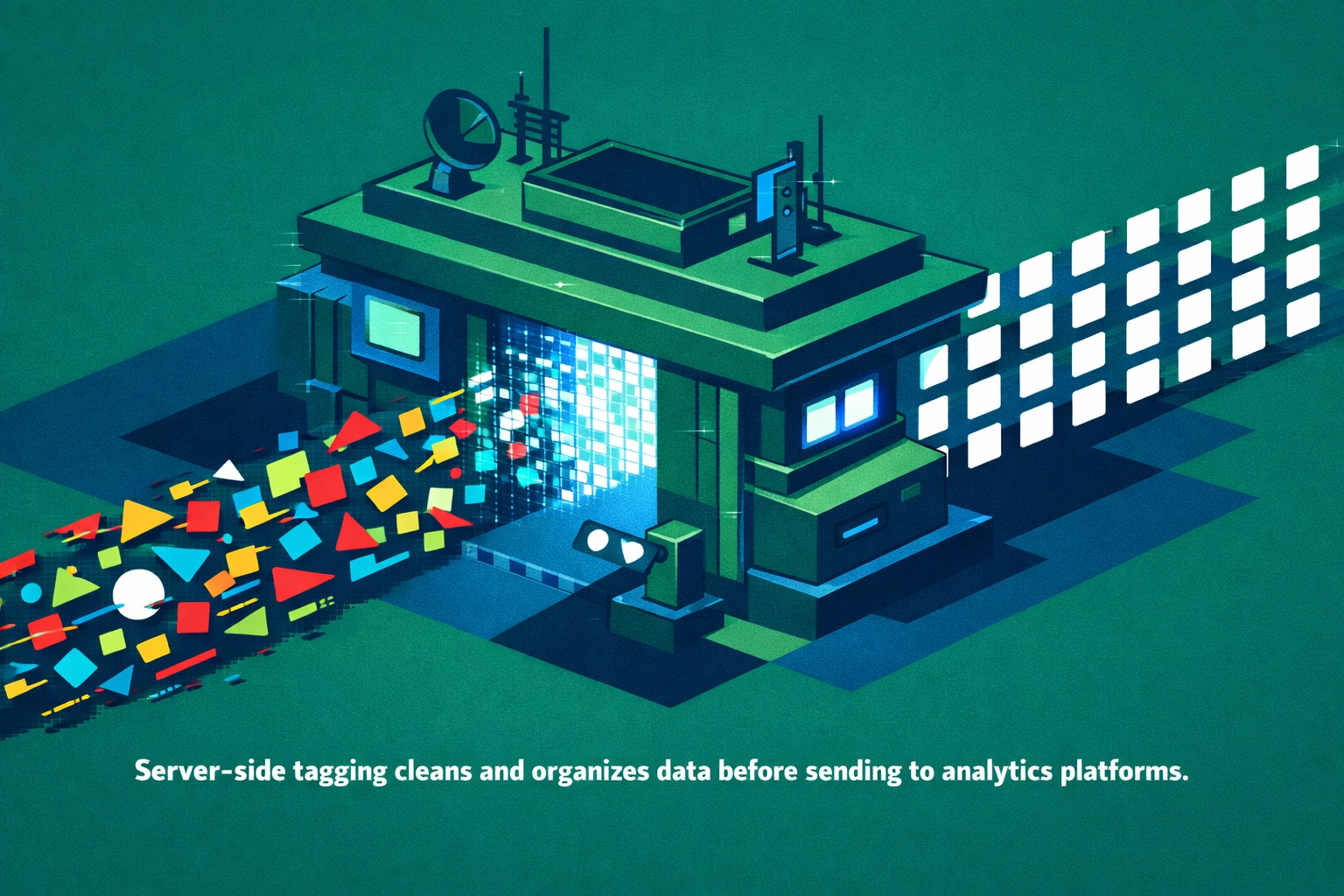
Instead of the browser talking directly to Google, the browser talks to a server you control (usually in Google Cloud or AWS). This server acts as a “Proxy.”
- The Collection: The browser sends data to your server.
- The Scrubbing: Your server looks at the data. It strips out the IP address. It removes any PII (Personally Identifiable Information) that might have accidentally slipped into the URL.
- The Distribution: Only then does your server send the cleaned, anonymized data to GA4, LinkedIn, or your CRM.
Key Takeaway: You become the gatekeeper of your own data. For Government and B2B sectors, this isn’t just a technical upgrade; it’s a policy win.
The B2B and Gov Trade-offs: Is it Worth the Weight?
I’m a pragmatist. I hate “speeds and feeds” marketing. Let’s talk about the actual costs, because SST is not free: either in dollars or in mental bandwidth.
1. The Tech Talent Gap
Running a server-side container requires actual DevOps or high-level technical SEO skills. You can’t just “set and forget” it like a client-side tag. If the server goes down, your tracking goes dark. Does your agency or internal team have the capacity to monitor a cloud environment 24/7?
2. Organizational Inertia
In Government sectors, getting approval for a new cloud instance can take six months of red tape. You have to justify the cost of the server (which scales with traffic) and pass a security audit.
3. The Complexity Tax
Every tag you move to the server requires a custom configuration. It increases the complexity of your system by 10x. If your goal is just to see “how many people clicked this button,” SST is overkill.
But, if your goal is to maintain a 1% to 5% MQL (Marketing Qualified Lead) conversion rate by actually knowing which LinkedIn ads drove high-value enterprise contracts, SST is the only way to get accurate data in 2026.
A Phased Roadmap for Implementation
If you’ve decided that data sovereignty and accuracy are worth the investment, don’t try to move everything at once. Use this three-phase framework to avoid a total system collapse.
Phase I: The Core (Audit and Assessment)
Before writing a single line of code, you need to map your data flow.
- Identify PII: Where is sensitive data being collected? (e.g., forms, search queries).
- Benchmarking: Establish your current visibility. According to Gartner, organizations that don’t transition to a first-party data strategy will see a 30% drop in lead quality.
- The Decision: Determine which tags must be server-side (Google Analytics, Facebook CAPI) and which can stay client-side for now.
Phase II: The Build (The Proxy Setup)
This is where the “Provocative Systems Architect” side of me gets excited. You set up your tagging server on a custom subdomain (e.g., metrics.youragency.gov).
- This enables First-Party Cookies. Because the data is coming from your own domain, browsers like Safari treat it with much higher trust.
- Set up basic IP anonymization at the server level. This ensures no raw IP addresses ever hit Google’s servers, putting you in a much stronger position for GDPR compliance.
Phase III: Complex Enrichment and Scrubbing
This is the “Enterprise” level.
- Data Enrichment: You can pull data from your CRM (like HubSpot or a government database) and add it to the tracking hit on the server. The user never sees this happening in their browser.
- Lead Nurturing: Map these enriched data points to specific funnel stages. This allows for hyper-accurate retargeting without violating privacy norms.
- PII Scrubbing: Automatically detect and redact email addresses or names that users might have typed into a site search or a URL parameter.
Why the “System” Matters More Than the Tool
I see too many B2B companies obsessed with whether they should use Google Cloud vs. Stape vs. AWS for their SST.
It doesn’t matter.
What matters is the strategy behind the data. If you have a perfect server-side setup but no business goal for what you’re measuring, you’re just creating “high-resolution noise.”
In my 20 years of consulting, the most successful projects aren’t the ones with the most expensive tools. They are the ones where the leadership understands that analytics is a customer experience launching pad.
When a citizen visits a government site, they want to find information quickly. When a B2B buyer visits your site, they want a frictionless path to a solution. If your tracking is broken or privacy-invasive, you are creating friction.

The Final Verdict
Do you really need Server-Side Tagging?
- You need it if: You are a Government agency handling sensitive citizen data, or a B2B firm with long sales cycles where accurate attribution is the difference between a $1M budget and a $0 budget.
- You don’t need it (yet) if: You are a small business with low traffic and no regulatory oversight, or if you don’t have the technical resources to maintain the infrastructure.
If you’re sitting on the fence, don’t just guess. The “Paradox of Choice” in marketing tech usually leads to paralysis. Start with a clear audit of your current data sovereignty.
If you want to move past the jargon and build a system that actually works for your organization’s specific needs, I’m here to help. We specialize in the “messy” sectors: Gov, Higher Ed, and B2B: where privacy isn’t optional.
Ready to stop the data leakage? Let’s talk about building a measurement system that respects privacy while delivering results.
Connect with us for a Technical Analytics Consultation
Key Takeaways for the Skimmers:
- SST is about control: It moves the data processing from the browser to a server you own.
- Privacy is the driver: It’s the best way to ensure GDPR/CCPA compliance for sensitive B2B and Gov sites.
- Accuracy is the benefit: First-party cookies bypass browser restrictions, giving you cleaner data for better decisions.
- Maintenance is the cost: It requires higher technical skill and cloud hosting costs.
- Start small: Use a phased approach (Audit -> Build -> Enrich) rather than a “Big Bang” implementation.