
Let’s be honest: most of you are still chasing blue links while the world has moved on to citations.
If your marketing meeting still starts and ends with "Where do we rank on page one of Google?" you’re effectively managing a horse-and-buggy fleet in the age of the jet engine. By 2026, the game isn't just about showing up in search results; it’s about becoming the canonical source of truth for the Large Language Models (LLMs) that your customers: and students: actually use.
I see the same systemic failures across government agencies, higher ed institutions, and B2B enterprises. You’re applying a 2018 SEO playbook to a 2026 AI reality. Research shows the overlap between Google top-10 results and AI citations is as low as 17–38%. In other words, ranking well no longer guarantees you’ll be the answer.
Here are the seven most common mistakes I’m seeing in AI discovery strategies right now: and the tactical fixes to get you back on the map.
1. Treating AI Discovery as "Just SEO"
This is the cardinal sin. Traditional SEO is a "click-based" economy. AI discovery (or AEO: Answer Engine Optimization) is a "citation-based" economy.
When a prospective student asks Perplexity, "What’s the best online MBA for working parents?" the AI isn't looking for a list of links to give the user; it’s looking for a synthesis of data to provide a direct answer. If you aren't the source of that answer, you don't exist.
The Fix:
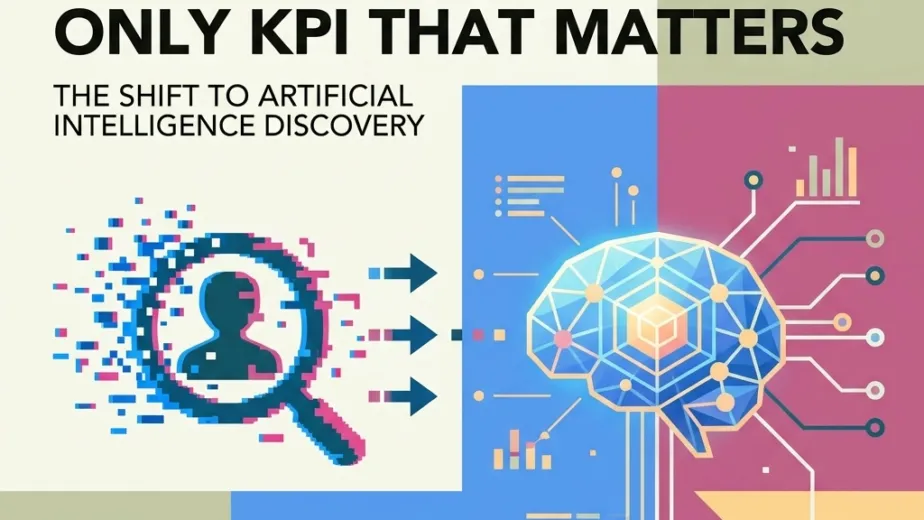
Pivot your KPIs. Stop obsessing solely over organic sessions. Start tracking "Share of Answer" and "Citation Volume" across ChatGPT, Gemini, and Perplexity. You need a dedicated AI discovery pivot that treats LLM visibility as its own channel, not a byproduct of search.
2. Blocking AI Crawlers Out of Fear
I get it. You’re worried about your data being used to train models without your permission. But for most organizations: especially government and higher ed: blocking AI crawlers is a form of digital suicide.
If the LLMs can't crawl your site, they can't cite your policies, your program details, or your expert research. They will simply cite your competitors instead. You are effectively erasing yourself from the future of information retrieval.
The Fix:
Move from a "block all" mentality to a "strategic governance" approach. Implement an llms.txt file (the robots.txt for the AI era) and use it to signal exactly what content is high-value for retrieval. Tell the models: "Crawl our program pages and faculty research, but keep your hands off our granular user clickstream data."

3. The "PDF Trap" for Critical Information
If you’re a state agency or a university, I bet half of your most important information: tuition rates, policy manuals, governance docs: is buried in a 40-page PDF.
LLMs can read PDFs, but they hate them. They prefer structured, semantically clear HTML. When an AI has to parse a messy PDF, the risk of "hallucination" or inaccurate synthesis skyrockets. You end up with students getting the wrong financial aid deadlines because the AI couldn't parse your 2024 vs. 2026 document.
The Fix:
Convert your critical "truth" documents into structured web pages. Use a BLUF (Bottom Line Up Front) format. Give the AI: and the human: the direct answer in the first 60 words, then follow with the detail. If it has to be a PDF, ensure it's tagged and optimized, but a technical SEO backbone always favors HTML.
4. Missing or Generic Schema Markup
Schema.org is no longer "optional SEO fluff." It is the primary way you communicate "meaning" to an AI agent.
Most enterprise sites have "lazy schema": they might have some basic Organization markup, but they’re missing the deep, specific layers like FAQPage, QAPage, or Course markup. Without this, you’re forcing the AI to guess what your data means. And in 2026, guessing is a luxury you can't afford.
The Fix:
Conduct a technical SEO audit specifically focused on entity-based schema. If you're a university, every program needs Course markup. If you're a government agency, every service needs Service markup. Match your schema to the actual content on the page: mismatched data is a fast track to being de-prioritized by AI filters.
5. Relying on AI-Generated "Thin" Content
The irony is palpable: using AI to write content to rank in AI search. It doesn't work.
LLMs are trained to find the source of truth. If your site is just a collection of generic, AI-spun articles that sound like everyone else's, you have zero "Information Gain." Why would an LLM cite you when you're just a echo of what it already knows?
The Fix:
Focus on "First-Party Data" and "Expert Authority." LLMs crave unique statistics, original research, and lived experience. In higher ed, this means faculty insights and real student outcome data. In B2B, it means proprietary benchmarks. Be the original source, not the aggregator.

6. Measuring the Wrong Things (The Vanity Metric Problem)
How many of you are still reporting on "Impressions" from a dashboard that hasn't changed since 2021?
In an AI-first world, a "zero-click" interaction: where the user gets the answer and never visits your site: can still be a win IF your brand is the cited authority. If you aren't measuring "Brand Mention Accuracy" in LLM outputs, you have a massive blind spot.
The Fix:
Stop trusting your CRM’s attribution blindly. Implement a Forensic Audit of your AI visibility. Run your top 50 high-intent queries through ChatGPT, Gemini, and Claude every month. Are you cited? Is the information accurate? If they say your tuition is $50k and it’s actually $30k, you have a conversion problem before the user even clicks a link.
7. Treating AI Discovery as a Silo
You have an "SEO person," a "Content person," and an "IT person." None of them are talking to each other about AI readiness.
AI discovery is a cross-functional problem. It requires technical infrastructure (IT), structured data (SEO), and authoritative information (Content). When these are siloed, the strategy fails. Your content might be great, but if your site is a JavaScript-heavy mess that LLMs can't parse, you're invisible.
The Bottom Line: Data Sovereignty
The Bottom Line: Data Sovereignty
At the end of the day, AI discovery is about owning your data. Whether it's a tax department visitor flow or a graduate student enrollment journey, your organization needs to be the architect of its own digital identity.
Don't let the models decide who you are. Give them the structured, authoritative, and technically sound data they need to tell your story correctly.
Key takeaways:
- Stop chasing links; start chasing citations.
- Blocking AI crawlers is usually a mistake for authoritative institutions.
- Structure your data (Schema/HTML) or be ignored.
- Unique, first-party data is the ultimate "citation bait."
Are you ready to stop guessing and start measuring your AI visibility? We specialize in helping large-scale organizations: from federal agencies to universities: bridge the tech talent gap and build a system that actually delivers results in the age of AI.
What’s your system for AI discovery? Let’s talk.