
A few years ago, I sat in a boardroom with a marketing team that was popping champagne. They had just launched a “stunning” new homepage for their flagship B2B service. It was a masterpiece of high-resolution video backgrounds, interactive scroll-triggered animations, and enough tracking scripts to follow a user into their next life.
Three weeks later, the champagne turned to vinegar. Their mobile rankings didn’t just dip; they fell off a cliff.
When we ran a technical SEO audit, the culprit wasn’t the content or the backlinks. It was the weight. That “beautiful” homepage was a 4.5MB monster. While the design team saw an award-winning aesthetic, Google saw a wall of code it simply refused to climb.
In the world of Enterprise SEO, “pretty” is a liability if it isn’t performant. If your pages are pushing past the 2MB threshold, you aren’t just slowing down your users: you are literally becoming invisible to the bots that matter.
The 2MB Threshold: Google’s Hard Ceiling
Most marketers think of page speed as a “user experience” metric. They think if a user is patient enough to wait four seconds for a page to load, then everything is fine.
Google does not have that kind of patience.
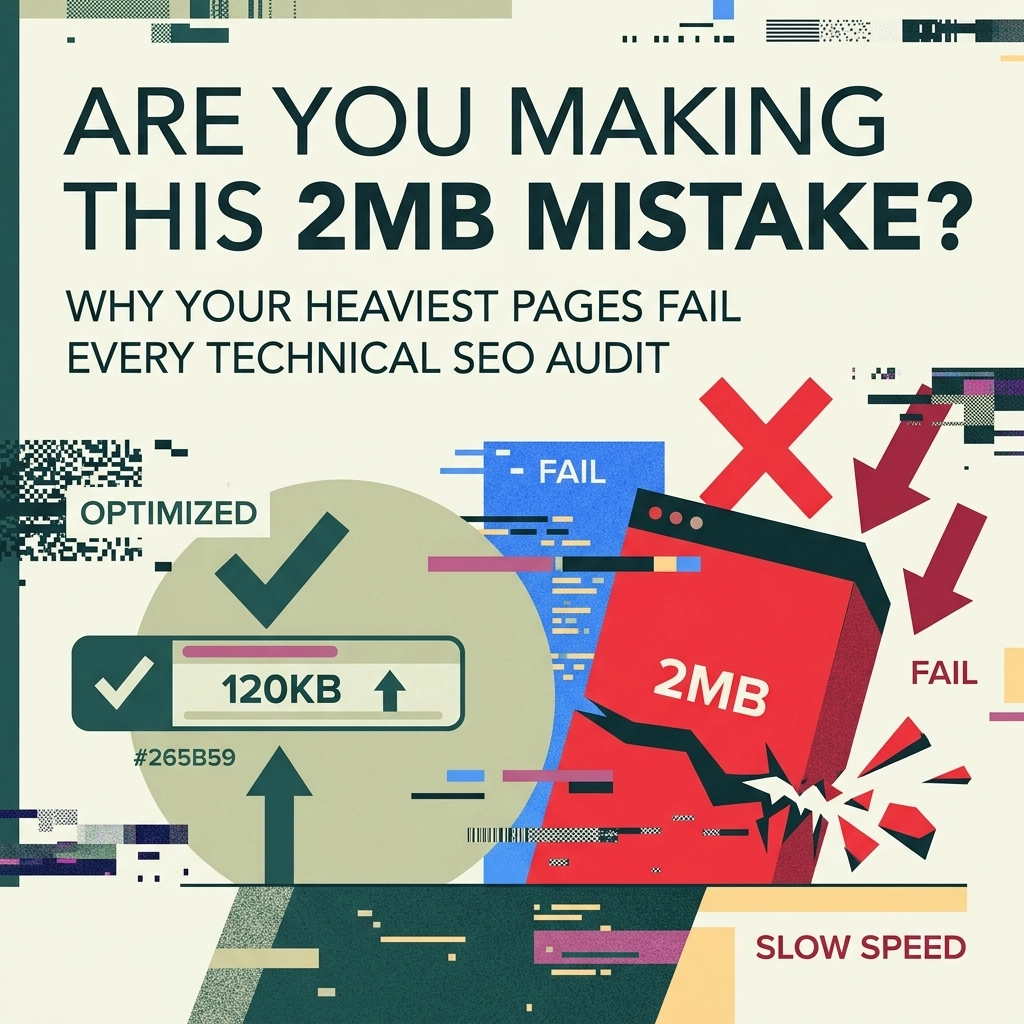
Recently, the technical community confirmed a hard truth: Google has a crawl limit for HTML files. While the total page weight (including images and scripts) matters for Core Web Vitals, the raw HTML file itself has a silent truncation point at around 2MB.
If your HTML file exceeds 2MB, Google stops reading.
Imagine writing a brilliant 5,000-word guide on government compliance, but because your CMS injected 1.8MB of messy, inline CSS and junk code at the top, Google cuts off the crawl before it even hits your primary headings. To the search engine, that content simply doesn’t exist.
For large organizations: especially in government or higher education: this is a frequent disaster. Legacy systems and “drag-and-drop” page builders often wrap a single paragraph of text in twenty layers of unnecessary <div> tags.
The takeaway: A heavy page isn’t just slow; it’s incomplete in the eyes of an indexer.

The AI Reading Tax: Why Bloat Kills LLM Discovery
We are moving into an era of “AI-Ready SEO.” It’s no longer just about ranking #1 on a SERP; it’s about ensuring Large Language Models (LLMs) can parse your data to cite you in AI Overviews or ChatGPT responses.
I call this the AI Reading Tax.
Search bots and LLM crawlers operate on a “crawl budget.” They have a finite amount of computational energy to spend on your site. When your pages are bloated with 2MB+ of inefficient code, you are forcing the bot to work harder to find the signal in the noise.
In my experience with AI-ready technical SEO, I’ve found that the cleaner the HTML, the higher the “citation rate” from AI engines.
If an LLM has to sift through megabytes of unminified JavaScript just to find your “About Our Services” section, it’s going to move on to a competitor who has a leaner, more semantic structure. In high-stakes sectors like government services or B2B tech, that’s a massive missed opportunity for data sovereignty.
Why Heavy Pages Fail the Audit (and How to Spot Them)
When we perform a technical SEO audit, we don’t just look at a “score” out of 100. We look at the forensic details of the DOM (Document Object Model) size.
Here is why your heaviest pages are failing your audits:
- Silent Truncation: As mentioned, if the HTML is too large, the bottom half of your page is never indexed. This is why some sites see “Discovered – currently not indexed” errors in Search Console that never seem to go away.
- DOM Depth: Heavy pages usually have a deep DOM tree. If a bot has to go 50 levels deep into nested containers to find a text string, it’s likely to deprioritize that content.
- Mobile-First Indexing: Google crawls your site as a mobile user. Heavy pages on a simulated 4G connection often time out before the crawl is complete.
If your homepage feels “heavy,” it’s likely failing the most basic requirement of modern SEO: accessibility.

Surgical Optimization: Turning the Monster into a Machine
So, how do we fix this? We don’t just “delete things.” Here’s the three-part framework to trim the fat while keeping the functionality.
The Low-Hanging Fruit
The first step is always the easiest. We look for the “accidental” bloat that adds no value to the user but weighs down the audit.
- Image Compression: Stop uploading 5MB JPEGs directly from a photographer’s drive. Use WebP formats and implement lazy loading.
- Font Stripping: Does your site really need five different weights of a custom brand font? Every extra font file is a massive hit to the initial load.
- Minification: Use automated tools to strip whitespace and comments from your CSS and JS files.
Script Deferral and Governance
In Enterprise SEO, “script creep” is a real disease. The marketing team adds a heat map tool, the sales team adds a chatbot, and the analytics team adds three different tracking pixels.
- Audit your Tag Manager: If you aren’t actively using a tracking tool, kill it.
- Defer non-essential JS: Ensure that your chatbot or “pop-up” doesn’t load until the main content is fully parsed and rendered.
Structural Refactoring: The Long Game
For government agencies and large universities, this is where the “organizational inertia” kicks in. It’s the hardest part, but the most rewarding.
- Move Inline CSS to External Files: Get that styling code out of the HTML and into its own cached file.
- Simplify Page Builders: If your CMS is generating “div-itis,” it might be time to move toward a more headless or component-based architecture.
The goal is a lean, mean, data-delivery machine that Google can read in milliseconds.

Business Goals Over Beautiful Bloat
I’ve seen too many companies prioritize a “hero video” over their actual search visibility. As a consultant, my job is to remind you that marketing software and flashy design are useless if they prevent you from hitting your business goals.
If your goal is to increase MQLs from 1% to 5%, you don’t need a heavier page; you need a faster, more relevant one. For a government agency, a heavy page is a barrier to equity: it prevents users on older devices or slower connections from accessing vital services.
At MM Sanford, we believe in data empowerment. We want you to own your data and your performance. That starts with a site that is technically sound from the ground up.
Is Your Site Holding You Back?
The 2MB mistake is just one of many “silent killers” we look for. Technical SEO isn’t just about keywords and meta tags anymore; it’s about the underlying architecture of how your brand exists on the web.
If you haven’t looked at your page weight in the last six months, you are likely carrying around dead weight that is dragging down your rankings.
Stop guessing and start auditing.
Ready to see what’s actually happening under the hood of your enterprise site? Let’s talk about a forensic technical SEO audit that prioritizes your business outcomes over industry jargon.
Don’t let a 2MB mistake be the reason your best content stays hidden. It’s time to get surgical.