If I hear the phrase "data-driven" one more time in a boardroom without seeing a single actionable insight to back it up, I might actually lose my mind.
Most organizations: especially in the high-stakes worlds of Higher Ed, Government, and B2B: fancy themselves as "data-driven" simply because they have a GA4 property and a couple of Looker Studio dashboards that someone glances at once a month.
Here is the blunt reality: Having a GA4 account doesn’t mean you’re data-driven any more than owning a stethoscope makes you a heart surgeon.
According to recent benchmarks, roughly 96% of organizations are still stuck in the "initial" or "developing" phases of analytical maturity. They are data-drowning but insight-starved. They have millions of rows of data but can’t tell you why their primary conversion rate dropped 20% between Tuesday and Thursday.
The "Maturity Gap" is the distance between where your organization is and where it needs to be to stop guessing and start growing. To bridge that gap, you need a roadmap, not more software.
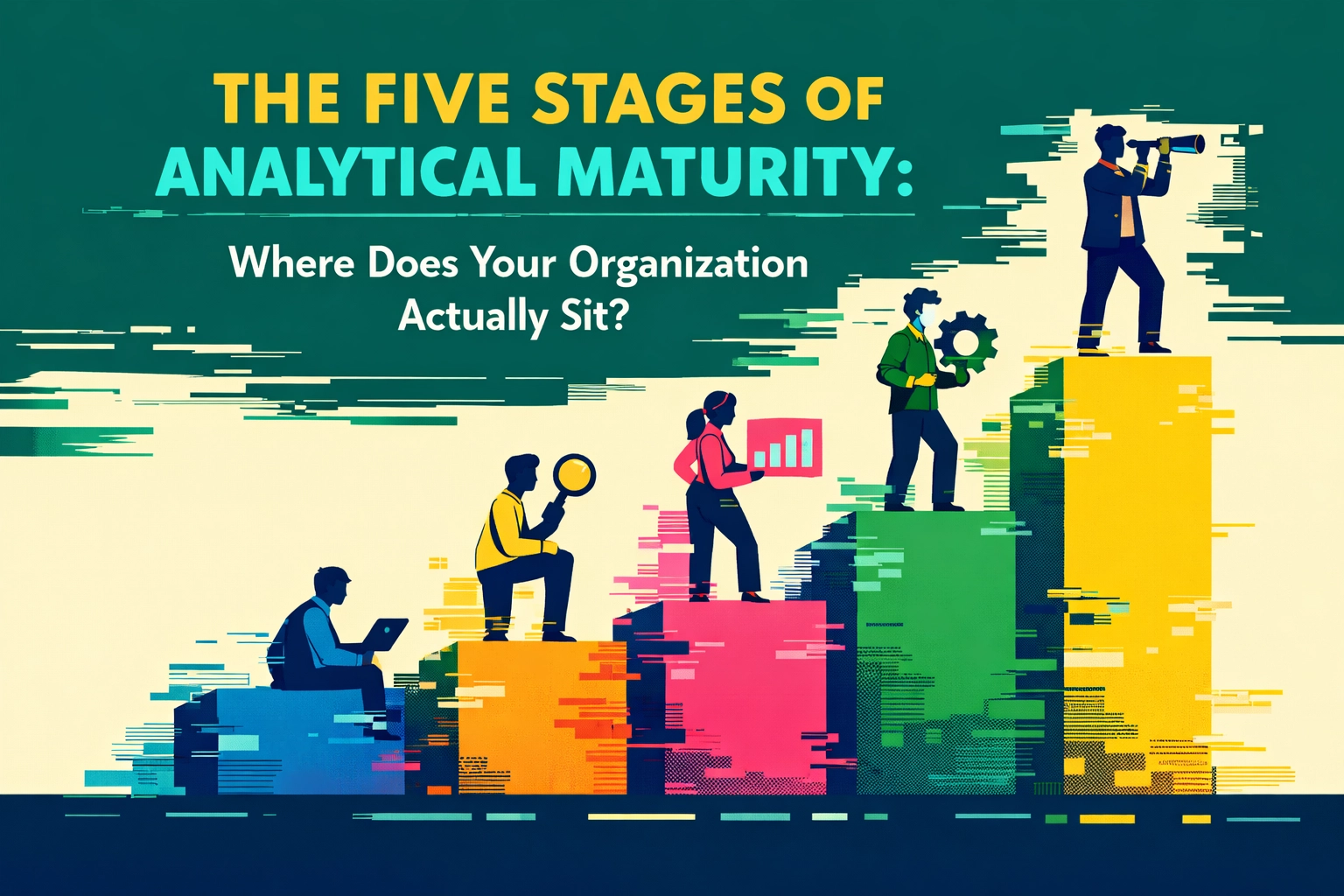
Let’s break down the Five Stages of Analytical Maturity so you can figure out where you actually sit: and how to move to the next level.
Stages 1 & 2: The Reactive Phase (The "What Happened?" Era)
This is where the vast majority of organizations live. In the Reactive Phase, data is used primarily as a rearview mirror. You’re looking at what happened last month, last quarter, or last year.
Stage 1 (Initial): You have basic tracking. You know how many people visited the site. You might even have a "thank you" page goal set up. But your data is fragmented. Your CRM doesn't talk to your analytics, and your marketing team is manually pulling CSVs into Excel to try and make sense of it all.
Stage 2 (Developing): You’ve realized that "total users" is a vanity metric. You’ve started to implement surgical event tracking. You aren't just tracking page views; you're tracking scroll depth on your "Why Our University?" page, document downloads for your agency’s new policy brief, and video completions on your B2B product demo.
The Move to Analytical Clarity
In this phase, the goal is to move from "What happened last month?" to "What is happening right now?"
For a government agency, this looks like identifying exactly where users are dropping off in a tax filing or permit application flow. For Higher Ed, it’s seeing which program pages are driving interest but failing to capture inquiries.
The Fix: You need a technical foundation. If you haven't performed a comprehensive GA4 audit, you are building your house on sand. You cannot move to Stage 3 if your Stage 2 data is broken.

Stages 3 & 4: The Proactive Phase (The "Why is it Happening?" Era)
This is the tipping point. This is where you stop being a "vendor" of reports and start becoming a "consultant" for your own organization. In the Proactive Phase, you are no longer just reporting on the past; you are explaining the present and reclaiming your Data Sovereignty.
Stage 3 (Defined): You have moved beyond client-side tracking. You’ve realized that ad blockers and browser privacy shifts (like ITP) are killing your data quality. To combat this, you’ve implemented Server-Side Tagging. This allows you to claim ownership of your data, improve site performance, and ensure your privacy-first analytics approach meets the strict requirements of Government and Higher Ed compliance.
Stage 4 (Managed): You are no longer satisfied with the limitations of the GA4 interface. You have moved your raw data into a first-party data warehouse like BigQuery.
Why Data Sovereignty Matters
In Stage 4, you own the raw logs. You can join your website behavior with your CRM data (Slate, Salesforce, HubSpot) without relying on "estimated" or "sampled" data from a third-party platform.
For a B2B leader, this means knowing that a specific lead didn't just "appear" today: they touched three different blog posts over six months, attended a webinar, and only then filled out the "Contact Sales" form. This is true attribution.
The Fix: Transitioning to Server-Side Tagging is the "barrier to entry" for Stage 4. It’s the difference between guessing which ads worked and knowing exactly which touchpoints drove a multi-million dollar contract or a record-breaking enrollment year.
Stage 5: The Predictive Phase (The "What Will Happen?" Era)
This is the pinnacle. At Stage 5, your analytics ecosystem is no longer a reporting tool; it’s an Integrated Intelligence system.
You are using Python-powered automation and machine learning models to predict buyer intent or student enrollment before the lead form is even touched.
Predictive Modeling in Action
Imagine a Higher Ed recruitment team that doesn't wait for "Intent to Enroll" deposits to see if they’ll hit their numbers. Instead, they use behavioral signals: cross-referenced with historical patterns in BigQuery: to assign a "probability score" to every prospect in the funnel.
Imagine a Government agency that can predict "peak demand" for a service based on real-time web traffic patterns and historical socioeconomic data, allowing them to shift staffing resources before the phone lines get jammed.
In Stage 5, you aren't just reacting to the market; you are anticipating it.
- Python Integration: We use custom scripts to pull data from multiple APIs, clean it, and run regression models to find the "hidden" drivers of success.
- Advanced Attribution: You’ve moved past "Last Click" and even "Linear" attribution. You’re using data-driven models that account for the unique complexities of long-cycle B2B or Higher Ed decision-making.

The Strategic Pillar: Why Most Teams Get Stuck
Why do 96% of organizations fail to reach Stage 4 or 5? It isn't a lack of tools. It’s a Tech Talent Gap and a lack of Governance.
Most large organizations suffer from "Tag Sprawl." Marketing adds a tag, IT adds a tag, a third-party agency adds four more, and suddenly the site is slow, the data is duplicated, and no one knows which number is correct.
Moving up the maturity ladder requires strict GTM Governance. You need a system. You need a process. You need someone who cares more about the integrity of the insight than the features of the software.
What Moving Up a Stage Actually Costs
The roadblock is rarely technical. Here’s what each transition actually requires in headcount and budget, since that’s usually the real question a leader is asking:
- Stage 1 → 2: Usually no new hire needed, just 20-40 hours of a marketer’s time to properly configure events instead of relying on GA4’s defaults.
- Stage 2 → 3: This is where organizations usually need to bring in a specialist, whether internal or contracted, since server-side tagging is genuinely a different skill set than standard GA4 configuration.
- Stage 3/4 → 5: Predictive modeling is where the budget conversation gets real, typically a data analyst or a specialized consulting engagement, since this is genuinely custom engineering, not configuration.
The Pragmatic Truth
Analytics is not a "set it and forget it" project. It is a continuous evolution of your business intelligence.
If you are a marketing leader in a complex organization, your job isn't to look at reports. Your job is to make decisions. If your current analytics setup doesn't give you the confidence to move $100k of budget from one channel to another on a Tuesday afternoon, then your organization is likely hovering at Stage 1 or 2.
Stop "playing with data" and start building a system.
Are you ready to find out where your organization actually sits? We specialize in moving Higher Ed, Government, and B2B organizations out of the "data-drowning" phase and into "Analytical Clarity."
Let’s stop the guessing games. Let's build a measurement strategy that actually drives your 2026 marketing decisions.

Key Takeaways for Skimmers:
- 96% of organizations are stuck in basic reporting phases.
- Stages 1-2 (Reactive) focus on "What happened" through event tracking.
- Stages 3-4 (Proactive) require Server-Side Tagging and BigQuery to reclaim data sovereignty.
- Stage 5 (Predictive) uses Python and AI to forecast outcomes like student enrollment or B2B buyer intent.
- Governance and Systems matter more than which software you buy.