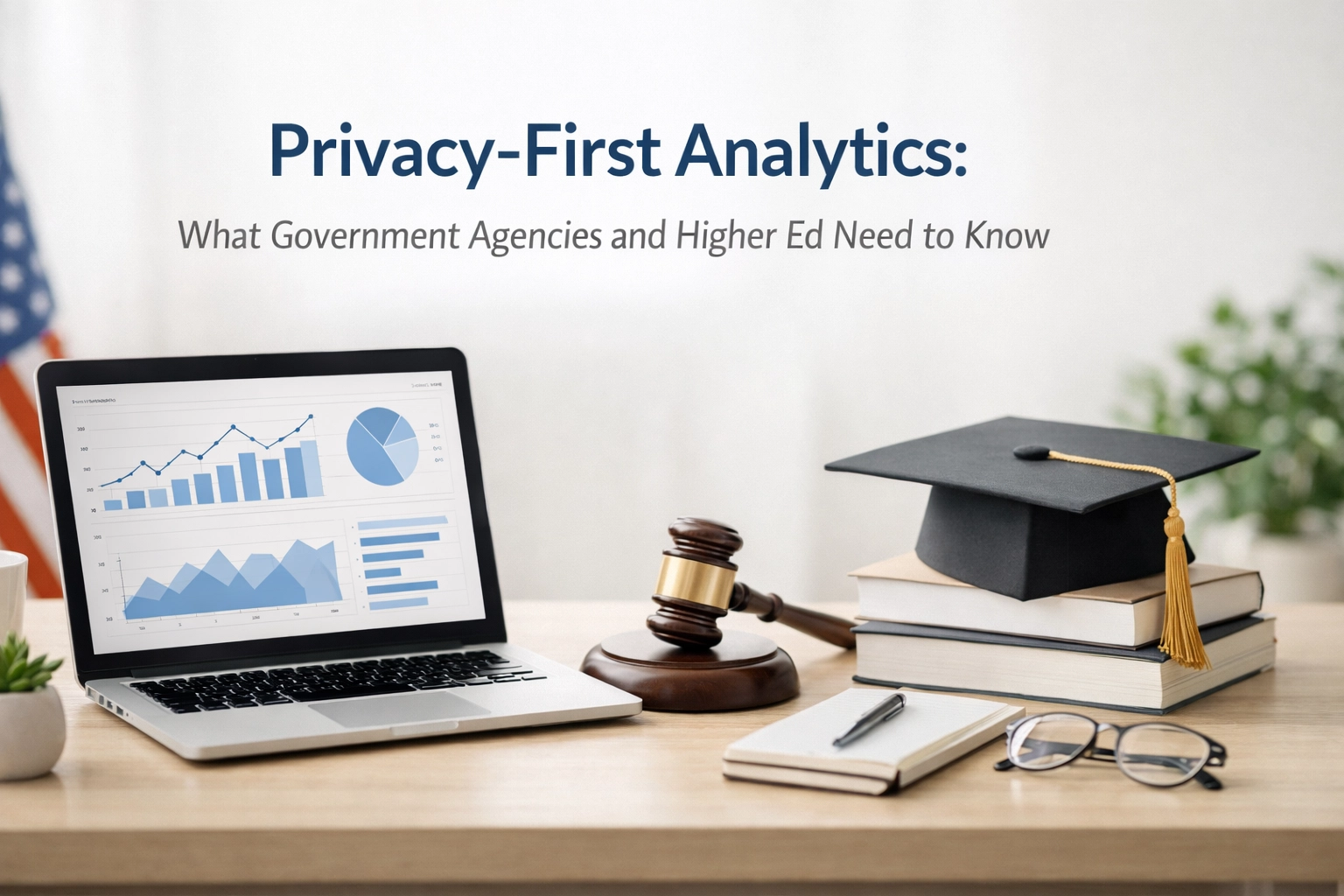
Are You Still Using Analytics Like It’s 2019?
If your government agency or university is still relying on traditional analytics platforms without considering the privacy implications, you’re not just behind the curve, you’re potentially exposing your institution to regulatory violations and eroding public trust.
I’ve worked with enough public sector clients to know the reality: most analytics implementations were set up years ago by a well-meaning IT team or marketing intern, and nobody’s touched them since. Until, of course, the legal department starts asking questions about GDPR compliance. Or a student files a FERPA complaint. Or your state passes its own privacy law (and who isn’t these days?).
The truth is, privacy-first analytics isn’t just about compliance anymore, it’s about maintaining the credibility and trust that government agencies and higher education institutions desperately need to function effectively.

Why Government and Higher Ed Can’t Afford to Ignore This
Let’s be blunt about the stakes here. Under GDPR, violations can result in fines up to €20 million or 4% of worldwide annual revenue, whichever is higher. The average cost of a data breach hovers around $4.5 million, and that number climbs when personally identifiable information (PII) is involved.
But here’s what keeps me up at night for my public sector clients: it’s not just the financial penalties. It’s the erosion of public trust.
Research shows that 39% of consumers prioritize clear information about data use when deciding whether to trust an organization. When you’re a government agency serving constituents or a university managing student data, that trust is everything. You don’t get a second chance when a data breach hits the news cycle.
The Compliance Minefield
Government agencies and higher education institutions face a unique compliance challenge because they’re juggling multiple frameworks simultaneously:
- GDPR if you have any European visitors or students
- CCPA and its state-level cousins (Virginia, Colorado, Connecticut, and counting)
- FERPA for educational records (with penalties that include losing federal funding)
- HIPAA if you’re tracking anything health-related (yes, that counseling center chat widget counts)
- State-specific laws that seem to pop up every legislative session
And here’s the kicker: traditional analytics platforms weren’t built with this regulatory patchwork in mind. They were built to collect everything and ask questions later. That approach doesn’t fly anymore.

What Privacy-First Analytics Actually Means
Privacy-first analytics isn’t just slapping a cookie banner on your site and calling it a day (though I’ve seen plenty of institutions try exactly that). It’s a fundamental shift in how you collect, store, and analyze user data.
Here’s what it looks like in practice:
Data Anonymization: Instead of tracking “Jane Smith from Building 402,” you’re tracking “Anonymous User from Government Network.” You still get the behavioral insights: what pages perform well, where users drop off, which campaigns drive traffic: without collecting PII.
Cookieless Tracking: As third-party cookies die their slow, painful death (thanks, Google), privacy-first platforms use alternative methods. This might include hashed user signatures, first-party data collection, or aggregated analytics that never identify individual users.
No Consent Banner Required: When you’re truly not collecting personal data, you often don’t need those annoying cookie consent popups that everyone clicks through anyway. (And let’s be honest: those banners are terrible for user experience and conversion rates.)
Aggregated Reporting: You get trends, patterns, and actionable insights without the ability to drill down to individual user sessions. For most government and higher ed use cases, this is exactly what you need anyway. You don’t care about Jane’s specific journey; you care that 47% of users abandon the financial aid application on page three.
The Technical Reality (That Nobody Talks About)
I recently audited a major state university’s analytics setup, and here’s what we found: they were using four different analytics platforms, none of which were talking to each other, all collecting overlapping data, and zero documentation about what was compliant with what regulation.
Sound familiar?
The migration to privacy-first analytics isn’t just a “flip the switch” operation. It requires:
-
Audit Current Data Collection: What are you actually tracking? Where is it stored? Who has access? (I promise you’ll be surprised by the answers.)
-
Define Business Requirements: What decisions are you making with analytics data? This is where most organizations realize they’re collecting way more than they need.
-
Choose the Right Platform: Plausible, Fathom, and Matomo are popular privacy-first options, but the “right” choice depends on your specific requirements. Some institutions need EU data storage. Others need government cloud compliance. One size does not fit all.
-
Implement Server-Side Tracking: This is where digital analytics consulting becomes critical. Server-side Google Tag Manager (GTM) can help you maintain data integrity while respecting privacy: but the implementation is complex enough that you want someone who’s done it before.
-
Document Everything: Your legal team will thank you. Your auditors will thank you. Your successor (when you eventually retire) will thank you.

The Innovation Paradox: Balancing Privacy and Insights
Here’s the tension I see in almost every government and higher ed project: leadership wants more data-driven decision making (AI insights! Predictive analytics! Personalization!), but the legal and compliance teams are rightfully pumping the brakes on data collection.
This is what I call the Innovation Paradox: wanting to innovate while being constrained by technical debt and compliance requirements.
The solution isn’t to abandon analytics. It’s to be surgical about what you collect and why. Privacy-first analytics forces this discipline. You can’t collect everything “just in case,” so you have to think critically about what actually drives decisions.
Example: A community college wanted to improve online enrollment. Traditional analytics tracked every mouse movement, form field, and page scroll. Privacy-first analytics revealed the same critical insight with a fraction of the data: 68% of users who started the application abandoned it when asked for their Social Security number on page two. Solution? Move that field to the final page after they’re committed. Enrollment increased 23% without compromising privacy.
That’s the beauty of constraints: they force clarity.
Cookieless Doesn’t Mean Clueless
One of the biggest misconceptions I hear: “If we go cookieless, we’ll lose all our attribution data and won’t know what’s working.”
Not true. You’ll lose some granularity, particularly around cross-device tracking and long conversion windows. But for most government and higher ed use cases, you’re not selling products with complex buyer journeys. You’re helping citizens access services or students find information.
What you’ll still have with privacy-first analytics:
- Traffic sources and campaign performance
- Content engagement metrics
- User flow and drop-off points
- Conversion tracking (for things like form submissions, downloads, inquiries)
- Geographic and device data (anonymized)
What you’ll lose:
- Individual user session recordings
- Cross-device tracking over long time periods
- Highly granular audience segmentation based on behavior
- Integration with some third-party advertising platforms
For most public sector organizations, that’s a worthwhile trade. You maintain the insights that drive decisions while dramatically reducing compliance risk.

Maintaining Data Integrity in a Privacy-First World
Here’s where things get technical (and where a lot of implementations fall apart): privacy-first doesn’t mean sloppy data collection. In fact, it requires more discipline.
When you’re working with aggregated data, you can’t “fix” individual records after the fact. You can’t go back and re-attribute a conversion to the correct campaign if your UTM parameters were misconfigured. The data collection has to be right the first time.
This is where technical SEO and analytics converge. Your tracking setup needs to be:
- Consistent: Same parameters, same naming conventions, every time
- Documented: So the next person (or you in six months) knows what’s what
- Tested: Before launch, not after you’ve spent budget on a campaign
- Monitored: Regular audits to catch configuration drift before it pollutes your data
In my experience, organizations that succeed with privacy-first analytics are the ones that treat data governance as seriously as they treat financial controls. You wouldn’t let just anyone access your budget system: why would you let anyone push tags to your website?
The Path Forward: Starting Your Privacy-First Transition
If you’re reading this thinking, “We need to do this, but where do we even start?”: you’re asking the right question. Here’s the pragmatic approach I recommend:
Start with a Privacy Audit: Before changing anything, understand what you’re currently collecting and where your compliance gaps are. This becomes your roadmap.
Identify Quick Wins: Maybe it’s removing unnecessary third-party scripts that are slowing down your site and creating privacy risks. Maybe it’s consolidating redundant tracking. These build momentum.
Pilot on a Subsection: Don’t try to migrate your entire web presence at once. Pick a high-traffic section (like your news site or blog) and test a privacy-first platform there first.
Involve Stakeholders Early: Legal, IT, marketing, and leadership need to understand both the “why” and the “how.” Surprises lead to project delays.
Plan for the Long Term: This isn’t a one-quarter project. Budget for ongoing maintenance and optimization, because regulations aren’t getting simpler.
The organizations that thrive in this new privacy-first landscape aren’t the ones with the biggest budgets or the fanciest tools. They’re the ones with clarity about what they’re trying to accomplish and the discipline to execute it properly.
And honestly? That’s always been the hallmark of effective digital analytics consulting: cutting through the noise to focus on what actually matters for your organization.
Need help navigating the transition to privacy-first analytics? Sanford Consulting specializes in implementation strategies for government agencies and higher education institutions. Let’s talk about your specific compliance requirements and analytics goals.
Related reading: Consent Mode v2: Why Your Gov or Higher Ed Site Leaks Data · Consent Mode v2: Compliance as a Competitive Advantage · OMB-2026-10817 Compliance: 10 Things You Should Know · The Data Liability Loop · The Liability of Just-In-Case Data Strategy · Your Marketing Analytics Warehouse Is a Legal Target