Back in the day, and by that, I mean about three years ago, SEO was mostly about convincing a Google bot that your page was the most relevant result for a specific keyword. It was a simpler time. We argued over meta descriptions and h1 tags like they were the holy grail.
Fast forward to 2026, and the game has changed entirely. We aren’t just optimizing for a search engine anymore; we’re optimizing for Large Language Models (LLMs) and AI-driven "answer engines."
If you’re running a large enterprise site, a state government portal, or a major university domain, you’re likely sitting on a mountain of technical debt. And here’s the blunt truth: AI crawlers are lazy. If your site makes them work too hard to find, render, or understand your content, they’ll simply skip you.
When ChatGPT or Google’s SGE (Search Generative Experience) looks for an authoritative source to answer a user's question, and your site is a technical mess, you don’t just drop to page two. You cease to exist in the conversation.
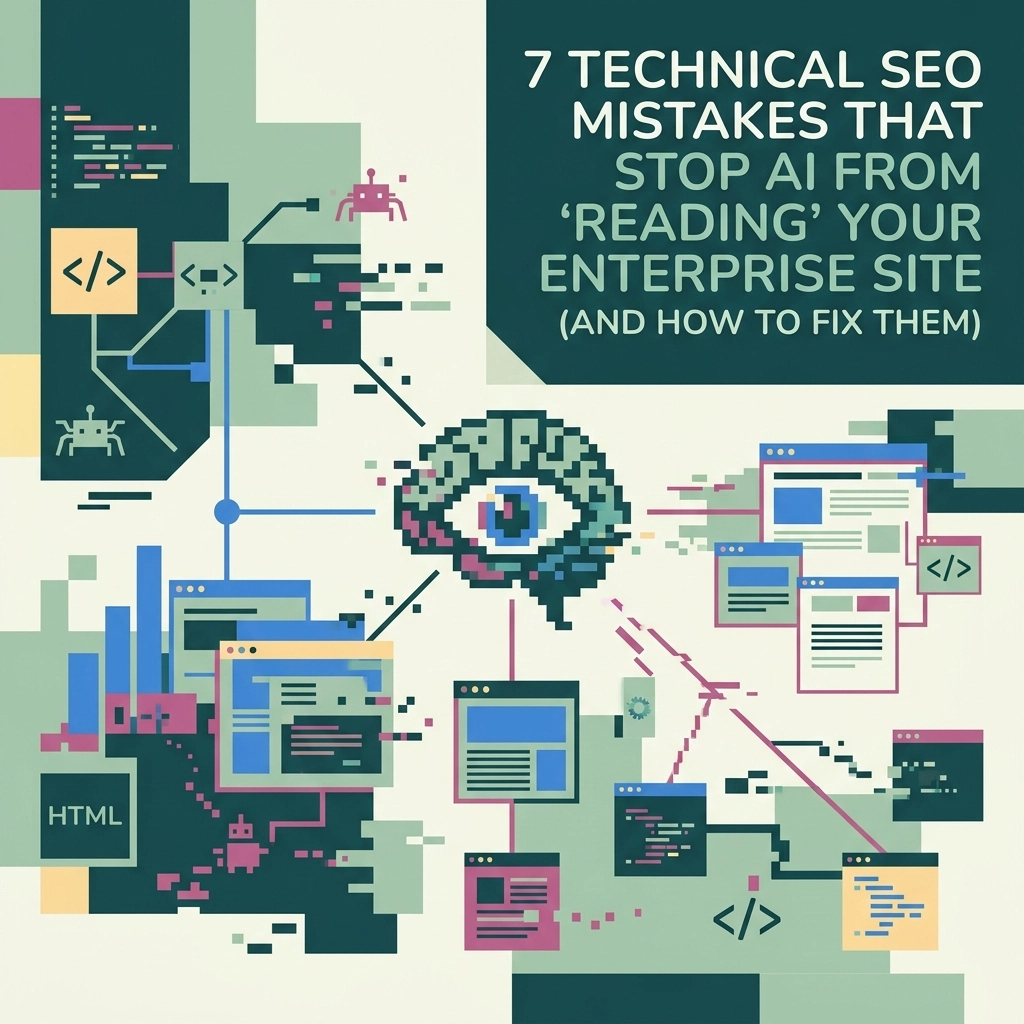
Let’s look at the seven technical SEO sins that are currently blinding the AI bots to your existence, and how we’re going to fix them.
1. The "Great Wall" of robots.txt
For years, the standard advice for government agencies and cautious B2B firms was to block everything that wasn't strictly necessary. "If we don't need it indexed, hide it," the IT department would say.
But in the era of AI, blocking "GPTBot" or "CCBot" in your robots.txt is the digital equivalent of locking your front door and wondering why the neighbors didn't come over for the BBQ.
The Mistake: Many enterprise sites are still using legacy robots.txt files that accidentally block AI crawlers from accessing the very data they need to cite you as an authority. I’ve seen cases where a single Disallow: / on a staging environment accidentally pushed to production, wiping out 95% of visibility in a weekend.
The Fix: Audit your robots.txt immediately. You need to ensure that you aren't blocking major AI agents unless you have a very specific, high-level PII (Personally Identifiable Information) reason to do so. If you want your agency’s services to be the "source of truth" for AI answers, you have to let the AI in to see the truth.

2. JavaScript Rendering: The Invisible Content Problem
I love a sleek, modern web app as much as the next guy. But if your enterprise site relies heavily on client-side JavaScript (React, Angular, Vue) to display its core content, you’re playing a dangerous game with AI.
The Mistake: LLM crawlers are getting better, but they still struggle with "heavy" JavaScript. If an AI bot has to wait 5 seconds for your "About Our Services" page to actually populate data from an API, it’s going to move on. To the bot, your page looks like a blank white screen.
The Fix: Move toward Server-Side Rendering (SSR) or dynamic rendering. This ensures that when the bot hits your URL, it gets a fully-baked HTML file immediately. For complex B2B and Gov sites, this is often the single biggest win for crawlability.
If you're wondering if your tech stack is holding you back, take a look at our Technical SEO Audit guide for 2026 to see where the bottlenecks usually hide.
3. The "Missing Labels" (Schema.org Markup)
Think of Schema.org markup as the "SparkNotes" for AI. It’s structured data that tells the bot exactly what it’s looking at without the bot having to guess.
The Mistake: Most organizations stop at basic breadcrumb schema. They completely ignore Organization and Service schemas. If you’re a government department providing "Low-Income Housing Assistance," and you don't have that explicitly defined in your Schema as a Service, the AI has to use its best guess to categorize you.
The Fix: Implement robust Service, FAQ, and Organization schema. This is especially critical for higher education. When a prospective student asks an AI, "What are the admission requirements for the Engineering program at X University?", the AI shouldn't have to hunt. It should pull that directly from your structured data.
4. Internal Linking: The Labyrinth vs. The Map
In large organizations, content often gets "orphaned." A PDF is uploaded to a subdirectory, linked once in a news release from 2019, and then forgotten.
The Mistake: AI bots follow paths. If your internal linking architecture is a mess of 404s, "click here" anchors, and deep-nested hierarchies, the bot will get lost. It will categorize your site as "unreliable" or "thin."
The Fix: Adopt a "flat" architecture where possible. No important piece of content, especially service-level data, should be more than three clicks from the homepage. Use descriptive, keyword-rich anchor text. Don’t just say "Download the report"; say "Download the [2026 State Budget Impact Report]."

5. Zombie Content and Low-Quality Data Signals
We’ve all seen it: the government site that still has a "New for 2012" banner on its homepage. Or the B2B site with 400 blog posts that are each 200 words long and offer zero value.
The Mistake: AI is trained to recognize quality. If 80% of your site is "Zombie Content", outdated, unvisited, and low-value, it drags down the perceived authority of your entire domain. It’s what I call "Data Poverty." You’re feeding the AI junk, so it assumes you are a junk source.
The Fix: It’s time for a digital prune. Delete the 2014 news releases. Consolidate thin pages. Focus on Data Sovereignty, owning and presenting only the most accurate, high-quality information. This isn't just about SEO; it's about not having an AI hallucinate an answer based on your ten-year-old broken data.
Check out our GA4 audit checklist to help identify which pages are actually performing and which are just dead weight.
6. Server Response Times: The Impatient Researcher
Speed has always been a ranking factor, but for AI interaction, it’s about more than just the user experience. It’s about "Crawl Budget."
The Mistake: Large enterprise sites often run on legacy servers that have the processing power of a potato. If your Time to First Byte (TTFB) is over 1 second, you’re burning through the bot's patience.
The Fix: Optimize your server response times. This often requires looking at your CMS (looking at you, bloated WordPress installs) and considering Server-Side Tagging. By moving the heavy lifting off the browser and onto the server, you speed up the site for both humans and bots.
I’ve written extensively about whether you need server-side tagging, and for government and B2B sites, the answer is almost always a resounding "Yes."
7. Core Web Vitals for 'AI Interaction' Speed
Wait, aren't Core Web Vitals for people? Yes, but they are also the benchmark for how efficiently a bot can parse your site's visual and structural elements.
The Mistake: Ignoring Interaction to Next Paint (INP) or Cumulative Layout Shift (CLS). If your site's layout jumps around while loading, it’s a sign of technical instability.
The Fix: Modernize your frontend. In 2026, AI "reading" speed is effectively the new SEO metric. If the AI can parse your data in 200ms vs. 2000ms, you win. It's that simple.

The Bottom Line
For my clients in government and higher ed, the idea of "fixing everything at once" is a non-starter. There’s too much bureaucracy and too few hands.
The Bottom Line
At MM Sanford, we don't believe in "tricking" search engines. That’s a loser’s game in the age of AI. Instead, we believe in Data Empowerment.
If you make your site the easiest, fastest, and most structured source of information in your niche, the AI will reward you by citing you as the expert. If you leave your technical debt to fester, don't be surprised when the bots start quoting your competitors instead.
Is your technical foundation ready for the AI era? If you aren't sure, it might be time to start with a GA4 audit to see what the data is actually telling you. Let's stop guessing and start building a site the bots: and your customers: will actually love.