Remember the "Golden Age" of SEO? You know, back in 2012 when you’d stuff a page with "Best MBA Programs" twenty times, buy a few sketchy backlinks, and wake up at the top of page one?
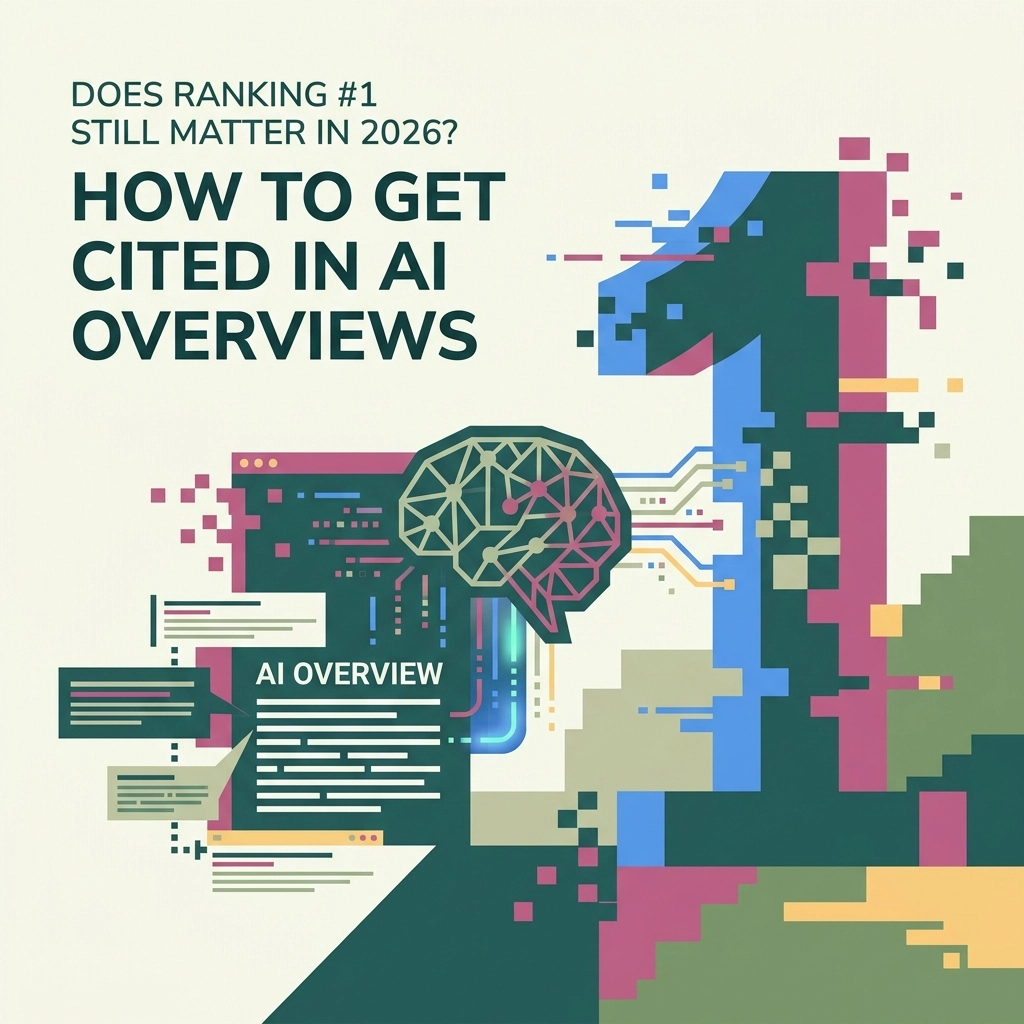
Fast forward to 2026. If you’re still obsessing over being the first blue link on the page, I’ve got some news that’s going to taste like lukewarm office coffee: Ranking #1 is no longer the finish line. In fact, it might not even be the podium.
With AI Overviews (SGE) dominating the top of the fold, the game has shifted from "How do I rank?" to "How do I become the source the AI trusts?"
Currently, over 80% of searches end without a single click. The AI reads your site, synthesizes an answer, and the user goes on their merry way. If your brand isn't the one being cited in that summary, you’re essentially a ghost in the machine.
Let’s talk about how to stop chasing vanity rankings and start winning the AI citation war.
The Zero-Click Reality: Why #1 is the New #10
The data doesn't lie, even if marketing gurus do. Recent studies show that 83% of searches including an AI Overview conclude without a click.
Think about a prospective student searching for "financial aid deadlines for state universities." In 2020, they’d click the first link. In 2026, the AI gives them a bulleted list of dates sourced from three different sites. If you’re one of those sources, your brand authority skyrockets. If you’re just the #1 organic link sitting below the fold? You’re invisible.
Here’s the kicker: 47% of AI Overview citations come from pages that aren't even in the top 5 organic results.
The AI doesn't care about your legacy backlink profile from 2018. It cares about Analytical Clarity and whether your content provides the "Ground Truth" for the query. To the AI, the most structured, authoritative answer wins, regardless of whether that page has the most "link juice."
E-E-A-T: The Only Currency That Still Scales
If you’ve heard me talk before, you know I have zero patience for "thin content." In 2026, thin content isn't just a nuisance; it’s digital suicide.
96% of all AI Overview citations come from sources demonstrating strong E-E-A-T (Experience, Expertise, Authoritativeness, and Trustworthiness). For my friends in Higher Ed and Government, this is actually your superpower. You have the experts. You have the data. You just suck at showing it to the algorithms.
How to Prove You’re the Expert:
- Entity Mapping: Stop thinking about keywords. Think about entities. Use Person Schema to link your faculty's research or your department heads' white papers to their professional profiles.
- Verified Affiliations: If you’re a government agency, your
.govor.orgstatus is a massive trust signal. But you need to back it up with Data Stewardship. Is your data consistent across all platforms? - The "Human in the Loop" Signal: AI models are increasingly trained to spot other AI content. To get cited, your content needs the "smell" of human experience, case studies, unique datasets, and nuanced opinions that a generic LLM can't hallucinate.
If you aren't sure if your technical foundation is supporting these trust signals, it’s probably time for a technical SEO audit.
Writing for the "Silicon Brain": Structure is Everything
LLMs (Large Language Models) are like very smart, very literal toddlers. They need you to hand-feed them information in a way they can easily digest. If your page is a wall of text with no hierarchy, the AI will skip you for a competitor who uses bullet points and clear headers.
The Semantic Completeness Framework
To get cited, your page needs a Semantic Completeness score higher than your competitors. This isn't about word count; it’s about covering the "intent journey."
Imagine a user looking for "how to file a state property tax appeal."
- Surface Level: "Here is the form." (Zero chance of being cited).
- Surgically Complete: "Here is the form, the 3 common reasons for denial, the 2026 deadline, and a video walkthrough of the filing portal."
Pages with high semantic completeness are 4.2 times more likely to be selected as the primary source for an AI Overview.
Data Stewardship and the "Broken Eyes" Problem
I see this every day: a massive organization spends $50k on a content strategy but has a broken GA4 implementation.
If your data is a mess, your "eyes" are broken. You can't see which content the AI is actually citing or where your users are dropping off after the zero-click interaction.
In 2026, Data Stewardship means owning the narrative of your performance. You need to move past "hits" and start looking at "Entity Visibility." Are people searching for your brand after seeing you in an AI Overview? That’s where the real ROI lives.
For complex organizations, this usually requires a proven GA4 implementation framework to ensure you’re actually measuring what matters.
Higher Ed & Gov: The Trust Advantage
Stop counting how many times "Digital Transformation" appears on your landing page. The AI knows what you’re trying to do. Instead, focus on Strategic Intent.
The Phased Roadmap for AI Visibility:
For my Higher Ed marketing directors: Your university is a "Ground Truth Entity." When an AI wants to explain a complex scientific concept or a policy shift, it wants to cite you.
But if your site is buried in a 2014 CMS with 404 errors and no Schema markup, the AI will cite a high-authority blog instead. Don't let a third-party site steal your expertise. Establish GTM governance so your team can deploy tracking and structure at scale without breaking the site every Tuesday.
The Bottom Line: Does Ranking #1 Matter?
Yes, but only as a signal of overall health. The real goal in 2026 is Omnipresence. You want to be the organic #1, the AI Citation, and the brand the user searches for by name five minutes later.
If you’re tired of playing "catch-up" with Google’s weekly updates and want a system that actually drives enrollment or service adoption, let’s talk. At MM Sanford, we don't just "do SEO." We build solutions that ensure your organization remains the authoritative voice in an AI-driven world.
Marketing in 2026 isn't about tricking a search engine. It's about being the most helpful, most structured, and most trustworthy source on the internet.
Are you the source, or are you just noise?
If you're worried your current setup isn't cutting it, check out our GA4 audit checklist for higher education to see where the holes are. Or, if you’re ready to stop guessing and start measuring, reach out to us directly.
Let's get your data: and your rankings: sorted.
Related reading: 5 Steps to Kill the PDF Trap: An AI-Readability Audit · 7 AI Discovery Strategy Mistakes · Trust Matters: 5 Ways to Build Authority Signals AI Cites · Why AI Citation Metrics Will Change SEO Reporting · SynthID & Content Credentials: The New SEO Trust Signal