You’ve spent the last decade perfecting your SEO. You’ve got the backlinks, the long-tail keywords, and a technical foundation that makes Google’s crawlers purr. But here is the hard truth: In 2026, being visible to Google doesn’t mean you exist to the systems actually making decisions for your customers.
We are moving past the era of the “Blue Link.” Your prospective students, your taxpayers, and your B2B buyers aren’t just scrolling through search results anymore. They are asking ChatGPT, Claude, and Perplexity for direct answers.
If your site isn’t architected for Large Language Models (LLMs), you are effectively invisible.
At MM Sanford, we’ve seen enterprise sites with millions of pages of “high-quality content” get completely bypassed by AI agents. Why? Because the site wasn’t built for discovery; it was built for ranking. Those are two very different things in a generative world.
The Shift from Indexing to Understanding
Traditional SEO is about matching strings. AI Discovery is about matching entities.
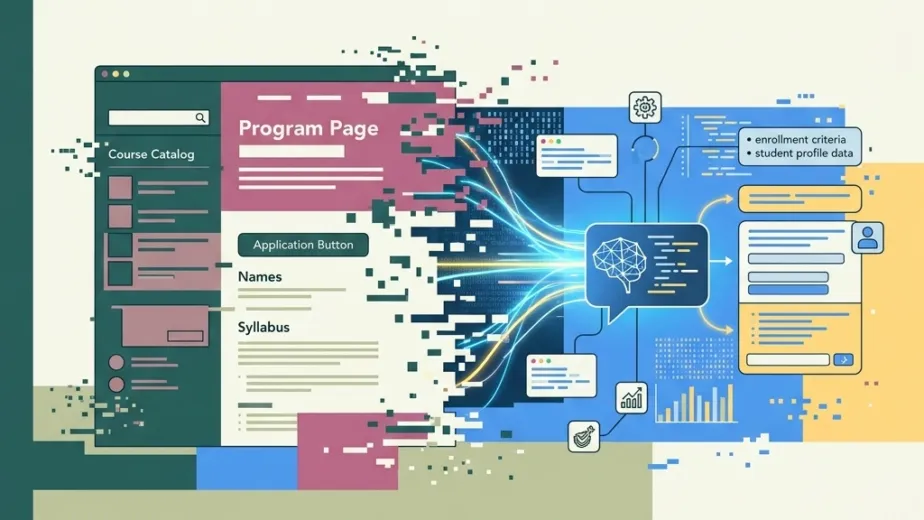
When an LLM “crawls” your site (or ingests the data training it), it isn’t just looking for keywords. It’s trying to build a knowledge graph of who you are, what you do, and whether you can be trusted. If your technical architecture is a mess of legacy code and unstructured data, the AI simply hallucinates a better competitor or leaves you out of the answer entirely.
I’ve seen this happen in the public sector specifically. A state tax department might have every form available online, but if the LLM can’t parse the relationship between “Form A-1” and “Small Business Filing Requirements,” the AI will tell the taxpayer it doesn’t know: or worse, give them the wrong information.
This isn’t a “content” problem. It’s a systems architecture problem.

Why Your Site is Currently a Ghost to AI
Most organizations are suffering from what I call “Legacy Data Inertia.” You have the information, but it’s trapped in formats that AI agents find indigestible. Here are the three main reasons your site is invisible:
1. The Schema Gap
Over 70% of enterprise sites have incomplete or broken schema markup. To a human, your “About Us” page looks like a biography. To an LLM, without proper JSON-LD, it’s just a wall of text. LLMs don’t guess. They require explicit, structured data to understand your business identity and credentials.
2. Information Fragmentation
In higher education, I often see “Siloed Knowledge.” The tuition rates are on one subdomain, the financial aid requirements are on another, and the ROI statistics are buried in a PDF. An AI agent trying to answer “Is this university worth the investment?” needs a cohesive information chain. If the links are broken or the data is inconsistent, the AI loses “confidence” in your entity.
3. Crawler Friction
Many large organizations, especially those with heavy security protocols, accidentally block the very AI agents they need to attract. If your robots.txt or your CDN’s firewall is treating GPTBot like a malicious scraper, you’re opting out of the future of search.
What an AI Discovery Audit Actually Involves
You can’t fix a decade of technical debt overnight, but the sequence matters. It starts with entity clarity: auditing your schema beyond basic “Organization” markup into specific types like “GovernmentService” or “Course,” checking that your robots.txt isn’t accidentally blocking the AI agents you actually want visiting, and making sure your name, address, and core mission are stated consistently everywhere instead of scattered across inconsistent versions.
Once the machines know who you are, the next stretch of work is making sure they understand what you actually know. That means stripping the marketing fluff that pads out most enterprise content, engineering genuinely structured FAQs (these aren’t just for human users anymore, they’re the fastest path to an AI-generated answer), and using internal links deliberately, so the site’s structure itself teaches the logic of how your topics relate to each other.
The final, and most future-facing, piece is treating your core data as something an API delivers rather than something buried in a page. Tax rates, tuition costs, service statuses, whatever your highest-stakes numbers are, become directly queryable rather than trapped in prose. Alongside that comes a genuine commitment to privacy-first analytics as you open the doors wider, and a feedback loop that tracks not just clicks but how often your site actually gets cited as a source in AI-generated answers.
Real-World Impact: Moving the Needle
I’ve heard the skeptics. “Marcus, why does this matter if I’m still getting Google traffic?”
It matters because the quality of the lead is shifting. We recently worked with a B2B consultancy that had a 1% MQL (Marketing Qualified Lead) rate. They were ranking for keywords, but they weren’t being “discovered” by AI agents used by procurement officers.
By performing an AI Discovery Audit and cleaning up their entity recognition, we didn’t just increase traffic: we increased the precision of the traffic. Within six months, their MQL rate jumped to 5%. Why? Because when a prospect asked an AI for a “consultancy that specializes in X with a proven track record in Y,” our client was the only one with the structured data to prove they fit the bill.
Data visibility is the new SEO.
The Tech Talent Gap and Organizational Inertia
I know the hurdles. If you’re in a state agency or a large university, you’re likely dealing with a tech talent gap. Your IT department is overworked, and your marketing team is still trying to figure out how to fix their GA4 data.
This is why you need a partner who understands the minutiae so you can stay focused on the high-level strategy. You don’t need to know how to write JSON-LD for “TaxRefundStatus.” You need a system that ensures that data is automatically surfaced to the AI world.
We specialize in taking the complex, “jargon-heavy” requirements of AI discovery and translating them into a roadmap your internal team can actually execute.
Stop Guessing. Start Auditing.
The decline of third-party cookies and the rise of generative AI aren’t just “trends.” They are a fundamental shift in how the internet functions. If you continue to treat your website as a digital brochure for humans only, you are leaving your most important “audience”: the algorithms that guide humans: in the dark.
Your site is either an open book for AI, or it’s a closed door.
Are you ready to find out which one it is? An AI Discovery Audit isn’t just a technical checkup; it’s a strategic necessity for any organization that wants to remain relevant in 2026 and beyond.
If you’re ready to bridge the gap between your data and the AI agents that want to use it, let’s talk. We can help you stop being invisible.
Key Takeaways for the Skimmers:
- Traditional SEO is insufficient: LLMs prioritize entities and structured data over keyword strings.
- Schema is the foundation: Without proper JSON-LD, your site is a “wall of text” to AI.
- Sequence matters: Establish entity clarity before investing in advanced API-level data integration.
- Business outcomes: Improving AI discovery can significantly increase MQL rates by capturing “high-intent” generative searches.
- Data Sovereignty: Ensure your organizational data is clean, accessible, and accurately represented.
Does your current strategy account for how ChatGPT sees your brand? If the answer is “I don’t know,” it’s time to reach out.
Related reading: LLM Governance 101: Mastering AI Crawler Controls · WebMCP & Browser Agents: The Next Technical SEO Standard · The Death of Autocomplete: Google’s New Agentic Search Box · Why Search Everywhere Optimization (GEO) Will Change SEO