The era of the “blue link” is effectively over. If you are a C-suite executive or a marketing director still measuring success primarily through organic sessions and click-through rates to your homepage, you are operating on a map of a world that no longer exists.
For twenty years, we’ve been trained to think of Google as a librarian: someone who points you to the right shelf so you can do the work yourself. But with the advent of agentic commerce, Google is firing the librarian and hiring a personal concierge. This concierge doesn’t just suggest a pair of boots; it checks your size, verifies they are in stock, compares the shipping times, and asks for your permission to buy them: all without you ever touching a merchant’s website.
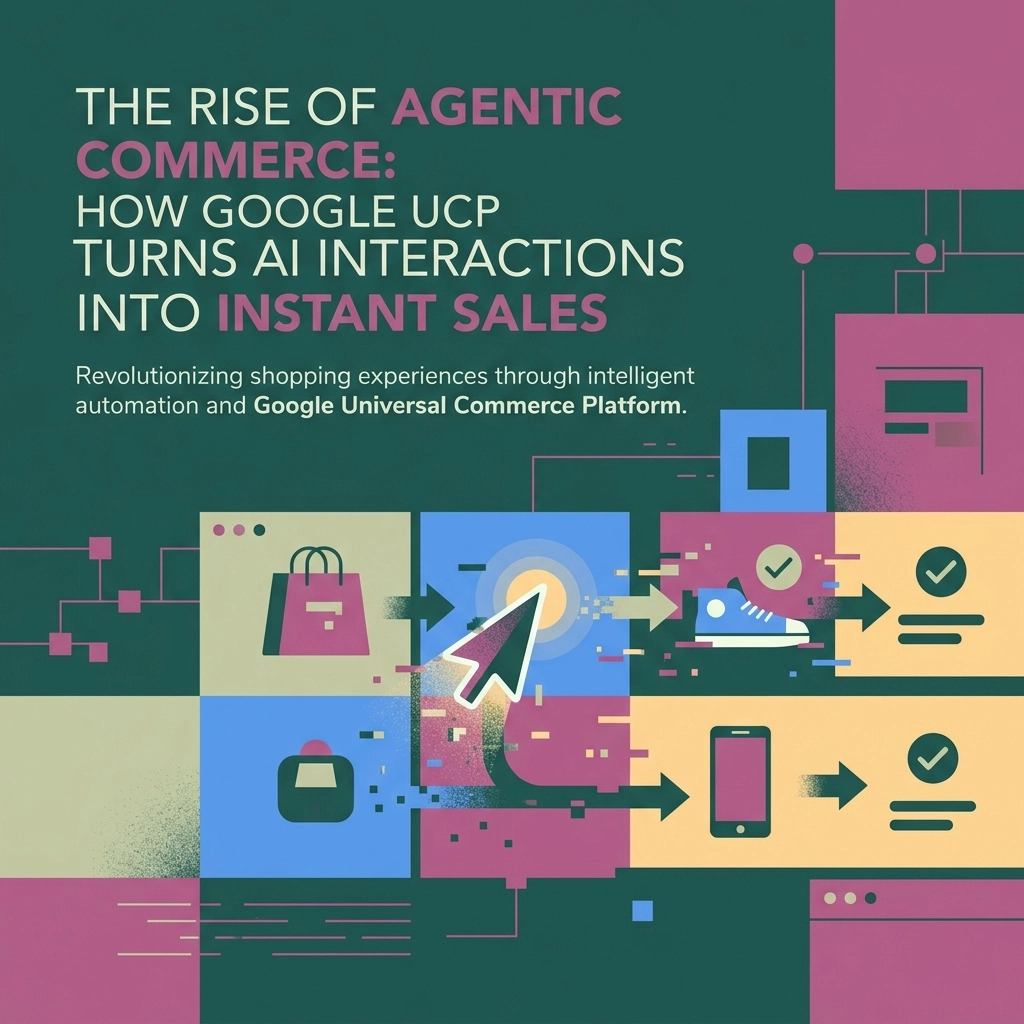
At the heart of this shift is the Google Universal Commerce Protocol (UCP). This isn’t just another technical update or a minor tweak to the Merchant Center. It is the fundamental infrastructure for a world where AI agents, not humans, are the primary “shoppers” on the web.
What is Agentic Commerce?
To understand why UCP matters, we first have to define the environment it inhabits. Agentic commerce is the transition from AI that talks to AI that acts.
In the old model (let’s call it 2023), you might ask an AI for “the best hiking boots for rainy weather.” The AI would spit out a list. You would then click a link, go to a site, add to a cart, and check out. In the agentic model, you tell your AI agent: “I need those boots by Friday for my trip, find the best price, and buy them using my preferred card.”
The agent evaluates the options, confirms the inventory, and executes the transaction. The consumer has delegated the task. This represents a massive psychological shift. We are moving away from the “Paradox of Choice”: where users are overwhelmed by options: and toward a “Delegate and Verify” model.
Enter the Google Universal Commerce Protocol (UCP)
Google UCP is the “common language” that allows this to happen at scale. For an AI agent (like Gemini) to actually perform a transaction, it needs more than just a scraped product description. it needs a structured, real-time, bi-directional flow of data.
UCP allows Google to:
- Understand exact product availability: No more “Out of Stock” disappointments after the user has already committed.
- Execute Native Checkout: Allowing the transaction to happen within the AI interface itself.
- Ensure Brand Consistency: Feeding the agent the exact specifications and brand narrative the merchant intends.
Without UCP, an agent is just a sophisticated search engine. With UCP, it becomes a Revenue Generator.

The 9x Conversion Reality
If you think this is a futuristic “maybe,” look at the data from the 2025 holiday season. Early adopters of agentic workflows saw conversion rates 9 times higher than traditional social media traffic.
Why? Because the friction was removed. Every click is a chance for a customer to change their mind. By moving the “Buy” button into the conversation, you aren’t just selling; you are solving a problem in real-time. This is where your SEO strategy must pivot. It’s no longer about ranking for “best boots”; it’s about being the most “agent-readable” provider of boots.
Why the C-Suite Cannot Ignore This
For the leadership at enterprise B2B firms, higher education institutions, or even government agencies, the “commerce” in agentic commerce isn’t always about a credit card transaction.
- In Higher Ed: Agentic commerce looks like a prospective student saying to their phone, “Find me a graduate engineering program within 50 miles that has a late application deadline and start the enrollment inquiry.”
- In Government: It looks like a citizen saying, “I need to renew my business license and pay the fee,” and the agent executing the payment through a secure UCP-compliant gateway.
- In B2B: It’s a procurement officer telling an agent to “reorder the usual HVAC filters at the best bulk rate available today.”
If your organization is not integrated into these protocols, you are invisible to the agents. And if you are invisible to the agents, you are invisible to the modern consumer.
Data Sovereignty and the Tech Talent Gap
One of the biggest hurdles I see, especially in government and large-scale B2B, is organizational inertia. There is a fear of losing “brand control” or “data sovereignty.”
I’ve always told my clients: You should own your data. UCP actually helps with this. It provides a standardized way to feed your data to AI without giving up the keys to the kingdom. However, the “speeds and feeds” aren’t the problem; the talent gap is. Most organizations are still struggling with basic technical SEO audit mistakes, let alone implementing bi-directional commerce protocols.

This is Part 1 of a 5-Part Series
We are just scratching the surface. Over the next few weeks, I’ll be diving deeper into the technical and strategic nuances of this revolution. Here is what we have on the horizon:
- The Rise of Agentic Commerce (You are here)
- Merchant of Record vs. AI Proxy: Why Google UCP is the “Safe Play” for Enterprise Brands.
- From “Blue Link” to “Buy Button”: The Architect’s Guide to Google UCP Integration.
- The Interoperability War: How Google UCP, AP2, and MCP are Building the Future of Shopping.
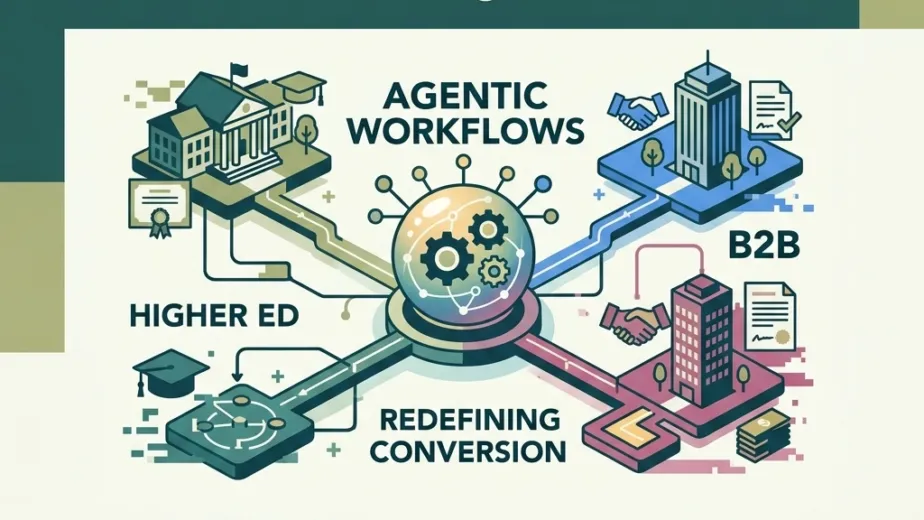
- Beyond the Cart: How Agentic Workflows are Redefining Conversion for Higher Ed and B2B.
The Bottom Line
The shift to agentic commerce is the most significant transformation since the invention of the shopping cart. It changes the role of the website from a “destination” to a “fulfillment engine.”
As a leader, you have to ask yourself: Is your digital presence designed to be looked at by humans, or to be used by agents? If the answer is only the former, your 2026 revenue projections are in serious trouble.
At MM Sanford, we help complex organizations navigate these technical shifts without losing sight of the business goal. We focus on the system, not just the software. If you’re ready to stop chasing “sessions” and start capturing “agentic actions,” let’s talk.
Key Takeaways for the Skimmers:
- Agentic Commerce is when AI agents perform transactions on behalf of users.
- Google UCP is the essential protocol that enables this within the Google/Gemini ecosystem.
- Conversion rates for AI-driven traffic are significantly higher due to reduced friction.
- Strategy must shift from attracting clicks to being “agent-executable.”
- B2B and Higher Ed must look past “retail” to see how this applies to enrollment and procurement.

Are you prepared for a world where your customer never sees your website? It’s time to find out. Check out our solutions to see how we can help you build a data-driven foundation for this new era.