If you’re an Executive Director at a government agency or a Marketing VP at a university, I’m willing to bet your inbox is a graveyard for 40-page SEO reports that nobody actually reads.
You know the ones. They’re filled with “speeds and feeds”: lists of keywords, technical jargon about canonical tags, and graphs showing “impressions” that don’t seem to correlate with your actual business goals.
Most agencies treat SEO reporting like a “contact grab.” They dump a bucket of data on your desk to prove they’ve been “working,” hoping the sheer volume of charts will distract you from the fact that they aren’t moving the needle on your mission-critical KPIs.
Here’s the blunt truth: If your SEO report doesn’t help you make a budget decision in five minutes or less, it’s not a report: it’s digital white noise.
In complex organizations: where you’re dealing with technical debt, organizational inertia, and a massive tech talent gap: you need a different approach. You need data visibility that acts as a launching pad for customer experience, not just a way to track Google’s whims.
The 10,000-Foot View: Why Most Enterprise Reporting Fails
In large-scale environments like state agencies or B2B giants, the website isn’t just a marketing tool; it’s a service delivery platform.
When a citizen visits a Department of Revenue site to find a tax form, or a prospective student tries to navigate a university’s financial aid portal, SEO is the bridge between their need and your solution.
Most reporting fails because it stops at the click.
We live in an era where AI-ready technical SEO is the new baseline. If your reporting doesn’t account for how Large Language Models are citing your site, or how your 2MB page-load “mistakes” are killing conversions, you’re looking at a map of the world from 1998.
The Paradox of Choice in Analytics
We have more data than ever, especially with Google Analytics 4 (GA4). But for many executives, GA4 has become a source of anxiety rather than insight.
I’ve seen organizations with a dozen different departments, each looking at a different version of “the truth.” This lacks Data Sovereignty. If you don’t own your data and understand exactly how it’s being collected and translated into human-readable insights, you’re flying blind.

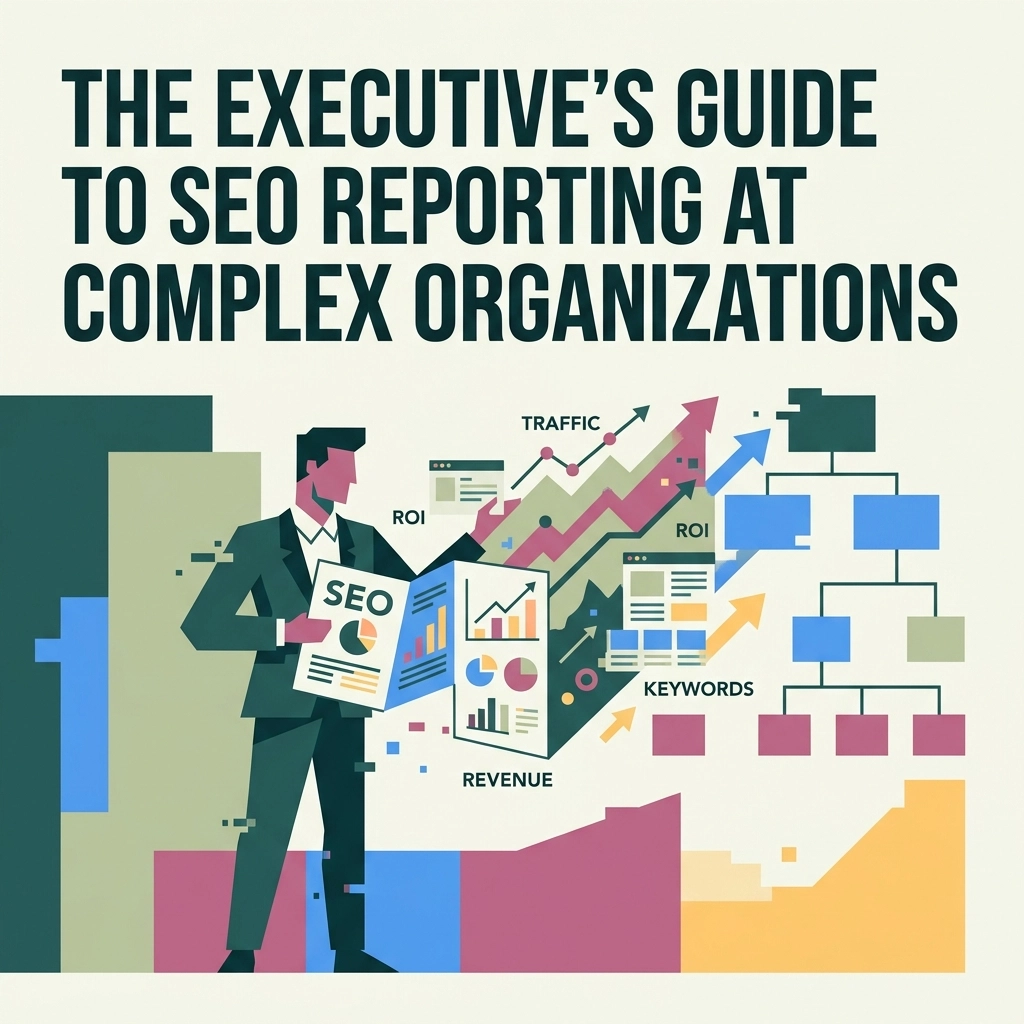
Caption: Effective SEO reporting bridges the gap between technical metrics and executive-level business outcomes.
What “Tracking Mission Queries” Actually Looks Like
This is the concept that matters most in this whole piece, so it’s worth making concrete instead of abstract. A “Mission Query” is the specific, high-stakes search a real constituent types when they need your service, not a generic keyword. For a state agency, that’s the difference between optimizing for the word “license” (broad, low-intent, full of competitors and news articles) and optimizing for “how to renew a commercial driver’s license after it expires” (narrow, high-intent, exactly what a real person in a real situation types).
A useful executive dashboard tracks a short list of these mission queries by name, shows current ranking position, shows whether the page is actually being indexed at all, and shows the conversion or completion rate for whoever lands on it. That’s five or six rows, not five hundred. It’s a report you can read in the time it takes to get coffee, and every row maps directly to a service outcome your board already cares about.
The “Executive Summary” Template: What You Should Actually See
If I were sitting in your chair, these are the only three things I’d want to see on page one of any SEO report:
- Mission Impact: How did organic search contribute to our primary goal? (Enrollments, applications, sales, or service completions).
- Efficiency Metrics: What is our organic Cost-Per-Acquisition compared to our paid channels? (This is how you justify your SEO budget to the board).
- The “Roadblock” Update: What technical debt or organizational hurdle is currently slowing us down?
Bold Take: Stop sending PDFs. Static documents are where data goes to die. Your agency should provide a live, human-readable dashboard that updates in real-time. If you have to ask “What does this number mean?”, the dashboard has failed.
Addressing Privacy, PII, and Organizational Inertia
I work with a lot of government and B2B clients who are (rightfully) terrified of privacy violations. With the decline of third-party cookies and the rise of strict PII (Personally Identifiable Information) mandates, your reporting system must be “Privacy First.”
Marketing software is secondary to your process.
Whether you use HubSpot, Marketo, or a custom government solution, the tool won’t save you from a bad strategy. You need a system that respects user privacy while still giving you the aggregate data needed to make decisions.
Often, the biggest hurdle isn’t the technology: it’s organizational inertia. The “we’ve always done it this way” mentality. My role as a consultant is often to act as the “Surgical Optimizer,” cutting through the bureaucracy to implement systems that work despite the red tape.
Framing Analytics as Customer Experience
We need to stop thinking about SEO as “ranking for keywords” and start thinking about it as Data Visibility for CX.
If a citizen can’t find the “Property Tax Relief” page because the search results are cluttered with old, irrelevant PDFs from 2014, that is a failure of both SEO and Customer Experience.
By cleaning up your technical SEO: removing the “2MB mistakes,” fixing broken internal links, and ensuring your schema markup is AI-ready: you aren’t just pleasing a search engine. You’re making your organization more accessible to the people you serve.
Comparison: The Tool vs. The System
| Feature | The “Factory Agency” Approach | The MM Sanford System |
|---|---|---|
| Focus | Keyword rankings & “impressions” | Mission-driven KPIs & ROI |
| Delivery | Monthly 40-page static PDF | Live, human-readable dashboards |
| Strategy | “More is better” (Thin content) | Quality, value, and technical precision |
| Data | They own the accounts | You own the data (Data Sovereignty) |

Caption: A screenshot of the MM Sanford logo, representing a partner focused on technical clarity and business outcomes.
The Bottom Line
SEO for complex organizations isn’t about magic tricks or “gaming the algorithm.” It’s about building a robust, technical foundation that allows your content to be found, understood, and utilized by both humans and machines.
If your current reporting feels like a chore to read, it’s time to demand more. You deserve a partner who speaks your language: the language of business outcomes, not “speeds and feeds.”
Ready to stop guessing and start seeing?
If you’re tired of the “factory” approach and want a technical SEO strategy that actually moves the needle for your agency or institution, let’s talk. I specialize in untangling the mess of large-scale analytics and turning it into a strategic asset.
No jargon. No fluff. Just the data you need to lead.
What’s your current reporting system? Does it help you make decisions, or is it just another item on your “to-do” list that you never quite get to? I’d love to hear your thoughts on how your organization handles data visibility.