

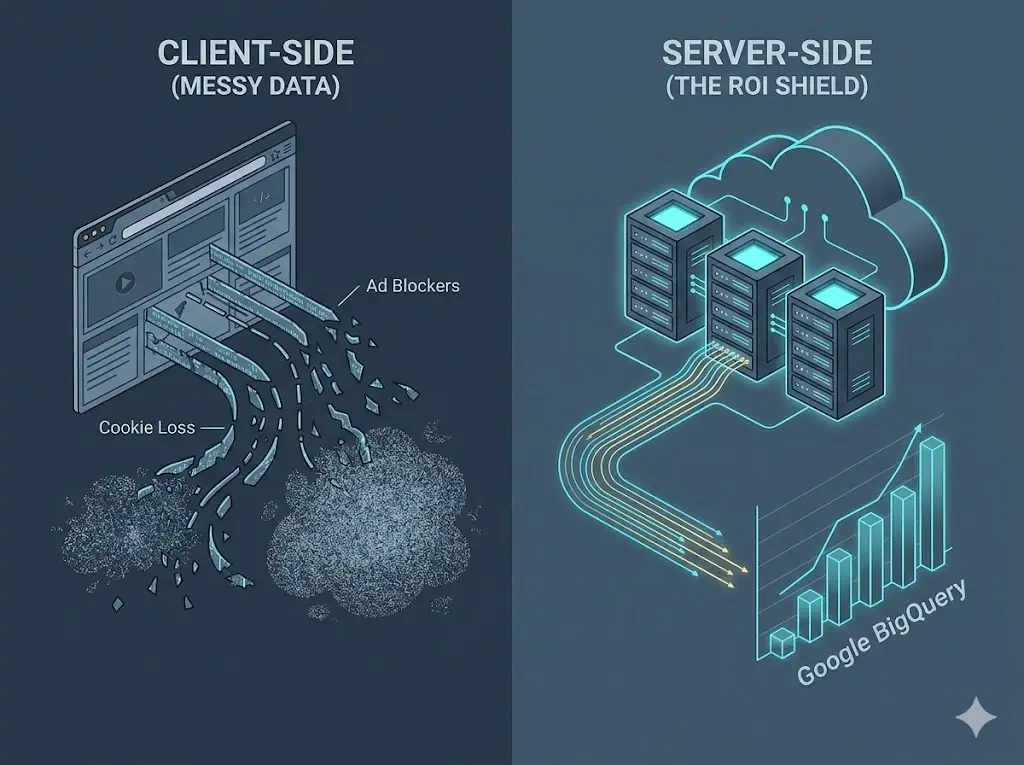
In the current digital landscape, “stock” analytics are lying to you. Between cookie deprecation and the rise of privacy-first browsing, client-side tracking (the old way) is losing up to 30% of your conversion data. For a high-stakes business, that 30% isn’t just a margin of error — it’s the difference between scaling a winner and killing a profitable campaign.
Why the Browser Can’t Be Trusted With Your Data Anymore
Client-side tracking asks a stranger to do your accounting. Every time a tag fires from a user’s browser, it has to survive ad blockers, Safari’s Intelligent Tracking Prevention, corporate network firewalls, and increasingly aggressive browser-level cookie restrictions. Each of those is a chance for a real conversion to simply vanish from your reporting before it ever reaches GA4.
This isn’t a rounding error. If a channel’s true conversion rate is 4% but your browser-side tracking only captures 2.8%, you’ll systematically underfund that channel every budget cycle — not because it’s underperforming, but because your instrumentation can’t see it clearly.
1. Moving Beyond the “Noise”
Most brands are drowning in data but starving for insights. Server-side tracking moves the data collection process from the user’s messy browser to a controlled server environment you own.
- Faster Site Speeds: By removing heavy tracking scripts from the browser, you reduce “Technical Debt” and shave real milliseconds off load time — which matters for Core Web Vitals and for users on slower connections.
- Cleaner Data: You bypass ad-blockers that skew your reporting, since the browser is now talking to your own domain instead of directly to a dozen third-party trackers.
- Security: You control exactly what data is sent to third parties like Meta or Google — including stripping PII before it ever leaves your infrastructure.
2. How This Actually Fixes Attribution, Not Just Data Loss
Here’s the part most explanations skip: server-side tracking doesn’t just recover lost events, it changes what’s possible for attribution modeling entirely.
When every touchpoint routes through your own server before reaching GA4, you can attach a consistent, first-party identifier to a user’s session that survives longer than a browser cookie ever could. That means a visitor who reads a blog post in January and converts in March can actually be connected in your data, instead of showing up as two disconnected “new users.” Without that continuity, GA4’s Data-Driven Attribution model is working from an incomplete map — it can only credit the touchpoints it actually saw.
The Power of BigQuery Integration is where this becomes strategic rather than just technical. By piping your server-side data directly into BigQuery, you transform static reports into a queryable asset. This allows for Python-based automation that can predict customer churn, model multi-touch attribution on your own terms instead of Google’s default logic, or identify “Qualified Leads” before they even fill out a contact form.
3. What Implementation Actually Involves
This isn’t a plugin toggle. A real server-side setup requires a hosted tagging server (typically on Google Cloud or AWS), a subdomain configured to route traffic through it, and someone who understands how to map your existing client-side tags to their server-side equivalents without breaking historical data continuity. Budget for both the infrastructure cost (usually modest — a few hundred dollars a month for most mid-size sites) and the setup time, which is measured in weeks, not hours.
The organizations that get the most value from this aren’t necessarily the biggest — they’re the ones already running paid campaigns at a scale where a 20-30% improvement in data completeness changes actual budget decisions.
4. Precision Over Volume
We don’t optimize for clicks; we optimize for profit. When your tracking is surgical, your “ROI Shield” is strong. You stop guessing which keywords work and start seeing the full path to conversion.
The Question: Is your current reporting giving you a “single source of truth,” or are you still making decisions based on fragmented browser data?