If you walk into any marketing department today, you’ll likely see a “Tech Stack” that looks like a NASA control room. There’s a subscription for keyword research, another for rank tracking, a third for “AI-driven” content optimization, and a massive CRM tying it all together.
But here is the hard truth: Your tools are not your strategy.
In over two decades of consulting for government agencies, higher education, and B2B firms, I have seen a recurring pattern. Organizations buy the most expensive tools on the market, hoping the software will provide the answers. They expect the tool to tell them what to do, only to end up with a dashboard full of green checkmarks and a bottom line that hasn’t budged.
We are living in a world of “Tool-First Marketing,” and it is failing your business goals. It’s time to take a 10,000-foot view of why this happens and how to fix it.
The Paradox of Choice in MarTech
The “Paradox of Choice” is a psychological phenomenon where having too many options actually leads to anxiety and paralysis rather than freedom. In the SEO world, this manifests as “Feature Bloat.”
Whether you are using Semrush, Ahrefs, or Moz, 99% of these tools offer the exact same features. They all crawl the web, they all estimate search volume, and they all give you a “technical health score.”
When you have access to 500 different metrics, which one do you prioritize? Most teams default to the easiest ones to track, like “Organic Rankings” or “Domain Authority”, rather than the ones that actually drive revenue or student enrollments.
The tool doesn’t know your business goals. It doesn’t know that a state tax department needs to reduce call center volume by improving “how-to” content visibility. It doesn’t know that a B2B firm needs high-intent leads, not just 100,000 random visitors.

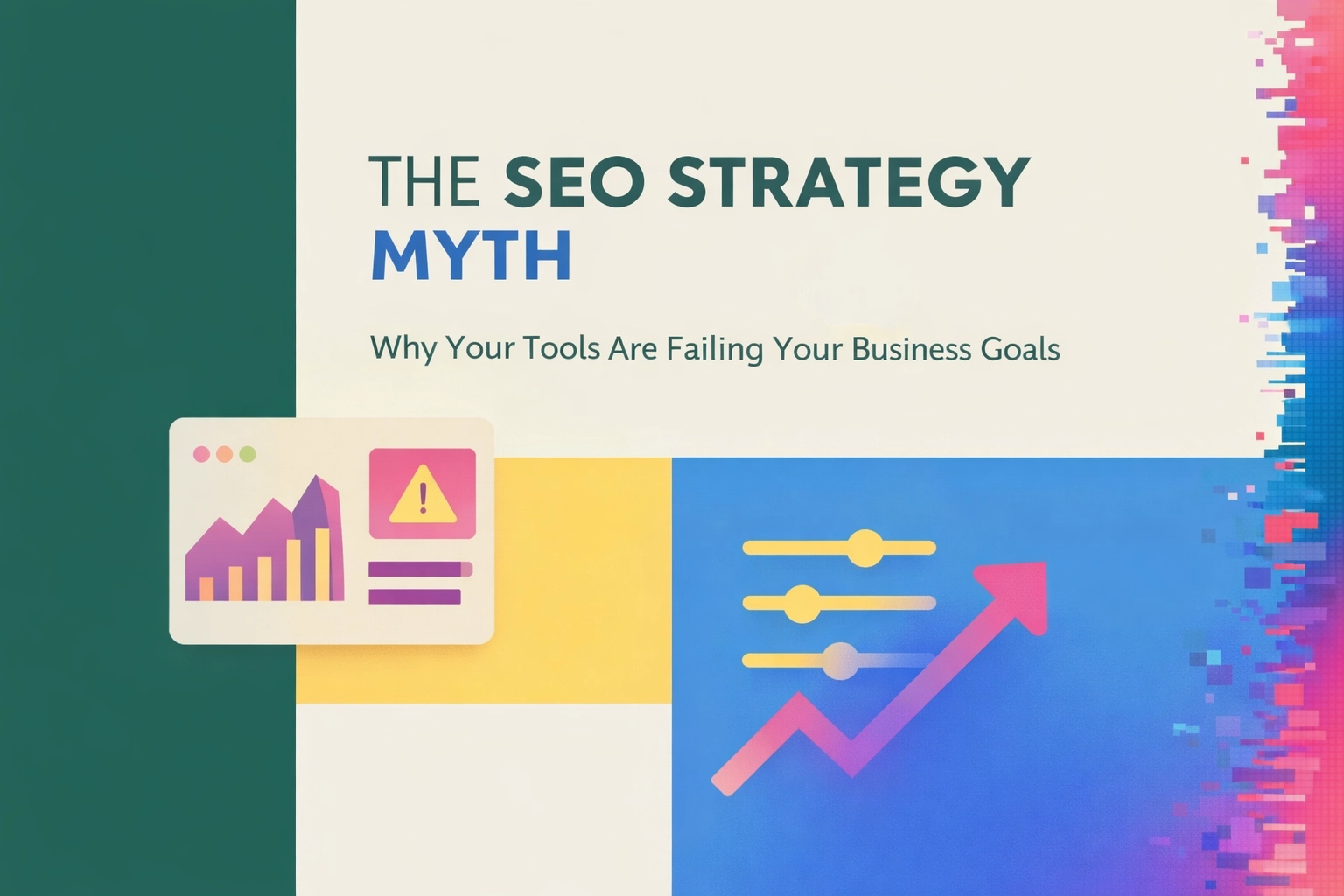
Caption: When your “strategy” is just dashboards, the signal gets buried under the noise.
Why Tools are Commodities (and Systems are Assets)
I often tell my clients that arguing over which SEO tool is “best” is like arguing over which brand of hammer built a house. The hammer is a commodity. The blueprint and the skill of the carpenter are the assets.
If your “SEO strategy” consists of exporting a PDF report from a tool and emailing it to your boss, you don’t have a strategy. You have a clerical task.
A real SEO strategy is a system. It’s a repeatable process that aligns search intent with the buyer’s journey. It’s about:
- Understanding the psychological triggers of your audience.
- Mapping content to specific decision-making stages.
- Ensuring your data visibility is actually “human-readable.”
When I work with an IT Services firm, we don’t start with keywords. We start with the business objective: “We need to increase MQLs (Marketing Qualified Leads).” By moving away from tool-driven “vanity metrics” and toward a systematic approach, I’ve seen clients improve their MQL rates from less than 1% to over 5%.
That didn’t happen because we bought a new tool. It happened because we fixed the system.
The Tech Talent Gap and Organizational Inertia
In the government and higher education sectors, there is a massive “Tech Talent Gap.” Organizations often have the budget for software, but they lack the internal bandwidth to interpret the data.
This leads to organizational inertia. Because the team is overwhelmed by the complexity of tools like GA4 or enterprise SEO platforms, they do nothing. Or worse, they do the wrong things because a tool told them their “Optimization Score” was low.
This is where a specialized SEO consultant adds value.
Your job as a leader is to focus on the high-level business goals. You should be worried about market positioning and mission-critical outcomes. You should not be spending four hours a week trying to figure out why your “Core Web Vitals” dropped by 2 points.
Leave the technical heavy lifting and the minutiae of SEO reporting to a partner who lives in that world.
What a Systems-First Approach Actually Looks Like
Here’s the difference in practice, not theory. A tools-first team opens Semrush, sees “Core Web Vitals: 62/100,” and spends a sprint chasing that number up. A systems-first team asks first: which pages on this site are actually costing us enrollments or leads right now, and is speed even the reason? Sometimes it is. Often the real leak is three clicks upstream of anything a crawler tool measures, in a confusing navigation structure or a form that asks for information nobody wants to give.
The tool will never ask that question, because the tool doesn’t know your business. It only knows what it can crawl. Your job, before you open any dashboard, is to write down in one sentence what outcome you’re actually trying to move, then let that sentence decide which of the tool’s 500 metrics are worth looking at this month and which 496 can wait.
That’s not a phase you complete once. It’s the filter you run every tool, every report, and every “optimization opportunity” through, indefinitely. Establishing data sovereignty, catching a broken GA4 setup before it poisons a quarter of decisions, mapping the buyer’s actual path instead of the one a keyword tool assumes: none of that is a “phase” you finish and move past. It’s the standing discipline underneath every tactical choice you make afterward.
Don’t Be an “Average” Marketer
The world is full of “average” marketers who are happy to hide behind a wall of jargon and complicated dashboards. They use tools as a shield so they don’t have to be accountable for actual business results.
Don’t be that person.
Be the “Innovative Marketer” who understands that the marketing value proposition of your organization is built on trust and value, not just “ranking #1.” If you provide genuine value to a visitor at the exact moment they need it, the search engines will eventually find you.
But if you write low-quality, AI-generated fluff just because a tool told you it has a high “SEO Score,” you are contributing to the noise that everyone, myself included, openly despises.
Staying Focused on the 10,000-Foot Level
As we move further into 2026, the complexity of the digital landscape is only going to increase. Privacy concerns (PII), the disappearance of cookies, and the rise of “Zero-Click” searches mean that your strategy has to be more robust than ever.
Tools are failing you because they are looking at the past. They are looking at what worked for someone else’s site last month. A strategy, however, looks at your specific customers and your specific goals for the next year.
If you’re feeling overwhelmed by the “speeds and feeds” of your current marketing efforts, step back. Ask yourself: “If I lost access to all my SEO tools today, would I still know how to reach my customers?”
If the answer is no, you don’t have a strategy. You have a subscription.
Ready to Move Beyond the Tools?
If you are tired of “average” results and want a system that actually aligns with your organizational goals, let’s talk. Whether you are a government agency dealing with organizational inertia or a higher ed institution trying to hit enrollment targets, I can help you build a roadmap that makes sense.
Feel free to contact me. I’m happy to walk you through a strategic approach that puts your business goals first and the tools where they belong: in the backseat.