If you’ve logged into GA4 recently and felt a pit in your stomach looking at your organic search trends, you aren’t alone.
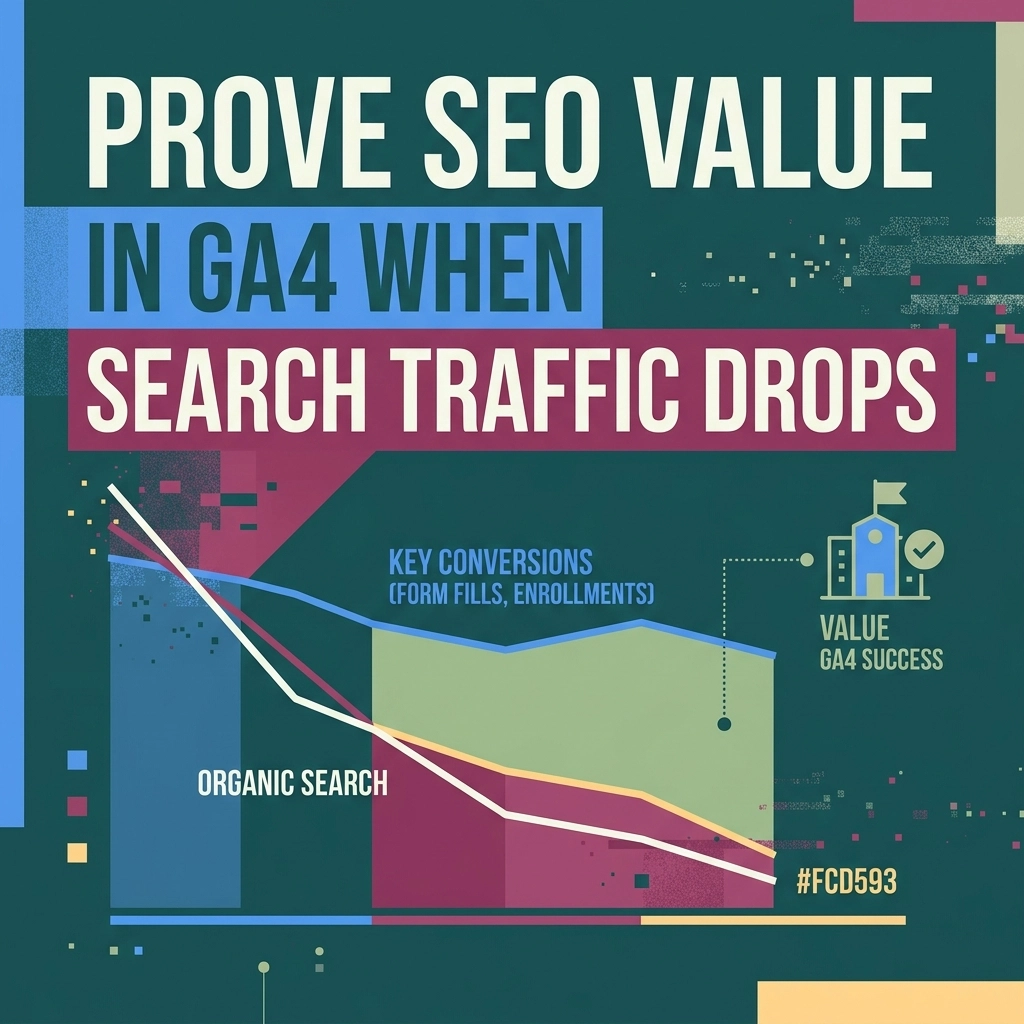
Across higher education and government sectors, we are seeing what I call the “Search Traffic Cliff.” On paper, it looks like your SEO strategy is failing. Total sessions are down, users from search are dwindling, and the “Green Up Arrow” we all love has turned into a stubborn red decline.
But here is the reality I’ve seen after 20 years in this game: Your SEO isn’t necessarily failing; your measurement of it is just outdated.
In 2026, the way people interact with Google has fundamentally shifted. Between AI Overviews (SGE) taking up the prime real estate and GA4’s aggressive bot filtering, the old “more clicks = more success” formula is broken.
If you are a marketing director at a university or a digital lead for a state agency, you need to stop defending “clicks” and start proving value. Here is how we do that when the traditional numbers are heading south.
The Reality of the 2026 “Search Traffic Cliff”
Let’s be blunt: Google is no longer a phone book; it’s an answering machine.
Research shows that Google’s AI Overviews now appear for nearly 47% of search queries. When those AI summaries pop up, the top organic result: the one you worked so hard to get: sees an average 34.5% drop in click-through rate.
People are getting their answers (like “When is the FAFSA deadline?” or “How do I renew my driver’s license?”) directly on the search results page. This is the Zero-Click Search reality.
If your stakeholders only care about traffic volume, you are going to lose the budget battle. You have to pivot the conversation to influence and intent.

Step 1: Validate GA4 Against Search Console
The first thing I do during a technical SEO audit is compare GA4 data with Google Search Console (GSC).
GA4 measures sessions (what happens on your site). GSC measures visibility (what happens on Google).
If your GA4 sessions are down 20%, but your GSC impressions and average position are steady or increasing, you haven’t lost your SEO authority. You’ve simply lost the “curiosity click.” The people who do click through are now higher-intent users who need more than just a quick AI summary.
Key Takeaway: If visibility is high but clicks are low, your content is likely being used to train or inform the AI Overview. You are still the authoritative source; you’re just providing the value “off-campus.”
Step 2: Account for the “GA4 Cleanliness” Tax
Many government and higher ed teams transitioned to GA4 and saw an immediate drop in traffic compared to the old Universal Analytics (UA).
It’s not you; it’s the bots.
GA4 has much stricter, automatic bot filtering. UA was notorious for counting “ghost traffic” and sophisticated scrapers as organic sessions. When you move to GA4, that “junk” is stripped away.
I often tell my clients that lower GA4 numbers often reflect improved data quality, not worse performance. You are finally seeing the humans, not the machines. If you haven’t verified your setup lately, you might want to check the 7 signs your GA4 data is broken.
Step 3: Shift Focus to Assisted Conversions and Key Events
In a complex environment like a university or a government agency, the “first click” rarely tells the whole story.
A prospective student might search for “best environmental science programs,” read an AI overview that cites your university, and then come back three days later via Direct traffic to apply. In a traditional report, SEO gets zero credit for that application.
In GA4, you need to look at Assisted Conversions (now often tracked through the Advertising research reports and Attribution settings).
How to Prove Value with “Key Events”
Stop reporting on “Sessions.” Start reporting on Key Events (the GA4 term for Conversions).
- Define the Value: Is it a PDF download of a tax form? An “Apply Now” button click? A newsletter sign-up?
- Use Path Exploration: Show your board how many users started with an Organic Search, left, and returned via Direct or Email to complete a task.
When you show that Organic Search initiated 40% of your high-value actions: even if it didn’t finish them: the traffic drop becomes a footnote.

Step 4: The Case for Brand Sentiment and Direct Traffic
In the Zero-Click era, SEO builds Brand Authority.
When a citizen searches for “How to start a small business in [State]” and your agency’s advice appears in the AI Overview, you’ve built trust. They might not click today, but next week, they will type your URL directly into the browser.
Look for a correlation between declining Organic Search traffic and rising Direct traffic.
If your “Direct” traffic is spiking while “Search” is dipping, that’s often a sign that your SEO and content strategy are working so well that people now remember who you are. They are skipping the middleman (Google) because you’ve established yourself as the primary resource.
How to Actually Say This in a Board Meeting
Here’s the actual language that works when a Dean or a board member sees a red arrow: don’t lead with the traffic number at all. Lead with, “Impressions are up 10%, and the visitors we do get convert at a higher rate than last year, here’s why fewer, higher-intent visitors is the win.” Show the Search Console screenshot before the GA4 screenshot. Most stakeholders panic at the first chart they see in a meeting; make sure the first chart is the one that tells the true story, not the one that happens to load first in your usual dashboard export.
Real-World Scenario: The University Admissions “Cliff”
Imagine a mid-sized university. Organic traffic to the “Programs” pages is down 15% year-over-year. The Dean is worried.
Upon digging into GA4, we find:
- Search Console Impressions are UP 10%: The school is appearing more often for high-value keywords.
- Key Events (Inquiry Forms) are UP 5%: Even with less traffic, the visitors coming through are higher quality.
- Assisted Conversions: 60% of students who applied interacted with an “Organic Search” result at some point in their 30-day journey.
The Verdict: The SEO strategy is actually more effective than last year. It’s filtering out the “window shoppers” and delivering the “buyers.”
Stop Fighting the Machine, Start Feeding It
As we move deeper into 2026, the goal of SEO isn’t just to get a click; it’s to be the source of truth.
Whether you are managing a government portal or a higher ed site, you have to accept that Google is changing. Your value is no longer in how many people you can force onto your homepage, but in how many people you can successfully serve: wherever they happen to be.
If you’re struggling to make sense of your GA4 data or need a roadmap to navigate the “Search Traffic Cliff,” let’s talk. I’ve spent two decades translating “speeds and feeds” into actual business outcomes, and I can help your team do the same.
Don’t let a red arrow in a dashboard distract you from the actual mission. SEO isn’t dying; it’s just growing up. Are your reports growing up with it?