If you’ve spent any time looking at your organic search traffic lately, you’ve probably felt a slight twinge of existential dread.
The old playbook: where you’d build a clean Program Page, sprinkle in some “Best Master’s in Data Science” keywords, and wait for the leads to roll in: is officially broken. It’s April 2026, and the search landscape looks more like a high-stakes conversation than a list of blue links.
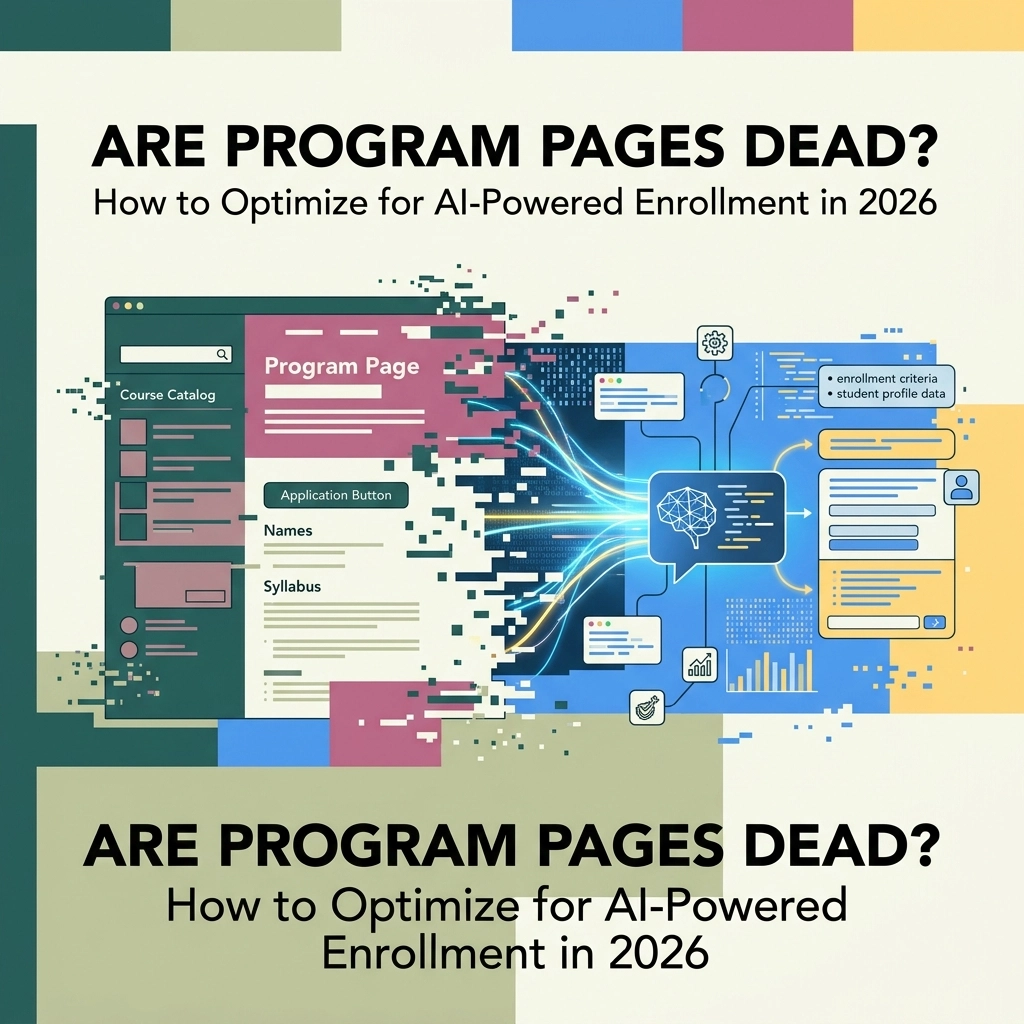
With AI Overviews (formerly SGE) dominating the top of every Google search and LLMs like Perplexity and Claude becoming the go-to “counselors” for prospective students, a terrifying question is circulating in Higher Ed boardrooms: Are program pages dead?
The short answer is no. But the version of the program page you’ve been clinging to since 2018? That’s definitely in the morgue.
If you’re a marketing director or an executive at a complex institution, you don’t need more “tips” on keyword density. You need a survival strategy for a world where “ranking #1” is secondary to “being cited by the AI.”
The Great Disruption: From “Ranking” to “Being Cited”
For twenty years, we played the ranking game. We optimized for the Google bot. But in 2026, the game has shifted. Prospective students aren’t just typing in “MBA programs near me.” They’re asking AI: “Which part-time MBA programs in the Pacific Northwest have the highest ROI for mid-career engineers and offer a hybrid schedule?”
If your program page is just a wall of marketing fluff and a “Apply Now” button, the AI is going to skip right over you.
The businesses and institutions that survive this transition are the ones that stop thinking about pageviews and start thinking about being an authoritative data source.
When an AI answers a student’s query, it has to get that information from somewhere. If your technical SEO is a mess, you aren’t even in the conversation. You’re essentially invisible to the very systems that are now gatekeeping 65% of all search traffic.

The Technical Reality: LLMs Are Your New Primary Audience
I’ve said it before: tools like GA4 or your shiny new CMS are useless without a strategic goal. In 2026, that goal is Data Sovereignty. You need to own your data and present it in a way that machines can actually digest.
Most Higher Ed sites are, frankly, a technical nightmare. They are bloated, slow, and full of “just-in-case” content that confuses both humans and crawlers. If your site is suffering from the liability of “just-in-case”, you’re effectively handing your enrollment numbers to your competitors.
Here is how you optimize for the AI-powered enrollment cycle:
1. Schema is the New Copywriting
In the past, Schema markup was a “nice to have” for getting star ratings in search results. Today, it’s the primary way you communicate with Large Language Models (LLMs).
You need robust, nested Schema for:
- Course/Program details: Credits, tuition, start dates, and prerequisites.
- Organization/Entity: Establishing your institution as a verified, high-authority entity.
- FAQ Schema: Directly feeding the answers that AI Overviews love to scrape.
If you aren’t sure where your technical foundations stand, you’re likely ignoring things large organizations can’t afford to miss in 2026.
2. The Death of the “Thin” Program Page
The “factory” agencies will tell you to spin up 500 program pages with slightly different keywords. This is a trap. AI is now incredibly good at spotting thin, low-value content.
If your page doesn’t offer more depth than a ChatGPT summary, why should anyone visit it? Your program pages need to become Authority Hubs. Think less “brochure” and more “comprehensive resource.”
Modernizing the Enrollment Funnel, In Order
Stop trying to fix everything at once. Organizational inertia is real, especially in government-funded or large-scale academic institutions. Here’s the order that actually works.
Clean Up the Junk First
Before you buy a single AI-powered chatbot, fix your house.
- Audit your technical debt: Get rid of the 2014 PDF course catalogs that are still indexing.
- Speed is a signal: If your program page takes 4 seconds to load, you’ve lost the student and the bot.
- Entity alignment: Ensure your institution’s name, address, and program details are consistent across the entire web.
Then Make It Interactive and Value-Driven
Prospective students in 2026 expect a “choose your own adventure” experience.
- ROI Calculators: Don’t just list tuition. Give them a tool to calculate the debt-to-income ratio based on their career path.
- Intent Tracking: Use GA4 to track intent, not just clicks. Are they scrolling to the “Career Outcomes” section? That’s a higher-value signal than a generic pageview.
- Permission-Based Nurturing: Stop the “contact grabs.” Offer a high-value syllabus or a career guide in exchange for an email, then actually provide value instead of spamming them.
Only Then Go Complex and AI-Ready
This is where the leaders pull away from the pack.
- BigQuery Integration: Move your data out of standard dashboards and into BigQuery to find the patterns that standard GA4 reports miss.
- Dynamic Content Feeds: Ensure your program data is accessible via an API or structured feed so that third-party AI advisors can accurately pull your latest enrollment deadlines.
Why Most “Factory” Agencies are Lying to You
I see this every day: agencies charging six figures to “do SEO” for colleges, yet they’re still reporting on “Keyword Rankings” as if it’s 2012.
Rankings are a vanity metric if they don’t lead to qualified applications.
These agencies love the “speeds and feeds” approach because it sounds technical and keeps you from asking about the actual business outcome. They’ll show you a chart with 10,000 new “visits,” but if those visits are just bots or people looking for your campus map, they haven’t moved the needle on your enrollment goals.
We focus on the system, not just the tool. Whether you use HubSpot, Marketo, or a custom-built solution, the software is secondary to the strategy. The process is the product.
Stop Wasting Time on Pageviews
If your executive team is still asking, “How many hits did the Nursing page get?” you have a communication problem.
You need to pivot the conversation toward Attributed Value. In GA4, we should be looking at how organic discovery (AI or Search) contributes to the long-term enrollment funnel.
For example, we recently helped a large state institution move their focus from “top-of-funnel clicks” to “high-intent engagement.” By optimizing their technical structure for AI citation and cleaning up their “just-in-case” content, we saw a 12% increase in qualified leads despite a 15% drop in total organic “clicks.”
Why? Because the traffic we lost was junk, and the traffic we kept was ready to apply.
The 2026 Verdict
Are program pages dead?
No. They are more important than ever, but their job has changed. They are no longer just the destination; they are the source of truth for the entire AI-driven ecosystem.
If you treat your program pages like a static brochure, you are opting out of the future. But if you treat them as structured, authoritative data hubs that provide genuine value to the user, you’ll find that AI isn’t your competitor: it’s your most effective recruiter.
How is your institution handling the shift to AI-powered search? Are you still fighting for the “blue links,” or are you building a site that the future can actually read?
If you’re ready to stop the “factory agency” cycle and start building a technical marketing system that actually drives enrollment, let’s talk. We specialize in making sense of the noise for complex organizations that don’t have time for fluff.