You have a dashboard. In fact, you probably have five. You’ve got the GA4 property your agency set up, a CRM dashboard that some analyst built in 2022, and maybe a spreadsheet or two where the “real” numbers live.
Congratulations. You are officially “data-aware.” But are you actually data-driven?
Most enterprise marketing teams, especially in complex sectors like Higher Ed, Government, and B2B, mistake the possession of data for the mastery of it. They are drowning in metrics while starving for insights. They look at a 10% increase in sessions and call it a win, without knowing if those sessions were potential students, taxpayers looking for a form, or just bot traffic from a server in Dublin.
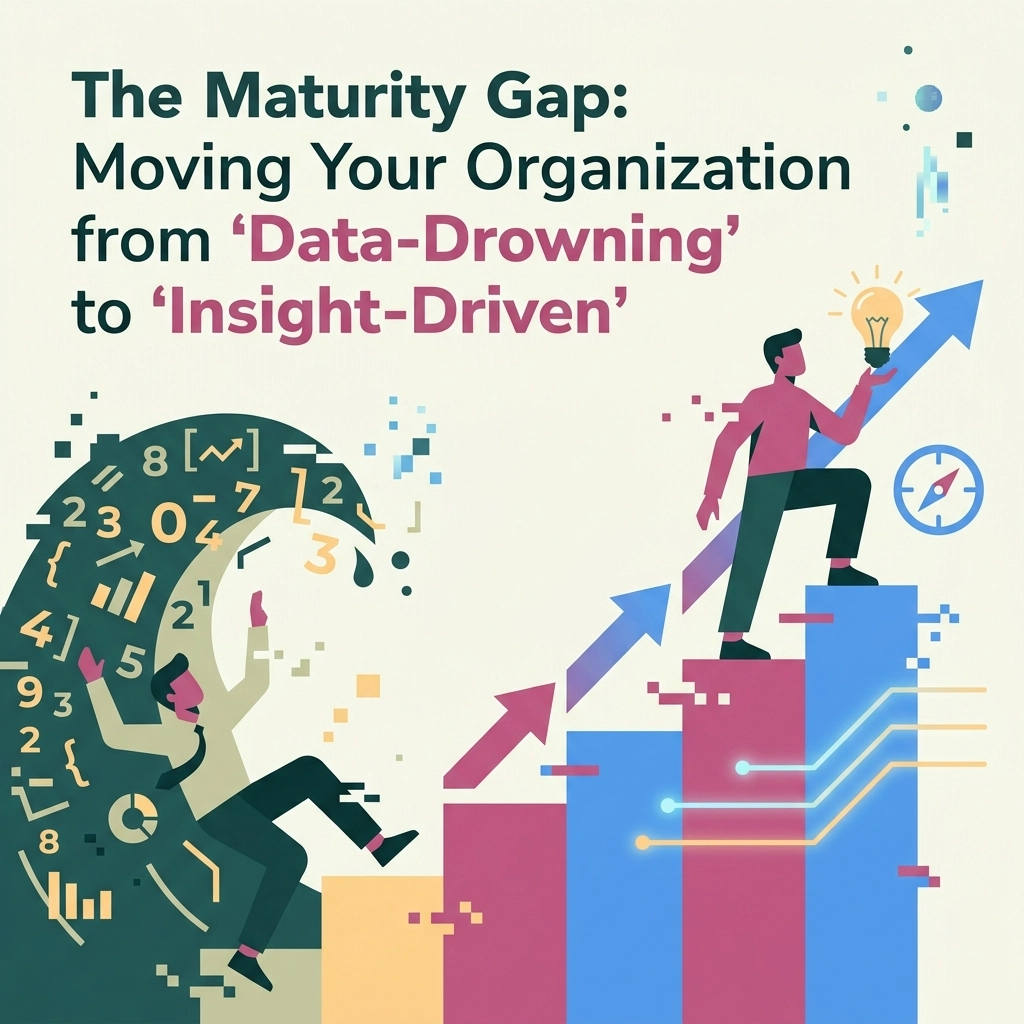
This is the Maturity Gap. It is the distance between having a chart that goes up and to the right, and having a system that tells you exactly where to put your next dollar to get a specific result.
If you’re tired of “reporting for the sake of reporting,” it’s time to talk about moving from reactive data-drowning to proactive, insight-driven leadership.
The 4 Stages of Analytical Maturity
In my two decades as a Marketing Analytics & SEO Consultant, I’ve seen organizations at every level of the spectrum. Moving up the ladder isn’t just about buying better software; it’s about shifting your organizational culture.
Stage 1: Basic Tracking (The Descriptive Phase)
At this stage, you’re just trying to figure out what happened. You track “vanity metrics” like pageviews, sessions, and maybe a few button clicks. If you’re a government agency, you might know how many people landed on a “Tax Forms” page, but you have no idea if they actually found the form they needed.
The hallmark of Stage 1 is the “Monthly PDF.” Someone exports a report, emails it to a director, and it’s never looked at again. It’s reactive and disconnected from actual business goals.
Stage 2: Functional Silos (The Diagnostic Phase)
In Stage 2, you start asking why things happened. You’ve probably moved past basic GA4 and started using Google Tag Manager governance to track specific behaviors.
However, your data lives in silos. Your web team looks at GA4. Your sales or admissions team looks at the CRM (Salesforce, Slate, HubSpot). They rarely speak the same language. You know you got 100 leads, but you can’t tell which marketing channel produced the leads that actually converted into revenue or enrollments.

Stage 3: Integrated Intelligence (The Predictive Phase)
This is where the magic starts. Your CRM and your web analytics finally shake hands. When a lead comes in, your system passes “GCLIDs” or other identifiers so you can trace a $50,000 B2B contract back to a specific whitepaper download or organic search term.
At this level, you’re not just looking backward; you’re looking forward. You can say, “If we increase our spend on this specific technical SEO strategy by 20%, we expect a 5% increase in high-intent qualified leads next quarter.”
Stage 4: Data Sovereignty (The Strategic Phase)
This is the gold standard. You own your data pipeline from end to end. You’ve moved to server-side tagging to bypass cookie restrictions and protect user privacy, a non-negotiable for Government and Higher Ed.
Your data isn’t just sitting in a Google-owned black box; it’s flowing into BigQuery, where you combine it with offline data, financial records, and historical benchmarks to create a “Single Source of Truth.” You are now making decisions based on Integrated Intelligence Layers rather than stock reports.
Which Stage Are You Actually In?
Most leaders assume they’re further along than they are, because the question they ask themselves is “do we have good tools,” not “do we act differently because of what the tools tell us.” A faster diagnostic: think about the last time a metric moved sharply, up or down. If the response was a Slack message asking “does anyone know why,” you’re in Stage 1 or 2, regardless of how sophisticated your dashboard looks. If the response was a specific, sourced answer within the hour, tracing the change back to a channel, a page, or a campaign, you’re operating in Stage 3 or 4. The dashboard’s polish is a vanity signal. Response time to an unexplained number is the real one.
The “Vanity Mirror” Trap: Why Stock Reports Are Killing Your ROI
The biggest hurdle to maturity is the comfort of the “Vanity Mirror.” Most marketing platforms are designed to make you feel good. They show you green arrows and high numbers for things that don’t actually matter to your bottom line.
If your dashboard focuses on the following, you are caught in the trap:
- Total Sessions: Without knowing the intent or quality of those sessions, this is noise.
- Time on Page: In Government or Higher Ed, a high time on page might actually mean your navigation is broken and users can’t find what they need.
- Raw Lead Count: If 90% of your leads are spam or unqualified, your “growth” is actually an operational burden on your sales team.
To break out of the trap, you must demand Human-Readable Insights. Instead of asking “How many people visited?” ask “What percentage of our target audience from the tri-state area completed the application after viewing the financial aid page?”
The goal is clarity, not volume. I’ve helped organizations audit their GA4 data and find that 40% of their “conversions” were actually internal staff members testing forms. That’s the difference between a vanity mirror and a window into reality.
Claiming Data Sovereignty: The Shift to Server-Side and BigQuery
For my clients in Higher Ed and Government, privacy isn’t just a “best practice”: it’s a legal and ethical mandate. With the decline of third-party cookies and the rise of strict PII (Personally Identifiable Information) regulations, the old way of tracking is dead.
Claiming Data Sovereignty means you own the signal.
By transitioning to a Server-Side GTM environment, you act as a gatekeeper. You decide exactly what data gets sent to third parties like Google or Meta. You strip out PII before it ever leaves your server. This doesn’t just improve privacy; it improves data accuracy by bypassing ad blockers and browser restrictions (like Apple’s ITP).

Why BigQuery is the Secret Weapon
If you are still relying on the standard GA4 interface for your high-level reporting, you are leaving money on the table. GA4’s interface is great for a quick check, but for serious budget-driving decisions, you need BigQuery.
- Zero Sampling: Get the full picture, not a “statistically significant” guess.
- Cross-Platform Analysis: Combine your website data with your actual CRM outcomes.
- Historical Integrity: Google can (and will) change how they calculate metrics. When you own the raw data in BigQuery, you define the rules.
Building the “Data Muscle”
Tools are secondary. Systems are everything.
You can buy the most expensive enterprise analytics suite on the market, but if your team doesn’t have the culture to act on those insights, you’ve just bought an expensive paperweight.
Moving from data-drowning to insight-driven is an organizational workout. It requires discipline, the willingness to be wrong, and a partner who isn’t afraid to tell you that your favorite metric is actually a distraction.
If you’re ready to stop guessing and start architecting a data-first future, let’s look at your current analytical maturity. The gap is only as wide as your hesitation to cross it.
Is your team currently looking at a “Vanity Mirror” or a “Single Source of Truth”? If you aren’t sure, it might be time for a technical audit.