Let’s be honest for a second: most of the “SEO advice” floating around your LinkedIn feed right now is functionally extinct. It’s a collection of legacy tactics designed for a version of the internet that no longer exists.
We used to live in a world of “strings”: sequences of characters we called keywords. You’d optimize a page for “government grant reporting software” or “higher ed enrollment analytics,” hope the Google crawler liked your keyword density, and wait for a blue link to appear.
Welcome to 2026. The blue link is no longer the finish line.
Today, the most important “visitor” to your website isn’t a human clicking through from a search results page. It’s an LLM-powered agent: an AI representative from OpenAI, Perplexity, or Google’s Gemini: that is scanning your site to determine if you are a credible entity worth mentioning.
If that agent cannot programmatically verify who you are, what you do, and the specific problems you solve, your brand effectively doesn’t exist in the “Agentic” search layer. You aren’t just losing rankings; you’re losing your place in the digital record.
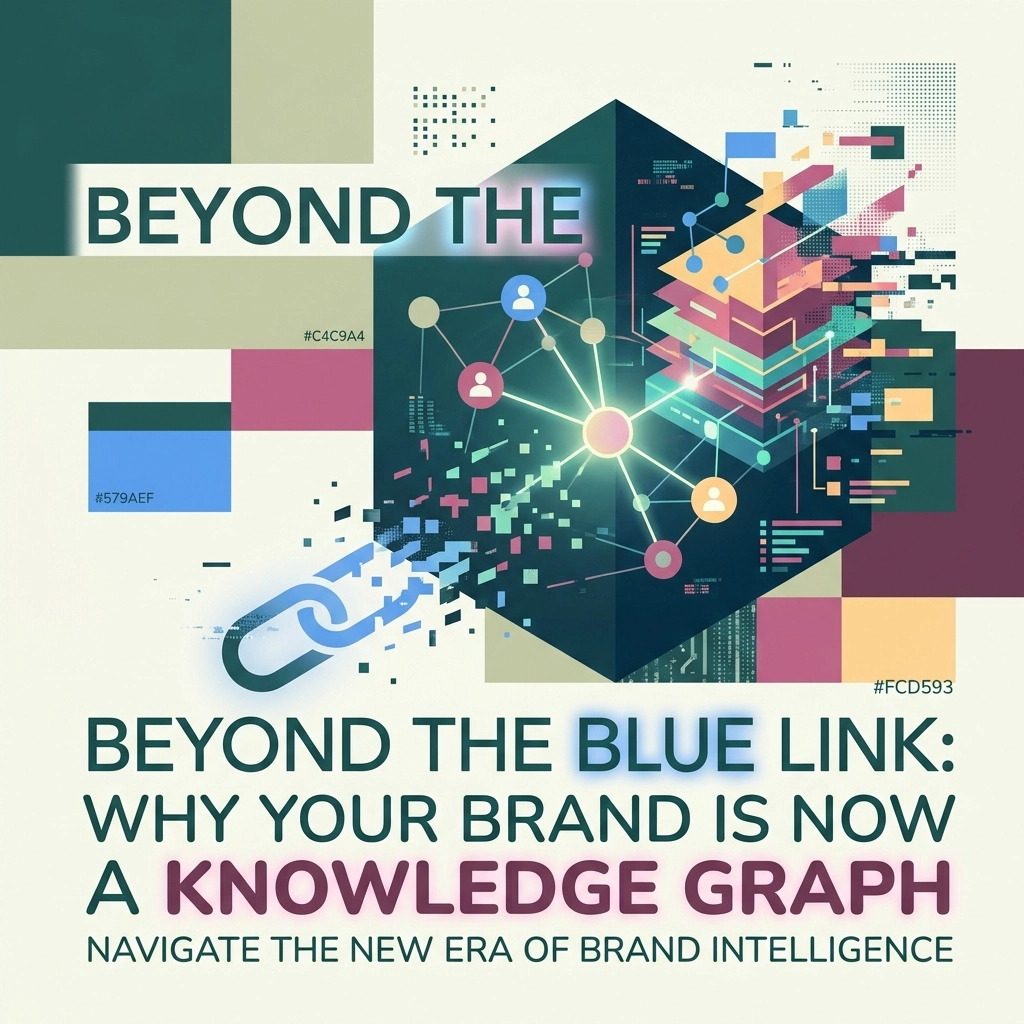
To survive this shift, you have to stop thinking of your website as a collection of pages and start treating your brand as a Knowledge Graph.
The Shift from Strings to Things: Why Keywords are a Legacy Tactic
For twenty years, search engines were essentially giant index cards. They matched the words on a user’s screen to the words on yours. But “strings” are dumb. They have no context.
In the modern era, search engines have moved to “Things.” In technical circles, we call this Entity-Based SEO.
An entity is a uniquely identifiable thing: a person, a place, an organization, or a concept: that is defined by its relationships to other entities. For example, “MM Sanford” isn’t just a string of letters. It is an Organization (Entity A) owned by Marcus Sanford (Entity B), which provides Marketing Analytics (Concept C) to Government Agencies (Entity D).

When you optimize for entities rather than keywords, you are building a technical fingerprint that AI agents cannot ignore. This is especially critical for B2B and government sectors where authority isn’t just a “vibe”: it’s a requirement.
If you’re a state tax department, an AI agent needs to know with 100% certainty that your “visitor flow” data is the authoritative source for tax deadlines, not a third-party blog. If your technical metadata is in the “dark ages,” the AI will likely hallucinate or, worse, cite a competitor who actually took the time to define their semantic architecture.
You can read more about why this shift requires a technical backbone rather than just more content here.
The “Agentic Handshake”: Using Persistent Identifiers (@id)
How does an AI agent verify your authority? It doesn’t “read” your “About Us” page the way a human does. It looks for the Agentic Handshake.
This happens through the use of persistent identifiers, specifically the @id attribute in your site’s Schema markup. Think of the @id as a digital social security number for your brand, your executives, and your core services.
Most brands make the mistake of having “disconnected data.” Their LinkedIn profile says one thing, their website says another, and their clinical or case data lives in a PDF somewhere that a bot can’t parse.
What an @id Actually Looks Like
Here’s the concept made concrete. Instead of a generic Organization schema block, you anchor it to a permanent URI:
{
  "@context": "https://schema.org",
  "@type": "Organization",
  "@id": "https://msanford.com/#organization",
  "name": "MM Sanford",
  "sameAs": [
    "https://www.linkedin.com/company/mm-sanford",
    "https://www.crunchbase.com/organization/mm-sanford"
  ]
}
Every other page on the site, and every mention of the brand in other schema blocks (an author’s worksFor property, for instance), references that same @id instead of restating the organization’s details from scratch. That’s the entire mechanism: one anchored identity, referenced consistently, instead of scattered restatements an AI has to reconcile on its own.
Building the Authority Record
To create an unshakeable authority record, you need to connect the dots:
- Unique URIs: Every core element of your business (your brand, your CEO, your primary service) should have a unique, persistent URI within your Schema.
- Verified sameAs Profiles: You must explicitly tell search engines that “This website” is the same entity as “This LinkedIn Company Page” and “This Wikidata entry.”
- Data Linkage: Link your executive profiles to the specific white papers or case studies they’ve authored.
When an AI agent sees this interconnected web of verified data, it grants your brand Semantic Authority. It no longer has to “guess” if you’re an expert; you have provided the proof in a machine-readable format. This is the difference between being a vendor and being a system architect.
If you’re still struggling with the basics of how these tools work together, I’ve broken down Google Tag Manager in under 3 minutes to show how we start capturing the right data at the source.
Building Your Semantic Moat: Schema as a Feed, Not a Decoration
Many marketers think Schema is just about getting “stars in search” or a fancy recipe card snippet. That’s thinking too small.
In 2026, Schema is the primary way you feed the internal Knowledge Graphs of the “Big Three”: Google, Perplexity, and OpenAI. By providing structured data, you are essentially handing them a pre-packaged “fact sheet” about your business.
This is your Semantic Moat.

Once you are established as a verified entity in their graphs, it becomes incredibly difficult for a “thin content” competitor to displace you. They might have better keywords, but they don’t have the verified relationships that you’ve built into your site’s architecture.
For our clients in Higher Ed and Government, this is where we see the most significant ROI. By clarifying the relationship between departments, services, and outcomes, we’ve seen organizations move from being buried in search to becoming the “Featured Snippet” or “AI Citation” for 80% of their core queries.
We’re talking about moving the needle from a 1% MQL rate to 5% simply because the right people (and the right bots) are finding the right verified information.
Why Technical SEO Often Fails the Systemic Test
The reason most “large-scale site audits” fail is that they focus on fixing errors (broken links, 404s) rather than building systems. You can have a technically “perfect” site that is still invisible to AI because it lacks semantic clarity.
At MM Sanford, we don’t just look for errors; we look for the systemic flaws in how your brand’s data is being communicated. If you’re tired of hiring vendors who just give you a list of problems without a roadmap to solve them, it might be time to start building with architects instead.

Final Thought: Is Your Brand Machine-Readable?
If an AI agent summarized your company mission today based solely on your site’s code: not your pretty graphics, but your code: would it get it right?
Or would it hallucinate your competitor’s values because their technical metadata is more organized than yours?
In the age of agentic search, Clarity is Authority.
Stop chasing the algorithm and start defining your entity. The blue links are fading, but the Knowledge Graph is permanent.
If you’re ready to stop guessing and start building a verifiable, machine-readable brand, let’s talk. We specialize in helping complex organizations in B2B, Government, and Higher Ed navigate this shift without losing their minds: or their data sovereignty.
Need help auditing your entity authority? Reach out to us here and let’s see if your site is ready for the 2026 search shift. Or, if you’re just starting to explore the impact of AI on your discovery metrics, check out our piece on why AI discovery is the only KPI that matters right now.