
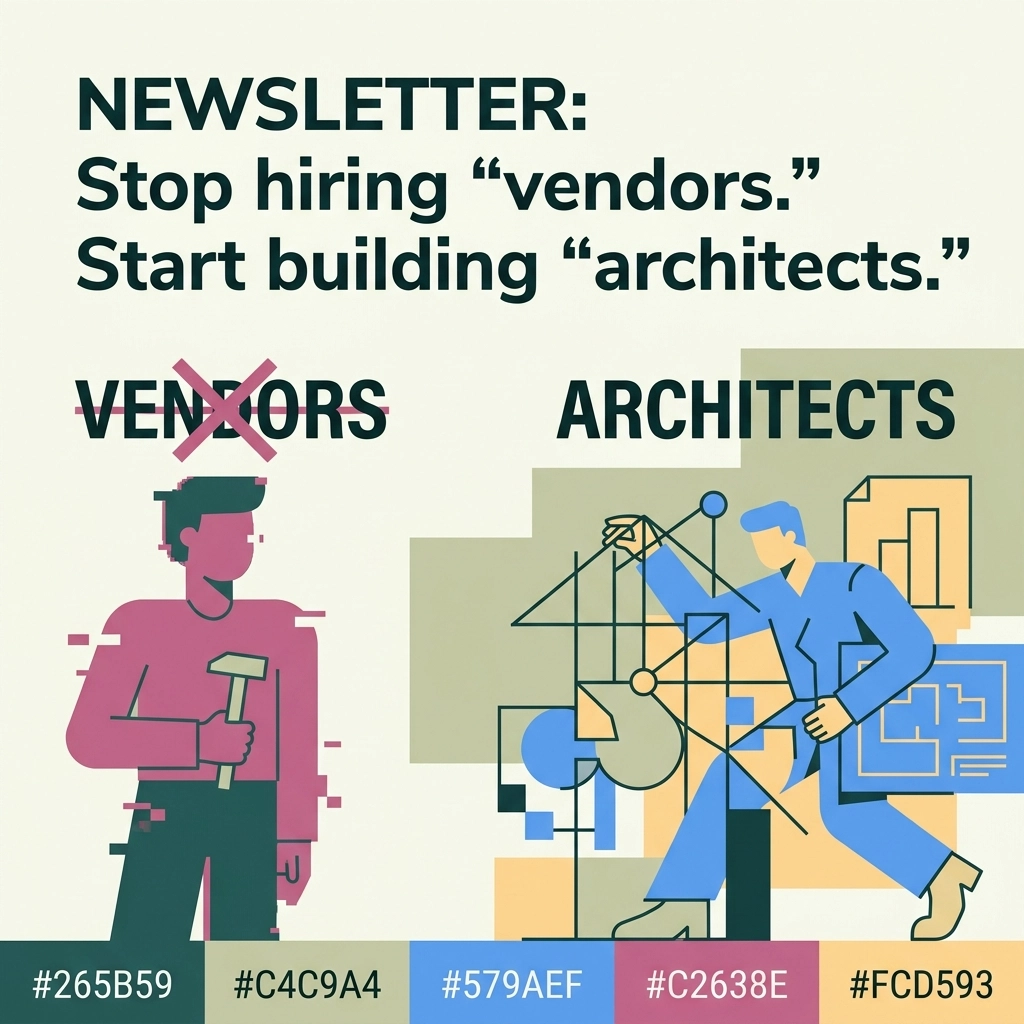
I’m going to start today with a hard truth that most agencies don’t want you to hear: The traditional agency model is designed to keep you dependent, not to make you successful.
I’ve spent over two decades in the technical marketing trenches. I’ve seen the inside of “Agency Factories” where a single junior account manager, bless their heart, they’re trying, is tasked with juggling 50 different clients. They aren’t thinking about your long-term data sovereignty or your specific organizational hurdles. They are following a checklist. They are a vendor.
In the world of Government, Higher Ed, and complex B2B, a “vendor” is the last thing you need. You need an Architect.
The “Agency Factory” Rant
Let me be even more blunt: the “Agency Factory” model is built for agency economics, not for your organizational maturity.
It usually looks like this: one junior account manager is juggling 40 or 50 clients, working from the same recycled templates, the same reporting deck, the same “best practices,” and the same canned explanation for why performance is up, down, or sideways this month. That’s not strategy. That’s throughput.
For government agencies, higher ed teams, and complex B2B organizations, this creates a serious mismatch. You’re dealing with privacy reviews, procurement friction, internal approvals, fragmented tech stacks, subdomains, CRM handoffs, and a very real tech talent gap. Meanwhile, the factory model is optimized for speed, standardization, and keeping labor cheap.
So when something actually important happens, say, a tax department sees abandonment spike in the middle of an online filing flow, or a university cannot connect campaign traffic to actual inquiries and enrollments, the factory has no answer except another generic dashboard.
When you hire a vendor in that environment, you’re usually buying a subscription to a black box. They set up your tracking, build your dashboards, and send you a polished PDF once a month that says very little about actual ROI, service outcomes, or customer experience friction.
If you ask them why a metric changed, they point to a broad industry trend. If you ask what should happen next, they suggest a tactic they already had in a template. And if you try to leave, you discover they built the whole thing in systems, accounts, or processes that you don’t actually control.
That is not partnership. That is dependency with nicer branding.
This is why I push for Surgical Consulting instead. Large organizations do not need more generic hands in the system. They need precise diagnosis, clear architecture, and a plan that fits the real constraints of the business.

Caption: The agency factory runs on repeatable templates. Complex organizations need diagnosis, not assembly-line marketing.
Surgical Consulting vs. The Managed Service Trap
I prefer a different approach: Surgical Consulting.
This starts with a philosophy I care about deeply: Analytical Clarity. If analytics is doing its job, it should reduce confusion, not multiply it. It should turn noisy systems into human-readable decision-making. It should help your team answer basic executive questions quickly: What happened? Why did it happen? What should we do next?
That sounds obvious, but the industry keeps drifting in the opposite direction. Too many firms hide behind jargon, dashboards, and “speeds and feeds” because confusion keeps the client dependent.
My view is the opposite: the goal of a true consultant should be to make themselves obsolete.
That doesn’t mean disappearing. It means building your internal Technical Backbone so your team can operate with confidence even if I’m not in the room. I should be able to come in, diagnose the weak points in your data infrastructure, fix what’s broken, create a clean measurement framework, document it, train your people, and then step back into a higher-level advisory role.
You should not need me to pull a report. You should not need me to explain what a dashboard means every single month. And you absolutely should not need me to verify whether your quarter produced ROI.
That is what I mean by Analytical Clarity:
- Your team owns the data and the access
- Your reporting is understandable by non-specialists
- Your systems survive staff turnover, vendor turnover, and platform changes
- Your measurement connects to outcomes, not just activity
For leaders in government and higher ed, this matters even more because institutional knowledge is fragile. People retire. Teams get reorganized. Procurement slows down replacements. If your analytics capability lives inside one outside consultant’s head, you do not have a system. You have a single point of failure.
At MM Sanford, we focus on building those internal muscles. I’m not interested in being your permanent crutch. I’m interested in helping you build the backbone so your organization can stand up straighter without me.
The Maturity Gap: From “Data-Drowning” to “Insight-Driven”
Most organizations I talk to believe they are data-driven because they have GA4 installed. In reality, they are drowning in noise.
To move from “Data-Drowning” to “Insight-Driven,” you have to bridge the Maturity Gap, which I’ve covered in full there.
Who Actually Does the Work at Each Stage
The “vendor vs. architect” question changes something specific about that journey: who actually does the work at each stage. A vendor relationship keeps every stage in their hands indefinitely, because that’s the retainer. An architect relationship front-loads their involvement into diagnosis and setup, then deliberately hands stages back to your team as they’re ready: a junior marketer can own basic reporting hygiene within weeks, a mid-level analyst can own CRM-to-web integration within a couple of quarters, and only the genuinely complex predictive work stays with an outside specialist long-term. If your current partner’s plan doesn’t include a point where something gets handed back to you, ask why not.
Why Your “Technical Backbone” Matters More Than Your Tools
I see leaders get caught in the “Platform Wars” all the time. HubSpot vs. Marketo. GA4 vs. Matomo. Cookiebot vs. OneTrust.
Here is my blunt take: The tool doesn’t matter if your system is broken.
A “vendor” will sell you on the features of a specific tool because they get a kickback or because it’s the only thing they know how to use. An “architect” looks at your business goal, for example, reducing the bounce rate on a complex tax filing portal, and builds a measurement system that works regardless of the software you’re using.
For our clients in Government and Higher Ed, this backbone is especially critical because of privacy and PII concerns. You cannot afford to have a “vendor” accidentally leaking data because they didn’t understand the nuances of GTM governance.

The “Integrity Test”: 3 Questions for Every Executive
If you’re currently working with a marketing partner, I want you to ask them these three questions today. This is a simple Integrity Test to find out whether they are a Black Box that keeps you dependent or a Bridge that helps your team grow.
-
“Do we own the keys to every account, container, tag manager, dashboard, and database you’ve built for us?”
If the answer is some version of “We manage that in our master environment,” you have a Black Box problem. A Bridge makes sure ownership lives with your organization. That is the foundation of Data Sovereignty. -
“If my internal team asked how this measurement system works, could you train them to validate the numbers without you?”
This is the big one. A Black Box will avoid documentation, dodge process questions, or act like the method is too technical for your team. A Bridge will show the logic, explain the assumptions, and create confidence inside your organization. -
“If our contract ended tomorrow, what would still work on day one without your help?”
A Black Box will tell you the reports stop, the dashboards break, or access becomes complicated. A Bridge will tell you the infrastructure stays with you because it was built into your environment, with your people in mind.
If you get vague answers, defensive answers, or sales answers, pay attention. The issue is not personality. It is structural integrity.
Moving from Reactive to Predictive
Most marketing teams are stuck in a Reactive loop. They look at what happened last month to justify why they spent the budget.
When you build a “Technical Backbone,” you move toward being Predictive. You stop asking “What happened?” and start asking “What should we do next Tuesday?”
For a B2B firm, this might mean identifying that a 1% increase in MQL quality (not quantity) leads to a 5% increase in bottom-line revenue. For a government agency, it means seeing a bottleneck in a visitor flow and fixing it before the support lines get overwhelmed.

The Bottom Line
Stop looking for people to “run your ads” or “do your SEO.” Those are commodities.
Instead, look for a partner who is obsessed with your Analytical Maturity. Look for someone who is willing to show you how the clock is built, rather than just telling you the time.
The industry is shifting. With the decline of third-party cookies and the rise of privacy-first browsing, the “old way” of vendor-led tracking is dying. The only way to survive is to own your infrastructure and build a system that is resilient to change.
If you’re ready to stop being a “client” and start being an “owner” of your data, let’s talk.
The Engagement Question:
I want to leave you with one thought to chew on this week:
If your lead analytics consultant disappeared tomorrow, would your team know how to verify your ROI for this quarter?
That question is uncomfortable on purpose.
Because if the answer is “No,” the issue is bigger than reporting. It means your organization is still relying on borrowed intelligence instead of building internal capability. And in sectors with long buying cycles, public accountability, privacy constraints, and lean internal teams, that is a dangerous place to be.
If the answer is “No,” you don’t have a strategy. You have a dependency.
Stay pragmatic,
Marcus Sanford
Owner, MM Sanford