The monoculture is dead.
For two decades, we’ve lived in a Google-centric reality where "SEO" was synonymous with "optimizing for a single algorithm." We obsessed over blue links, backlink profiles, and keyword density like digital alchemists trying to turn lead into Page 1 gold.
But the search landscape has fractured.
Your audience isn't just "googling" anymore. They are querying ChatGPT for complex breakdowns, searching TikTok for visual proof-of-concept, scouring Reddit for the "real" truth, and asking Perplexity to synthesize 20 sources into one coherent answer.
If your strategy starts and ends with a search engine results page (SERP), you aren’t just behind; you’re invisible to 46% of Gen Z and a growing percentage of B2B decision-makers.
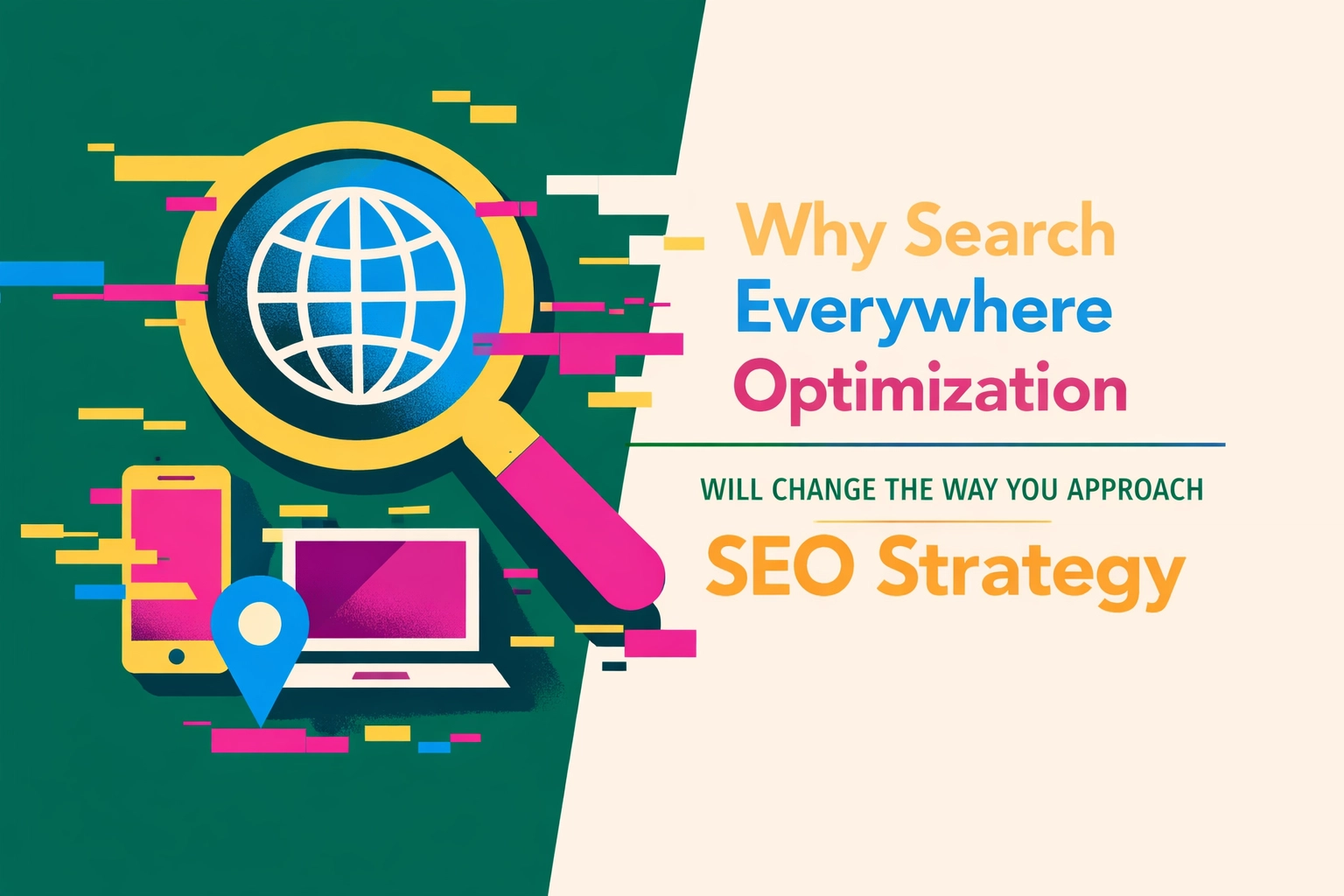
Welcome to the era of Search Everywhere Optimization (SEvO). It’s time to stop optimizing for a search engine and start optimizing for the entire discovery substrate.
The Systemic Failure of Traditional SEO
Traditional SEO is a "single point of failure" architecture. You spend months building authority on one platform, only for a core update or an AI-integrated snippet to wipe out 40% of your organic traffic overnight.
Why does this happen? Because traditional SEO treats content as a static destination.
In 2026, content must function as a portable data packet. Whether it’s a state tax department explaining new filing requirements or a university highlighting its engineering research, the information needs to be structured so that any engine: be it a LLM, a social algorithm, or a voice assistant: can parse it accurately.

The Death of the "Click-Through" Metric
We’ve been trained to value the click above all else. But in a world of Zero-Click searches and AI Overviews, the "answer" is often delivered before the user ever sees your URL.
If your goal is only a click, you're going to lose. If your goal is Entity Authority, you win regardless of where the answer is consumed. This shift requires moving from a "speeds and feeds" marketing mindset to a systems architecture approach.
Three Steps to Search Everywhere Optimization
Transitioning to SEvO isn't an overnight task, especially for large-scale organizations like government agencies or higher ed institutions dealing with legacy tech debt and PII concerns. You need a phased deployment.
Step One: Core Entity Consolidation
Before you can be everywhere, you must be clearly defined somewhere.
- Schema as Source Code: Your website’s Schema markup isn't just "bonus points" for Google; it’s the metadata layer for AI crawlers. If your technical SEO audit doesn't prioritize structured data, your "entities" (your brand, your key personnel, your services) are just unparsed strings of text.
- The Single Source of Truth: Ensure your brand’s "digital fingerprint" is consistent. I’ve seen government agencies with three different addresses across Google Business, LinkedIn, and their own footer. Inconsistent data creates friction in AI retrieval.
- Data Sovereignty: Stop letting third-party platforms own your relationship with your users. Own your data. Translate your analytics into human-readable dashboards that show where these non-Google interactions are happening.
Step Two: Platform-Native Authority
Once the core is stable, you must optimize for the platforms where discovery is actually happening.
- Vertical Search: If you are a B2B firm, your "search" strategy must include LinkedIn and specialized marketplaces.
- Video Discovery: YouTube is the world’s second-largest search engine. If you aren't optimizing video transcripts and descriptions, you're ignoring a massive discovery node.
- Social Search: For younger demographics, TikTok and Instagram are the primary research tools for local services and educational programs.
Real-World Result: We recently worked with a client who shifted focus from broad industry keywords to platform-native video content. By treating YouTube as a primary search channel, they saw an increase in MQL (Marketing Qualified Lead) rates from 1.2% to 4.8% within six months. They didn't just get more traffic; they got more intent-driven traffic.

Step Three: The AI and LLM Feedback Loop
This is the "glitch in the matrix" stage. You aren't just writing for humans; you’re feeding the models that feed the humans.
- Generative Engine Optimization (GEO): This involves creating content that answers complex, multi-layered questions that LLMs like to synthesize.
- Trust Signals: AI engines prioritize sources that demonstrate high E-E-A-T (Experience, Expertise, Authoritativeness, and Trustworthiness). This is where your white papers, case studies, and citations from government or educational (.gov / .edu) domains become your most valuable assets.
- Server-Side Logic: For complex enterprise sites, your GTM setup might need server-side tagging to ensure that the data you're feeding back into these systems is clean, private, and accurate.
Privacy, PII, and the Government Hurdle
I talk to government agencies and higher ed institutions every day. I know the "Search Everywhere" concept sounds like a privacy nightmare.
"How do we maintain PII compliance while being discoverable across 10 platforms?"
"How do we handle organizational inertia when it takes six months to change a header?"
The answer is Privacy-First Analytics.
You don't need to track individual users across the web to understand how your brand is being discovered. By using privacy-first analytics frameworks, you can measure aggregate signals and entity mentions without compromising data ethics.
The Paradox of Choice in marketing tools often leads to paralysis. Don't worry about whether you should use HubSpot, Marketo, or a custom stack. The software is secondary to the system. The system is: Capture the entity search, provide the value, and measure the outcome.
Why "Good Enough" SEO is Failing You
Most agencies will tell you to keep doing what you’re doing: just "add AI."
That’s a lie.
Adding AI-generated noise to a broken search strategy is like putting a high-performance engine in a car with no wheels. You’ll just spin your tires faster.
Search Everywhere Optimization requires a fundamental re-architecture of your digital presence.
It means moving from:
- Keywords → Entities
- Clicks → Conversations
- Rankings → Ubiquity
The MM Sanford Approach: Technical Truth over Trends
At MM Sanford, we don't care about the latest "growth hack." We care about building resilient marketing systems. Whether it’s fixing a broken GA4 implementation or architecting a multi-platform search strategy, we focus on the technical substrate that makes marketing work.
We’ve seen the "Blue Link" era rise and fall. We’ve seen the shift from desktop to mobile. Now, we’re seeing the shift from "Searching" to "Discovering Everywhere."
Are you ready to stop chasing the algorithm and start owning the ecosystem?
If you’re managing a complex organization and your current SEO report is just a list of keywords and green checkmarks, you're missing the bigger picture. It’s time for an audit that looks at your entire digital footprint, not just your Google ranking.
Your next move:
- Check your entity health.
- Audit your technical infrastructure.
- Let’s talk about a strategy that actually works in 2026.
Key Takeaways for the Skimmers:
- Google is no longer the sole gatekeeper. Discovery happens across AI, Social, and Vertical search.
- Shift from Keywords to Entities. Make your brand recognizable to machines and humans alike.
- Build it in layers. Start with core technical SEO, move to platform-native content, then optimize for AI retrieval.
- Privacy is a feature, not a bug. Use server-side tagging and privacy-first analytics to maintain data sovereignty.
- The system matters more than the tool. Stop obsessing over platforms and start obsessing over your data architecture.

Don't let your strategy be a single point of failure. The search world is fracturing. Reprogram your approach before it leaves you behind.