We’ve officially entered the era of the “Answer Engine.”
If you’re still obsessing over whether you’re position #1 or position #3 for a specific keyword in 2026, you’re playing a game that’s rapidly becoming obsolete. The new goal isn’t just to be found; it’s to be cited.
When an AI like Perplexity, Gemini, or SearchGPT synthesizes an answer for a user, it doesn’t just look for the best keyword match. It looks for the most trustworthy entity. It’s looking for a source that won’t make it look like a hallucinating idiot.
If you are a marketing director in higher education, a digital lead for a state agency, or a B2B executive, this shift is your biggest threat: and your greatest opportunity.
The “Wild West” of thin AI-generated content is leading us toward a “Model Collapse” where AI starts reading AI until the internet reaches a state of digital Idiocracy. To survive, you must prove you are a human-led, authoritative source.
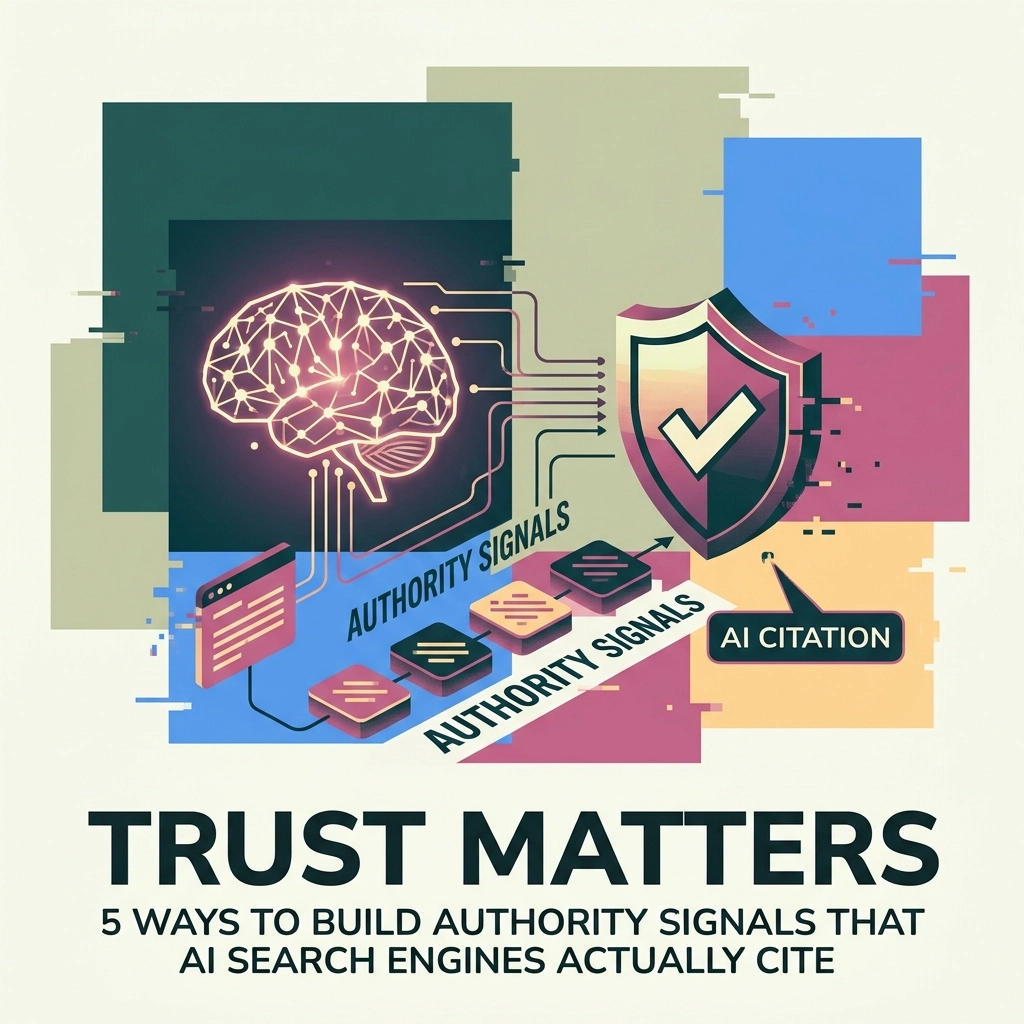
Here is how you build the authority signals that AI search engines actually respect.
1. Move From “Keyword Ranking” to “Entity Building”
AI doesn’t see your website as a collection of pages; it sees it as an Entity.
Think of an Entity as a node in a giant digital web of facts. If the AI can’t confidently connect your brand name to a specific set of expertise, a verified physical location, and a clean history of mentions, it will skip you in favor of a source it “understands” better.
For large organizations: especially government agencies managing complex visitor flows or higher ed institutions with dozens of departments: this is often where the wheels fall off. If your LinkedIn says one thing, your technical SEO setup says another, and your Google Business Profile is a ghost town, the AI sees a “low-confidence” entity.
The Fix:
- Organization Schema: Use advanced JSON-LD schema to tell search engines exactly who you are.
- The “sameAs” Attribute: This is the most underutilized tool in SEO. Link your homepage schema to your official social profiles, your Wikipedia page (if you have one), and your Crunchbase or government registry.
- Consistency is King: If your state agency’s name varies between “Department of Revenue” and “State Tax Office” across different platforms, you are confusing the machine. Pick a name and stick to it everywhere.

2. Purge the “Nuclear Waste” of Legacy Data
I’ve seen it a hundred times: a massive university site with 50,000 pages, half of which are PDF forms from 2012 and “test” blog posts from a CMS migration in 2018.
In the old days, this was just “clutter.” In 2026, this is Nuclear Waste.
AI models are trained on the data you provide. If your site is full of outdated, contradictory information, the AI will perceive your overall “Trust Score” as low. If a citizen asks an AI about tax filing deadlines and the AI finds a 2015 PDF on your site that says “April 30th,” the AI might hallucinate or, worse, cite the wrong info and blame you.
Trust is a zero-sum game. Every piece of low-value, thin, or outdated content on your site dilutes the authority of your high-value content.
The Fix:
- Perform a Content Audit: Use a tool like Screaming Frog to find every page that hasn’t been updated in 24 months.
- The “Kill or Cure” Rule: If it’s not accurate, useful, or cited, delete it or 301 redirect it to a modern resource.
- Governance Matters: Large teams need GTM and content governance frameworks to ensure that “junk” doesn’t get published in the first place.
3. Verified Authorship: The Institutional “Seal”
AI search engines are increasingly sensitive to who is writing the content. A generic blog post by “Admin” or “Marketing Team” carries zero weight in a world where AI can churn out 10,000 such posts in an hour.
To be cited, your content needs to be tethered to a real person with verifiable credentials. In higher ed, this means your faculty; in government, it’s your subject matter experts; in B2B, it’s your C-suite and lead engineers.
The AI wants to know:
- Does this person have a digital footprint?
- Are they mentioned on other authoritative sites?
- Do they have a history of writing about this specific topic?
The Fix:
- Author Pages: Every article should link to a robust author bio page. This page should include a headshot, a short CV, and links to their LinkedIn and academic citations.
- Author Schema: Use
Personschema to explicitly tell the AI: “This article was written by Dr. Jane Smith, who is an expert in Marketing Analytics.” - Institutional Authority: Ensure your site’s “About” page clearly defines your organization’s mission and history. Link to it from your about page to reinforce your institutional standing.

4. Leverage First-Party Data as Your Moat
Generic advice is a commodity. If you’re writing “7 Tips for Better Budgeting,” an AI can write that better and faster than you.
The only way to stay relevant is to provide original, proprietary data.
AI models are hungry for “New Knowledge.” When you publish a report based on your own first-party data: like a study on how GA4 reporting drives marketing decisions: you are providing something the AI cannot find elsewhere. This makes you a “Primary Source,” which is exactly what AI engines want to cite.
For government agencies, this might be anonymized visitor trend data. For B2B, it’s original case studies with concrete results (e.g., “How we moved MQL rates from 1% to 5% using server-side tagging”).
The Fix:
- Stop Hiding Data in PDFs: If you have a great study, put the key data points in HTML tables and bulleted lists. AI reads HTML much more reliably than complex PDF layouts.
- Case Study Framework: Don’t just say what you did. Explain the problem, the process, the data used, and the verifiable outcome.
- Data Sovereignty: Own your data. Ensure your GA4 implementation is clean so that the insights you publish are actually accurate.
5. Digital PR: Mentions are the New Backlinks
In the old SEO world, we wanted a “do-follow” link. In the AI world, we want a Contextual Mention.
AI search engines learn by association. If your brand is mentioned alongside “Top Marketing Analytics Consultants” in a podcast transcript, a news article, or a professional forum, the AI creates a semantic link between your brand and that expertise.
This is why Digital PR is now a core component of technical SEO. You need to be part of the “Knowledge Graph.”
The Fix:
- Be a Guest: Get your experts on industry podcasts and webinars. These transcripts are indexed and used as training data for LLMs.
- Verified Profiles: Ensure your brand is listed in major directories relevant to your sector (e.g., .edu directories for higher ed, official vendor lists for gov).
- Avoid “Contact Grabs”: Don’t put your best insights behind a lead gen wall. If the AI can’t crawl it, the AI can’t cite it. Give away the “what” and the “why” to build authority, then sell the “how” through your services.
What the “sameAs” Attribute Actually Looks Like
Since it’s the most underutilized tool on this list, here’s the actual JSON-LD:
{
  "@context": "https://schema.org",
  "@type": "Organization",
  "name": "Your Organization Name",
  "sameAs": [
    "https://www.linkedin.com/company/your-org",
    "https://en.wikipedia.org/wiki/Your_Organization",
    "https://www.crunchbase.com/organization/your-org"
  ]
}
Every URL in that array is a vote of confidence: it tells the AI that these profiles and this website describe the same entity. The more independently-verified profiles you link, the more confidently an AI can resolve who you actually are, rather than guessing based on a name that might be shared by several organizations.
The Bottom Line
AI search engines are designed to mimic human trust. They cite the sources that seem most reliable, most current, and most “human.”
If you continue to treat your website as a static brochure or a dumping ground for generic blog posts, you will disappear from the search results of 2026. But if you embrace data sovereignty, verified authorship, and entity-based SEO, you’ll become the source that the “brains” of the internet rely on.
Don’t let your data be an afterthought. Whether you are managing a complex higher ed site or a high-stakes B2B funnel, authority is your only lasting competitive advantage.
Is your data telling a story of authority, or is it just noise?
If you’re not sure where your authority signals stand, it might be time for a technical SEO and analytics audit. Let’s make sure the AI knows exactly who you are: and why you’re the expert.