Skip to content Skip to footer

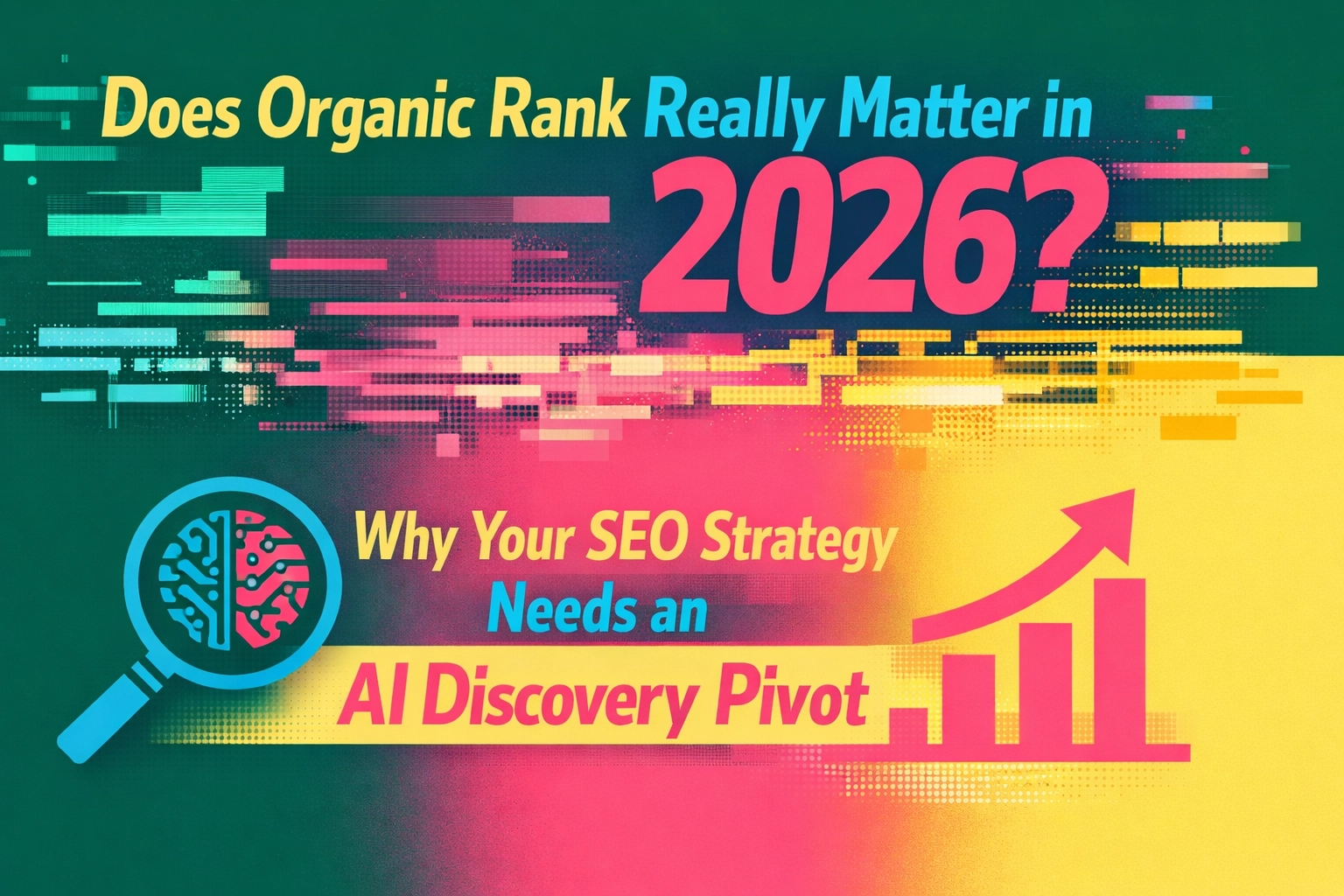
Does Organic Rank Really Matter in 2026? Why Your SEO Strategy Needs an AI Discovery Pivot

Let’s be blunt: if your primary marketing KPI is still "Ranking #1 on Google," you are managing a ghost.

In 2026, the traditional Search Engine Results Page (SERP) is no longer a list of ten blue links. It is a synthesized, AI-driven interface that answers questions before a user ever thinks about clicking a link. Between Google’s evolved Search Generative Experience (SGE), Perplexity’s citation-heavy discovery, and the rise of vertical-specific AI agents, the "click" has become a luxury, not a guarantee.

For B2B leaders, Higher Ed recruiters, and Government agency directors, this shift isn't just a technical hurdle. It is a fundamental change in how your audience finds: and trusts: your information.

The goal is no longer to rank; the goal is to be the authoritative source that the AI cites.


The Death of the "Top Spot" Vanity Metric

For two decades, we treated SEO like a real estate play. You bought your way to the top with backlinks and keyword density. But in the current landscape, the "top spot" is often occupied by an AI overview that pulls data from four different sites to provide a 200-word summary.

If your content is buried in that summary without a clear path to your site, you’ve provided free training data for an LLM without gaining a single lead.

I’ve seen too many organizations pour six-figure budgets into "ranking" for high-volume keywords, only to see their organic traffic crater because those keywords now trigger "Zero-Click" results. We have to stop chasing the ghost of 2019 SEO and start building for AI Discovery.

The Problem of the "Information Gap"

In Higher Ed, a prospective student doesn't search for "best MBA program" and click through ten sites anymore. They ask an AI agent: "Which MBA programs in the Midwest offer the best ROI for mid-career transitioners in green tech?"

If your program’s data isn't structured for discovery, you don't exist in that conversation.

Visualizing traditional search links transforming into an AI discovery cluster for modern SEO strategy.


Why B2B and Government Sites are Feeling the Squeeze

The stakes are higher for complex sectors. In B2B, the sales cycle is long and technical. In Government, the priority is data sovereignty and accessibility.

The B2B Reality

B2B decision-makers are using AI to bypass the "fluff" of top-of-funnel blog posts. They want technical specifications, peer reviews, and implementation timelines. If your solutions aren't presented as structured, authoritative entities, the AI will hallucinate your capabilities or, worse, recommend a competitor whose documentation is more "readable" for a machine.

The Government Hurdles

For state and federal agencies, the challenge is organizational inertia and the "tech talent gap." Moving a massive portal: like a tax department visitor flow: requires more than just a fresh coat of paint. It requires a technical architecture that allows AI agents to pull accurate, real-time data for citizens without compromising PII (Personally Identifiable Information).

We aren't just tracking visits anymore; we are ensuring data visibility.


The AI Discovery Pivot: A Three-Phase Roadmap

At MM Sanford, we don't believe in "tricking" algorithms. We believe in building systems that command authority. Here is how we are advising our clients to pivot their strategy for 2026.

Phase I: The Core (Technical Authority & E-E-A-T)

Before you can be discovered, you must be understood. This phase is about the "plumbing" of your digital presence.

  • Entity Home Strategy: Your website must be the definitive "Entity Home" for your brand. This means aggressive use of Schema.org markup so LLMs don't have to guess who you are or what you do.
  • The Death of Thin Content: If an AI can summarize your article in two sentences, the article shouldn't exist. We focus on "Human+ Expertise": content that includes original research, proprietary data, and nuanced analysis that AI cannot replicate.
  • Privacy-First Analytics: With the decline of third-party cookies, you must own your data. We advocate for server-side tagging to ensure compliance and data accuracy. Check out our privacy policy for how we view data ethics.

Phase II: Interactive Visibility

Once the foundation is solid, we move from static pages to interactive discovery.

  • Conversational Optimization: We optimize for how people talk, not just how they type. This involves restructuring FAQs into conversational pillars.
  • Brand Signals as Backlinks: In 2026, a mention in a high-authority community or a citation in a Gartner report carries more weight than a hundred low-tier backlinks. We build authority by getting you where your peers are talking.

Phase III: Complex Applications & AI Agents

For those ready to lead the market, we build custom pathways for AI discovery.

  • API-First Content: Making your data accessible via secure APIs so that specialized AI agents (like those used in Higher Ed counseling or B2B procurement) can pull your most up-to-date information directly.
  • Custom GPTs and LLM Tuning: Creating specific "knowledge bases" that you control, ensuring that when an AI references you, it’s using the most accurate version of your "truth."

Brand Signals: The New "Ranking Factor"

One of the biggest shifts I've observed is that brand signals now rival traditional on-page optimization.

Google and other discovery engines are looking for "Real World Authority." Are people searching for your brand name specifically? Are you being discussed in non-indexed spaces like private Slack communities or Discord servers?

If your marketing strategy is siloed into "SEO" and "PR," you're losing. In 2026, they are the same thing. Authority is the only currency that doesn't devalue in an AI world.

MM Sanford brand logo


Measuring What Matters: From Clicks to Conversions

Stop looking at "Total Organic Sessions." It’s a vanity metric that hides the truth. If you have 10,000 sessions but a 0.5% conversion rate, you don't have a traffic problem; you have a relevance problem.

I’ve worked with B2B clients where we deliberately reduced their total organic traffic by 30% by cutting out "fluff" keywords. The result? Their MQL (Marketing Qualified Lead) rate jumped from 1% to 5%.

We traded noise for signal.

Key Metrics for 2026:

  1. Brand Search Volume: Are more people looking for you by name?
  2. Citation Share: How often does an AI overview cite your domain as a source?
  3. Entity Health: Is your Schema markup being consumed correctly by major LLMs?
  4. Revenue per Organic Session: Is the traffic you do get actually moving the needle?

The "Provocative Architect" Perspective

I often tell my clients: "Don't build a website; build an information ecosystem."

We use a minimalist, glitch-tech visual style in our reporting: heavy on the #265B59 forest green: because it represents the intersection of organic growth and technical precision. Your SEO shouldn't feel like a marketing layer; it should feel like a structural component of your business architecture.

How many times do you review your technical debt? What is your system for ensuring your most valuable insights aren't being swallowed by a "Zero-Click" result?

If you don't have a clear answer, you are likely falling into the "Paradox of Choice": paralyzed by too many tools and not enough strategy. Tools like HubSpot or GA4 are secondary. The system is what matters.

Isometric blueprint of a digital marketing ecosystem emphasizing data architecture and system strategy.


How to Start Your Pivot

You don't need to rebuild your entire site tomorrow. You need a phased roadmap.

  1. Audit for "AI Readability": Use tools to see how an LLM interprets your top 10 most important pages. Are they getting the "Why" behind your service?
  2. Double Down on E-E-A-T: Start sourcing quotes from your internal subject matter experts. Stop using generic AI-written filler.
  3. Claim Your Entity: Ensure your About Us page and your executive profiles are marked up with Linked Data.

The "Tech Talent Gap" is real, especially in Government and Higher Ed. You don't need a 50-person team to do this; you need a specialized partner who understands the plumbing so you can focus on the vision.

Organic rank isn't dead: it just has a new job description. In 2026, it's about being the most trusted nodes in a global neural network.

Are you ready to stop chasing links and start building authority?

Let’s talk about your system. Contact MM Sanford to begin your AI Discovery audit.