
Let’s start at the 10,000-foot level.
If you are an executive director at a state agency or a marketing VP at a large university, you are likely writing six- or seven-figure checks to media agencies every year. These agencies are brilliant at what they do: buying ads, crafting creative, and driving traffic.
But there is a systemic flaw in the room.
The same agency responsible for spending your budget is also the one reporting on how well that budget worked. In any other industry, this would be a massive red flag. In digital marketing, it’s just Tuesday.
I’ve spent 20 years in this space, and I’ve seen it play out the same way dozens of times: the agency provides a beautiful PDF dashboard, the numbers look green, and yet, the internal stakeholders are left wondering why that “record-breaking traffic” isn’t translating into enrolled students or citizens successfully navigating a tax portal.
The truth is simple: You cannot expect an entity to objectively grade its own homework.
The “Grading Your Own Homework” Problem
In digital marketing, a conflict of interest isn’t usually about malice; it’s about incentives.
Most agencies are paid based on a percentage of media spend. Their financial health is directly tied to your budget increasing. This creates a natural bias toward metrics that justify more spend: like impressions, clicks, or “estimated” conversions: rather than the cold, hard business outcomes that actually matter to your organization.

When an agency controls the measurement setup, they control the narrative. They choose the attribution model, they define what counts as a “conversion,” and they manage the filters.
I call this “Data Drowning.” You get so many charts and graphs that you lose sight of the fact that the tracking might be fundamentally broken. Are they over-crediting paid media for organic renewals? Are they counting bot traffic as “high engagement”? Without independent oversight, you’ll never know.
Key Takeaway: Independent oversight isn’t about distrust; it’s about verification. It’s the difference between a sales pitch and a forensic audit.
Why Higher Ed and Government Are Different
If you’re a local B2B shop, you can probably get away with standard agency reporting. But if you’re managing a complex, multi-departmental web ecosystem, the stakes are exponentially higher.
1. The Multi-Agency Mosh Pit
Large universities and government agencies rarely work with just one vendor. You might have one agency for SEO, another for programmatic display, and a third handling social media. Each one brings its own reporting “system.”
The result? Attribution chaos.
The SEO agency claims the enrollment. The social agency claims the enrollment. The display agency takes the credit too. Suddenly, you have three “enrollments” in your reports for one actual human student. Independent oversight acts as the “referee” in this scenario, ensuring your data reflects reality, not agency ego.
2. The Subdomain Nightmare
Government and Higher Ed sites are notorious for “tag sprawl.” You have the main .edu or .gov site, but then you have application portals, student information systems, grant-funded microsites, and third-party payment processors.
If your Google Analytics 4 (GA4) isn’t configured to handle cross-domain tracking perfectly, your data is a lie. As I’ve noted in my GA4 Audit Checklist for Higher Ed, self-referrals from your own subdomains can inflate your traffic by 30% or more, making your marketing look far more effective than it actually is.

3. Privacy and Compliance (FERPA, GDPR, CCPA)
For a government agency, data isn’t just a marketing asset; it’s a legal liability. If your agency is firing PII (Personally Identifiable Information) into GA4 via URL parameters or form fields, they aren’t just giving you bad data: they’re putting you at risk.
An independent consultant focuses on privacy-first architecture, ensuring that your tracking systems comply with legal mandates while still giving you the visibility you need.
GA4’s Hidden Walls: The Technical Truth
Google Analytics 4 is more powerful than the old Universal Analytics, but it is also significantly more fragile.
If you are an enterprise-level organization, you’ve likely run into the “Token Crisis.” This happens when your agency builds a massive Looker Studio dashboard that pulls too much data, hitting API limits and breaking your reports.
An agency’s fix is usually to “simplify the report.”
My fix is to build a BigQuery bridge.
By moving your data into a warehouse you own, you gain data sovereignty. You are no longer dependent on an agency’s dashboard. You own the raw data, the historical integrity, and the ability to join that data with your CRM or Student Information System.
The system matters more than the tool. If your agency is just “using GA4,” they are a vendor. If they are building an architecture that scales, they are an architect.
The Forensic Audit: Finding the “Ghost” in Your Data
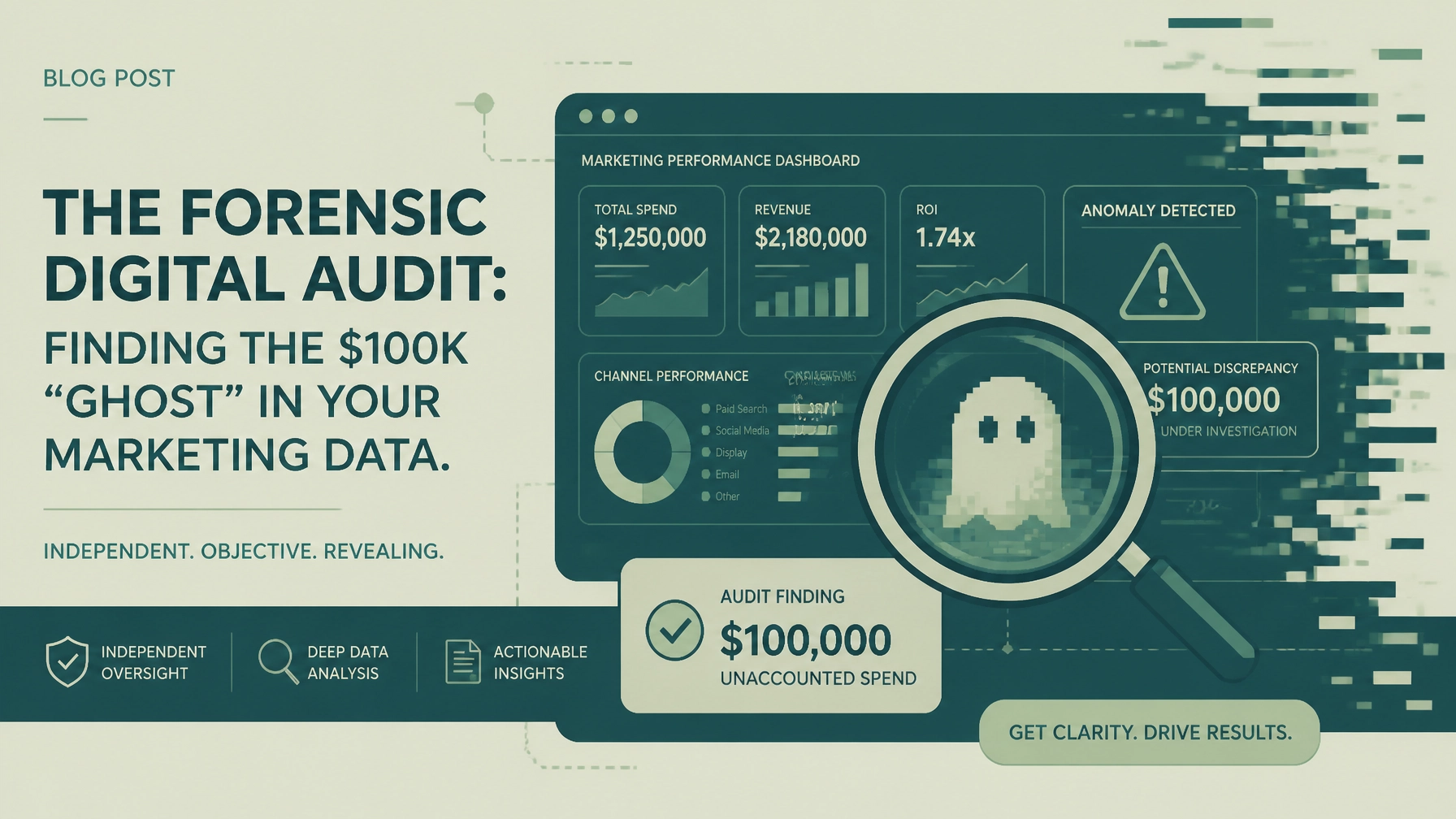
When I step into a complex organization, I’m looking for the $100k “ghost.” This is the budget that is being spent on traffic that never had a chance of converting, or results that are being double-counted across platforms.

A forensic audit typically uncovers three things:
- Measurement Gaps: High-value actions (like downloading a financial aid guide) that aren’t being tracked.
- Attribution Theft: Paid media taking credit for users who were already going to convert via direct or organic search.
- Governance Issues: Multiple departments firing conflicting tags, leading to slow site speeds and broken data.
As we discussed in our guide on GTM Governance, without a centralized “source of truth,” your data will inevitably decay.
What to Actually Put in the Contract

Most of this problem is preventable before it starts, if the contract with any agency includes a data ownership clause on day one rather than trying to claw ownership back after the relationship sours. Three clauses worth insisting on, regardless of which agency you hire:
- All GA4 and GTM containers are created under your organization’s own Google account, not the agency’s. The agency gets granted access; they never own the account itself.
- Any custom dashboards, Looker Studio reports, or BigQuery pipelines are delivered with full documentation, not locked inside the agency’s internal tools where they become unreadable the day the contract ends.
- A named exit clause specifying exactly what gets handed over, in what format, and within how many business days of termination.
None of this is adversarial. A genuinely good agency partner will have no problem agreeing to all three, because they’re not planning on holding your data hostage anyway. The agencies that push back on these terms are telling you something important before you’ve spent a dollar with them.
Conclusion: The ROI of Truth
Stop hiring “vendors” who just want to keep the ads running. Start building “architects” who want to protect your data.
Independent GA4 oversight isn’t an added expense; it’s an insurance policy for your marketing budget. When you have a technical partner who doesn’t have a stake in your media spend, you finally get the one thing every executive needs: The truth.
Does your data represent reality, or is it just a well-designed narrative?
If you aren’t sure, it’s time to stop letting the agencies grade their own homework.
Contact MM Sanford today to schedule a forensic digital audit and take back control of your data.