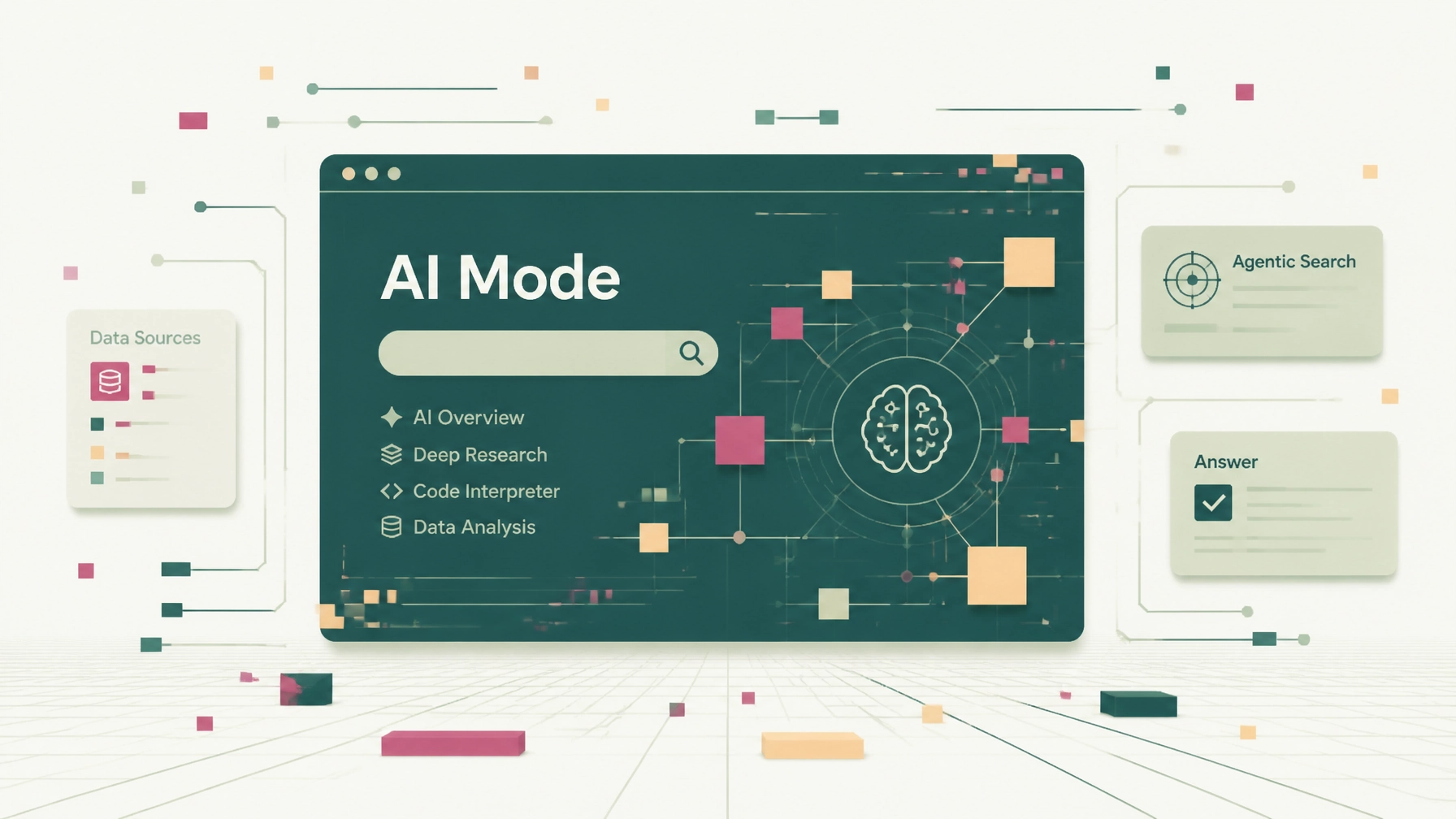
If you spent the last two weeks scrolling through the Google I/O 2026 highlights, you’ve likely realized one thing: the search bar as we knew it is dead. It hasn’t been replaced by a simple chatbot: it’s been consumed by an "Agentic Runtime."
Google’s transition to Gemini 3.5 Flash as the default engine for AI Mode: which now serves over a billion monthly active users: isn't just a UI update. It’s a fundamental shift in how information is retrieved, synthesized, and acted upon. For those of us in complex sectors like Higher Ed, Government, and B2B, this is the "pivot or perish" moment for your SEO strategy.
We are moving away from the "Blue Link Era" and into the "Agentic Era." If your 2026 SEO reporting still leads with "Keyword Rankings" and "Click-Through Rate," you aren't just behind the curve: you’re measuring the wrong ocean.
The Shift: From Clicks to Task Inclusion
In the old world, we optimized for the click. We wanted a human to see a link, decide it looked promising, and land on our site. In the agentic world, Google’s Information Agents are doing the "clicking" for the user 24/7.
These agents aren't just summarizing your blog posts; they are building custom dashboards, comparing program curricula, and vetting B2B vendors inside a persistent AI Mode interface. Your site is no longer the destination; it is the data source.
The new mission? Agentic Task Inclusion. You don't just want to be ranked; you want to be the "tool" the agent chooses to complete a user’s task.
Why AI ‘Mode’ Coverage is the New KPI
If a prospective student asks Gemini to "Compare three MBA programs in the Midwest with a focus on sustainability and a part-time schedule," Google doesn't just give them links. It builds a comparison table.
If your program isn't in that table, you don't exist. This is why AI Mode Impression Coverage and Citation Share have replaced traditional organic visibility.
- AI Mode Impression Coverage: The percentage of strategic queries where your brand is surfaced inside the AI-generated answer.
- Citation Share: Of the sources the agent cites to verify its answer, how many belong to you versus your competitors?
- Task Inclusion Rate: How often does an agent use your structured data or API to execute a "step" in a user’s workflow (e.g., "Check tuition availability" or "Download a technical spec sheet")?
Higher Ed: The Program Page Crisis
For years, colleges and universities have treated program pages like brochures. In 2026, that's a fatal mistake. Prospective students are using agents to filter through thousands of options based on micro-criteria: "Which program has the highest ROI for first-generation students in the Pacific Northwest?"
If your data is buried in a PDF or a client-side rendered (CSR) JavaScript mess, the agent skips you. I’ve written before about why Higher Ed enrollment tracking needs to go beyond the stock setup, but the technical SEO side is now even more critical.
The Fix: You need a technical backbone that is "agent-ready." This means moving from simple metadata to deep Course and EducationalOrganization Schema. Your program details must be machine-readable, verifiable, and: ideally: exposed via an API.
B2B and Government: Solving the "Information Agent" Problem
B2B procurement officers and government citizens are no longer interested in "learning" your site’s navigation. They want answers.
Government agencies, in particular, face massive hurdles with "organizational inertia" and "tech talent gaps." But the cost of doing nothing is an explosion of AI hallucinations that point citizens toward the wrong services.
As I noted in my guide to Technical SEO for Government Agencies, you have to move from chaos to compliance. In 2026, that means ensuring your "AdministrativeArea" and "GovernmentService" schemas are nested and logic-heavy.
Getting to Agentic SEO, In Order
You can’t fix your entire site overnight. Here’s the sequence that actually works to bring your technical infrastructure into the Agentic Era:
Start With the Core Fundamentals: Data Stewardship
Before you worry about "Agentic Commerce," you must own your data.
- Robots.txt Audit: Ensure you aren't accidentally blocking the very bots (GPTBot, PerplexityBot, Google-SearchBot) that provide your citations.
- Server-Side Rendering (SSR): If your content requires the user's browser to work to see the text, agents will likely time out and skip you.
- Semantic H-Tag Hierarchy: Use headers for logic, not style. H1 is the entity; H2 is the attribute.
Then: Structured Data and Schema Implementation
This is where the "Answer Engine" finds its proof.
- Implement nested JSON-LD for every core service or product.
- Use "Action" schema to tell agents what they can do with your information (e.g., "Inquire," "Register," or "Calculate").
Concretely, that looks like adding a potentialAction property to your existing schema rather than replacing it:
"potentialAction": {
  "@type": "RegisterAction",
  "target": "https://youruniversity.edu/apply/mba",
  "name": "Apply to MBA Program"
}
This tells an agent not just what the page is about, but what it can actually do on the user’s behalf, which is the difference between being cited as a source and being invoked as a tool.
Finally: API and Agentic Connectivity
The final frontier.
- Expose your program catalogs or product databases via open APIs.
- Develop custom AI hooks (Proprietary GPTs or Concierge AI) that allow agents to pull real-time data directly from your domain, bypassing the "scraped" web entirely.
Revamping Your SEO Reporting for 2026
If you want to keep your budget, you have to prove value in a world with fewer clicks. Your SEO reporting needs to pivot toward "Causal Measurement."
Since AI Mode often satisfies the user's intent without a visit to your site, you need to use tools like Google’s Causmos to estimate the incremental lift of your presence in AI answers. Even if they don't click, the "Brand Impression" in an AI comparison table has a measurable impact on your downstream branded searches.
Stop reporting:
- Average Position (it’s meaningless when there are no "positions" in an AI summary).
- Total Organic Clicks (this will naturally decline as agents take over).
Start reporting:
- AI Citation Share: Your percentage of mentions in the "Sources" section of Gemini 3.5.
- Agent Inclusion Rate: How many of your "Actions" were invoked by an agent.
- Topic Coverage: How many sub-queries in a "Search Journey" cite your domain.
The Bottom Line: Be the Source of Truth
At MM Sanford, I’ve always advocated for Business Goals Over Tools. The tool is now Gemini 3.5. The goal is still the same: being the trusted, authoritative source for your customers.
The "Chatbot" was just the waiting room. "AI Mode" is the new reality. Your SEO strategy shouldn't be about chasing the latest hack; it should be about building a machine-readable foundation of truth that agents cannot ignore.
Are you ready to audit your site for Agentic Readiness? Don't wait for your traffic to hit zero before you realize the game has changed.
Check out my 10-Point AI-Readiness Checklist here to see where you stand.