If you’re running marketing or communications for a state agency or a major university, you’ve likely realized that the "out-of-the-box" version of Google Analytics 4 (GA4) feels like trying to navigate a complex city with a child’s drawing of a map.
It looks okay on the surface, but the moment you need to find a specific route: like tracking a four-year student journey or auditing citizen engagement across multiple departments: the details just aren't there.
I’ve spent two decades as a GA4 consultant, and I see the same pattern everywhere: large organizations are hitting a wall with standard reporting. They’re facing data retention cliffs, API token limits that break their dashboards, and a lack of true data ownership.
The solution isn't a new "plugin" or a flashier dashboard. It’s BigQuery.
In this guide, I’m going to skip the "speeds and feeds" jargon and explain exactly why the GA4 + BigQuery integration is the only way for Government and Higher Ed teams to stop "renting" their insights and start owning their data sovereignty.
Why "Stock" GA4 is a Trap for Large Organizations
Most people don’t realize that the standard GA4 interface is essentially a "lite" version of your data. It’s designed for small-to-medium businesses, not for an institution managing $100M+ in tuition revenue or a state department handling millions of citizen interactions.
The biggest trap? The 14-month data retention limit.
By default, GA4 only keeps your detailed user data for 2 months, and even if you toggle the switch to the maximum, it cuts you off at 14 months. For a university, where the recruitment cycle alone can span 18 months and the student lifecycle is 4+ years, this is a disaster.
If you want to compare this year’s fall enrollment behavior to three years ago, you simply can't do it in the standard interface. The data is gone.

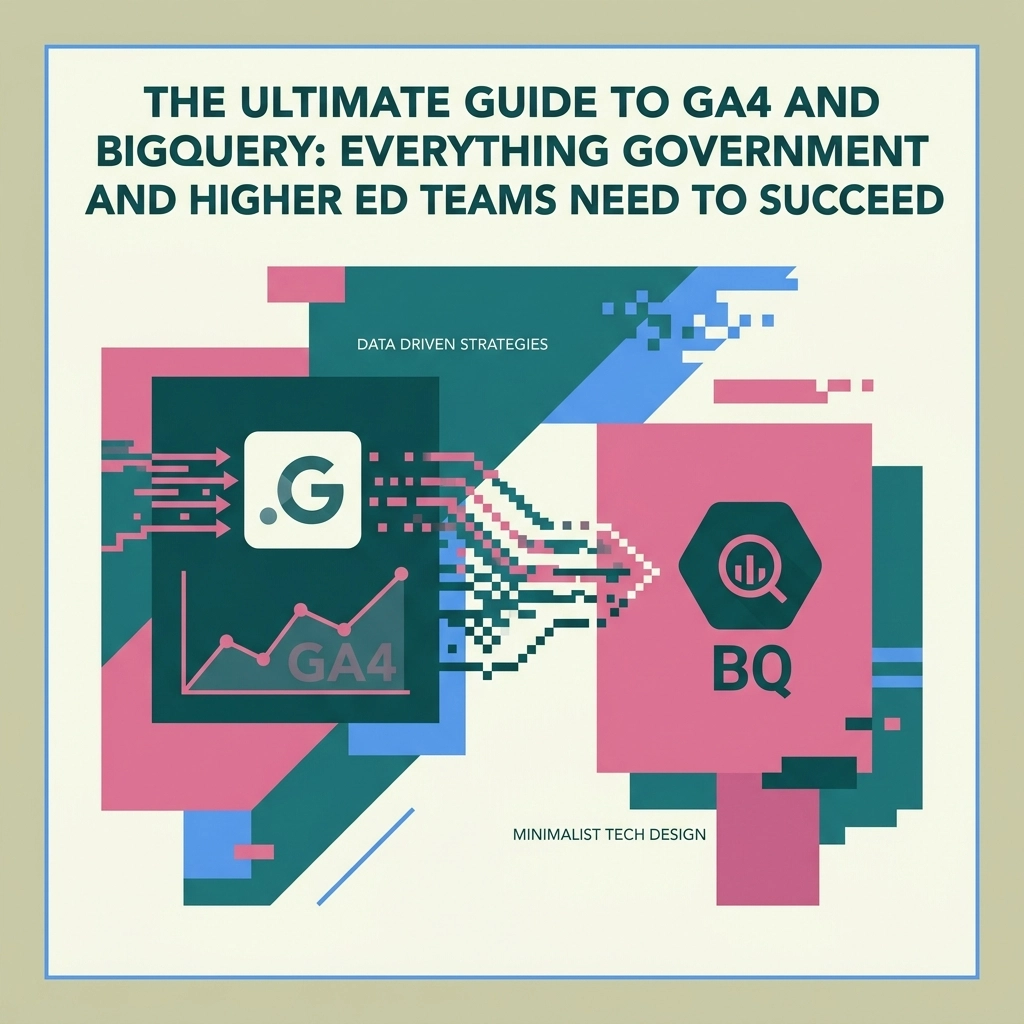
BigQuery is your insurance policy. When you link GA4 to BigQuery, you are exporting your raw event data into your own secure warehouse. Once it’s there, it’s yours forever. You own the "source of truth," not Google. This is the first step in moving your organization from data drowning to insight-driven.
Fixing the Looker Studio "Token Limit" Nightmare
If you’ve ever opened a Looker Studio report only to see a sea of "System Error" boxes or "Quota Error" messages, you’ve met the GA4 API token limit.
Google limits how much data can be pulled directly from the GA4 API at any given time. For a high-traffic government site or a university with multiple departments checking reports simultaneously, those tokens vanish in minutes. Your SEO reporting grinds to a halt because the dashboard literally can't "talk" to the data fast enough.
How BigQuery solves this:
- No More API Middlemen: When Looker Studio connects to BigQuery instead of GA4 directly, it bypasses the token system entirely.
- Speed: Queries that take 30 seconds to load in GA4 happen in milliseconds in BigQuery.
- Complexity: You can blend data from your Student Information System (SIS) or your tax department’s backend directly with your web traffic.
As a Google Analytics 4 consulting partner, I always tell my clients: if your dashboard breaks when you need it most, it’s not a dashboard problem: it’s a data architecture problem.
Higher Ed: Beyond the Stock Setup
Universities have some of the most complex "conversion" paths in the digital world. A prospective student might visit your site 50 times over two years before applying.
Standard GA4 struggles to stitch these sessions together over long periods. However, with BigQuery, we can build custom attribution models that account for the reality of higher ed. We can see how a blog post read in 2024 contributed to an enrollment in 2026.
I’ve written extensively about this in my GA4 consultant’s guide to higher ed enrollment tracking, but the gist is this: If you aren't using BigQuery, you're only seeing the tip of the iceberg.

Government Agencies: Privacy, PII, and Public Trust
For government agencies, the stakes are even higher. You aren't just selling a product; you’re providing essential services. This comes with massive hurdles: organizational inertia, the tech talent gap, and strict PII (Personally Identifiable Information) concerns.
Many agencies are hesitant to move data around because of security. But here’s the reality: keeping your data in a raw, accessible format within a Google Cloud Project (which can be localized and locked down to specific regions) is often more secure than letting it sit in a third-party reporting tool.
The Public Sector Approach:
The practical starting point: set up the daily BigQuery export today, even before you’ve decided exactly how you’ll use the data, because you cannot backfill it later. From there, the real value comes from mapping actual citizen service flows (where in the “tax filing deadline” journey are people dropping off, and at which specific step) and eventually connecting that web data to offline service metrics to prove the ROI of the broader digital transformation effort.
This is especially critical for
This is especially critical for technical SEO for government agencies, where compliance and accessibility are non-negotiable.
The Tech Talent Gap: You Don't Need a Data Scientist (Yet)
A common reason teams avoid BigQuery is the "SQL Scare." They think they need to hire a $150k/year data scientist just to look at their traffic.
That’s a myth.
In 2026, the barrier to entry has never been lower. With AI-assisted SQL generation and pre-built query templates, your existing marketing team can get 80% of the way there. The goal isn't to become a coder; the goal is to build a system that outpaces your competitors.
Stop looking for "vendors" who just hand you a PDF report once a month. You need architects who build systems you actually own.

The Bottom Line: Data Sovereignty is the Goal
Whether you are trying to increase enrollment or improve the efficiency of a state portal, your decisions are only as good as your data.
The three key takeaways for 2026:
- Standard GA4 is for visibility; BigQuery is for strategy. Don't rely on a 14-month window for a multi-year business cycle.
- Own your infrastructure. Don't let your insights be held hostage by API limits or third-party storage.
- Start now. You cannot retroactively export GA4 data to BigQuery. Every day you wait is a day of raw data lost forever.
If your organization is drowning in data but starving for insights, it’s time to look under the hood. Most "SEO problems" or "reporting issues" are actually symptoms of a weak technical backbone.
Does your current setup actually support your 2026 goals, or are you just checking boxes? If you're ready to move from "tracking" to "intelligence," let's talk about building a system that actually works for you.
Are you struggling with GA4 migration or broken reports?
MM Sanford specializes in helping large-scale organizations solve the "systemic flaws" in their data. From technical SEO audits for higher ed to enterprise GA4 governance, we help you turn "messy data" into a clear roadmap for growth.
Related reading: 10 Reasons Your GA4 Direct Traffic Is Skyrocketing · 10 Reasons Your Multi-Property GA4 Setup Isn't Working · 7 Mistakes You're Making with GA4 Consent Mode · GA4 Attribution and Budget Forecasting in 3 Minutes · GA4 Consultant's Guide to Cross-Channel Budgeting